29 August 2026 · 8 min read
"We Want AI" — What Gulf Buyers Actually Mean
When a Gulf business says it wants AI, it usually means one of four different things. Learn to diagnose which one fits your operation before spending a dirham.

Key takeaways
- 84% of Gulf organizations use AI in at least one function, yet only 11% can attribute more than 5% of earnings to it — the gap is almost never the model.
- The phrase 'we want AI' hides four distinct requests: a chatbot, a dashboard, an automation trigger, or a genuine decision agent — each with a different cost, timeline, and readiness bar.
- Most Gulf operations need workflow standardization before any AI layer adds value; automating a broken process produces faster, more articulate chaos.
- The right diagnostic starts with one question: does your team currently agree on the single source of truth for the data this AI would consume?
The meeting ends and someone from the leadership team says it plainly: "We want AI." Everyone nods. Nobody in the room is thinking about the same thing.
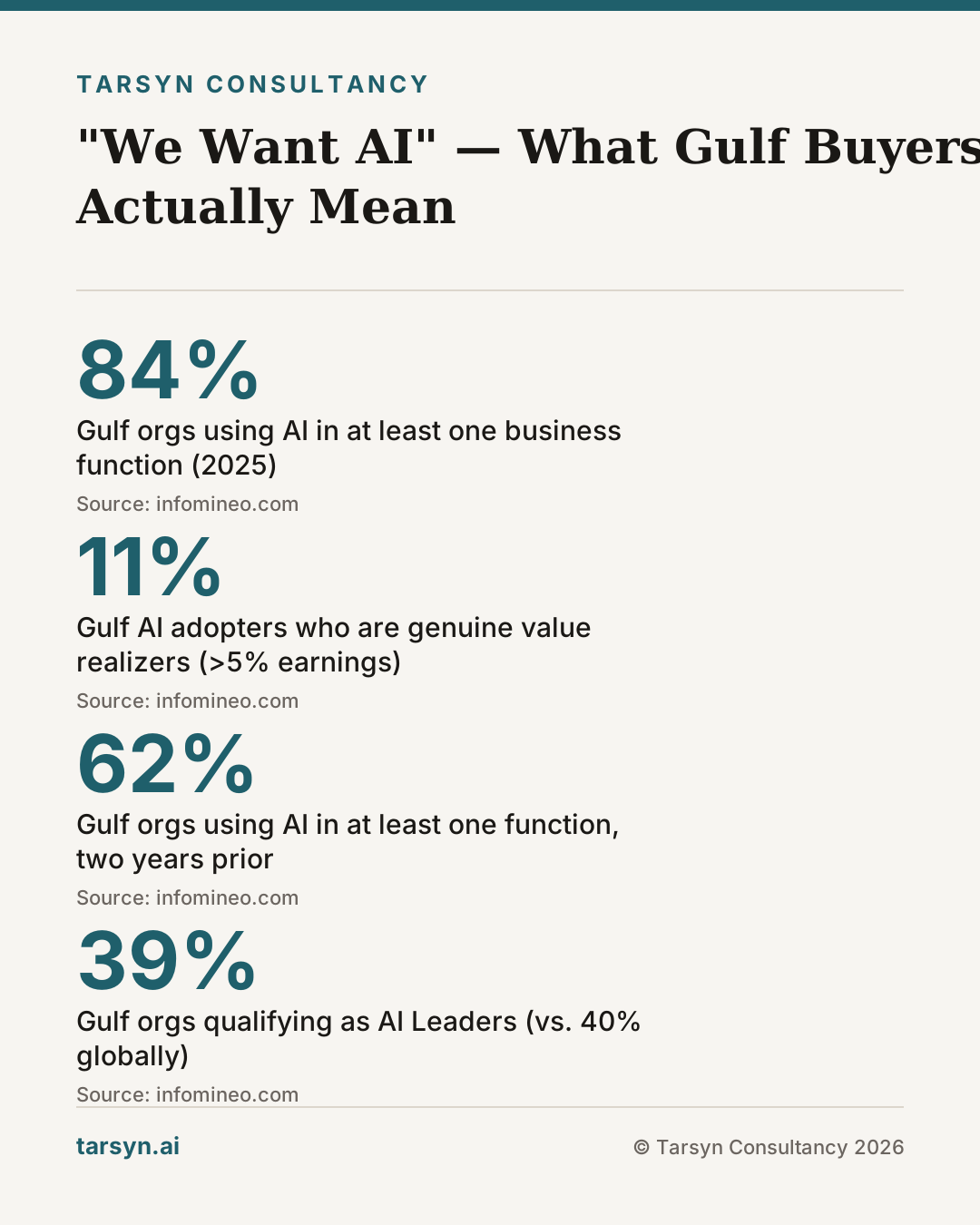
This happens in boardrooms from Abu Dhabi to Riyadh almost daily now. "AI for business" has become a budget line before it became a defined requirement. The result is procurement cycles that circle back on themselves, pilots that prove nothing, and vendors who are happy to keep the ambiguity alive because vagueness sells dashboards. Gulf organizations are moving fast — McKinsey's 2025 survey found that 84% use AI in at least one business function, up from 62% two years earlier. But only 11% qualify as genuine value realizers, meaning they can attribute more than 5% of earnings to it [3]. The gap between adoption and value is not a technology problem. It is a language problem.
Why "We Want AI" Is Four Different Requests in One Sentence
The phrase does real damage because it sounds precise. Everyone in the room believes they understand it. They don't — and the proof is that the follow-up questions reveal four completely different mental models sitting behind the same three words.
Listen carefully enough to Gulf buyers and the requests cluster into four types:
- A chatbot — "Our customers ask the same twenty questions on WhatsApp. Can AI answer them?" This is a conversational interface problem. It is real, it is solvable, and it is the simplest of the four.
- A dashboard — "We want visibility. I shouldn't have to call three people to know where our stock sits." This is a data consolidation and reporting problem, not an AI problem. The word "AI" gets attached because dashboards feel futuristic and justify budget.
- An automation trigger — "When a purchase order comes in, approvals take four days because somebody has to manually ping finance." This is a workflow orchestration problem. AI might sit inside it, but the core ask is removing a human handoff from a defined, repeatable process.
- A decision agent — "We want the system to look at demand signals, inventory levels, and supplier lead times, and tell us what to reorder — or just do it." This is the only request that genuinely requires AI reasoning. It also requires the most process maturity to deploy safely.
These four things have different costs, different timelines, different governance requirements, and different readiness bars. Treating them as one category is how AI investments stall before they start.
The Four Things Gulf Buyers Are Actually Asking For
A closer look at each type shows exactly why conflation is expensive.
The chatbot is the fastest to deploy and the easiest to scope. It works when the inputs are defined (a catalogue of questions) and the outputs are bounded (a catalogue of answers). Problems arise when businesses deploy chatbots on top of unstructured knowledge — PDFs nobody has updated since 2021, WhatsApp threads that serve as informal ERP, approval logic that lives only in the operations manager's head. The chatbot then either hallucinates or deflects, and confidence collapses. The chatbot was not the problem. The WhatsApp-to-ERP gap underneath it was.
The dashboard is the most commonly mislabeled AI request in the region. A reporting layer that consolidates data from three sources and surfaces a KPI is not AI — it is BI. That is fine. BI has genuine value. But calling it AI inflates the budget requirement, attracts the wrong vendors, and sets expectations that a static report cannot meet. As we have written before, a dashboard reports; a decision layer acts. Confusing the two wastes money in both directions: overpaying for a dashboard dressed up as AI, or underfunding a genuine decision tool because the team thinks a dashboard will do the job.
The automation trigger is where the region has the fastest legitimate wins available right now. Manual handoffs in procurement, finance approvals, freight booking confirmations, and inventory alerts are predictable, rule-based, and expensive in person-hours. Workflow automation tools connected to ERP can eliminate most of them without a single language model involved. The mistake Gulf businesses make is skipping this layer entirely and reaching straight for a large AI platform, when seventeen manual steps in a purchase order process were the actual bottleneck.
The decision agent is the real thing — and it is where most organizations are not yet ready to go. A genuine decision agent ingests live data, reasons over it, and either recommends action or takes it within defined guardrails. Vendors demo this beautifully. The demo assumes clean, structured, real-time data; agreed business rules encoded somewhere a system can read; and a team that trusts the output enough to act on it. In the average Gulf mid-market operation, none of those three preconditions hold on day one. That is not a critique — it is a sequencing problem, and sequencing is solvable. What AI agents actually do versus what vendors claim is a conversation worth having before signing anything.
How to Diagnose Which One Your Operation Needs First
The diagnostic does not require a consultant. It requires honest answers to four questions:
1. Can your team name one agreed source of truth for the relevant data? If the answer involves reconciling two spreadsheets, a WhatsApp group, and "ask Ahmed on Tuesday," the data layer is not ready for AI of any type. Fix the data first.
2. Is the process documented well enough that a new hire could follow it in writing? If the answer is no — if the process lives in experienced heads, in informal judgment calls, in tribal knowledge about which supplier calls back — you are not ready for automation, let alone AI reasoning. As one Dubai-based strategist put it: "You cannot take a company from the Stone Age directly into the AI age. Transformation happens gradually." [2]
3. Where does the current process actually break? Map the last five times something went wrong. Was it data quality? A missing approval? A communication gap between systems? A decision made on stale information? The break type determines the fix type. Most breaks in Gulf operations are automation-trigger problems, not decision-agent problems.
4. Who owns the outcome if the AI is wrong? This question alone rules out decision agents for most organizations that haven't built accountability structures around automated outputs. If the answer is "nobody" or "the system," you are not ready for autonomous action. Start with a recommendation layer that a human still approves.
Run these four questions across your biggest operational pain point. The answer almost always points to chatbot or automation trigger — not to the full decision agent the vendor demoed on slide nine.
Where AI Investments Stall — and Why It Rarely Has to Do with the Model
Gulf organizations that have moved fast on AI adoption without corresponding value to show for it share a recognizable pattern [3]. BCG's 2025 data found that Gulf organizations match global peers on AI maturity — 39% qualify as AI Leaders against 40% globally — yet the value realization rate tells a different story. Maturity without value is a process problem wearing a technology mask.
The failure modes are consistent:
- No baseline: The organization deployed AI without measuring the process it replaced. Proving value later becomes impossible because nobody recorded what "before" looked like.
- Clean demo, dirty reality: The pilot ran on curated data. Production runs on seventeen spreadsheets, three ERP instances, and a field team reporting over WhatsApp. The model performs fine. The inputs destroy it.
- Skipped the automation layer: The organization jumped from manual processes to AI reasoning, missing the middle step of basic workflow automation. The AI then has to compensate for process gaps it was never designed to handle.
- Governance gap: Nobody defined what the AI is allowed to do, what it must flag for human review, and what it cannot touch. The first edge case that falls outside the training distribution creates a trust collapse that takes months to recover from. When AI autofix becomes a security hole is not a hypothetical risk — it is a documented pattern.
The fix is rarely a better model. It is almost always a process and governance fix that should have preceded the model selection. Automation silent failures — where the system reports success while the business quietly loses ground — are the most expensive outcome of skipping this step.
Tarsyn's View: Start with the Process, Not the Product
We run AI and process audits across Gulf operations, and the most common finding is not that a business needs more AI. It is that the business has not yet standardized the process the AI would need to run on. Add AI to that and you get articulate chaos — outputs that sound confident and are systematically wrong because the inputs were never clean.
The honest sequencing looks like this:
- Document the process — not aspirationally, but as it actually runs today. Include the WhatsApp messages, the informal approvals, the spreadsheets that live on one person's desktop.
- Automate the repeatable — remove manual handoffs from anything rule-based before introducing any machine reasoning.
- Establish a data baseline — agree on one source of truth per data domain. This is harder than it sounds and more valuable than any AI tool.
- Layer AI at the decision points — only after steps one through three, introduce AI where human judgment is the actual bottleneck: demand forecasting, anomaly detection, procurement recommendations.
We have seen businesses skip straight to step four and spend eighteen months unwinding the damage. We have seen businesses complete steps one through three and realize, genuinely, that they don't need AI yet — that a well-run workflow automation layer delivers everything they needed. Most companies don't need more AI; they need fewer spreadsheets.
The Gulf's AI ambition is real and well-funded. The five-point gap between global adoption rates and GCC adoption has effectively closed [3]. What hasn't closed is the gap between adoption and value — and that gap closes with process work, not procurement. If you are not sure which of the four requests is actually yours, that is exactly what a structured audit is for. We charge the same whether the answer is "build the agent" or "fix the workflow first."
The phrase "we want AI" deserves a precise answer. Give it one before the budget moves.
Frequently asked questions
What are the four things Gulf businesses usually mean when they say 'we want AI'?+
They typically mean one of: (1) a chatbot or conversational interface for staff or customers, (2) a dashboard that consolidates data they currently chase across spreadsheets, (3) an automation trigger that removes a manual handoff in a workflow, or (4) a genuine decision agent that recommends or acts autonomously. Each requires different infrastructure, budget, and process maturity to work.
Why do so many Gulf AI projects fail to deliver measurable value?+
McKinsey's 2025 GCC survey found 84% of organizations use AI in at least one function, but only 11% qualify as value realizers — meaning they can attribute more than 5% of earnings to it. The constraint is almost never the AI model itself. It is unclear data ownership, undocumented processes, and the absence of a baseline measurement set before deployment.
How do I know if my business is ready for AI or needs workflow fixes first?+
Ask one question: can your team name a single agreed source of truth for the data the AI would consume? If the answer involves WhatsApp threads, three versions of an Excel file, or 'it depends on who you ask', you need process standardization before AI. Adding intelligence to ambiguous inputs produces ambiguous — and faster — outputs.
What is the difference between an AI dashboard and an AI decision agent?+
A dashboard surfaces data; it tells you what happened. A decision agent acts on data — it recommends next steps, triggers workflows, or executes transactions within defined guardrails. Most businesses asking for a 'decision agent' actually need a better dashboard first. The distinction matters because the two have very different build costs, risk profiles, and governance requirements.
Sources
- 1. AI Won’t Fix a Broken Process and Why Automation Needs Structure First — www.brainzmagazine.com
- 2. Fast on AI, Slow on Value: What Is Holding the Gulf Back? | Infomineo — infomineo.com
Mohammed Z
Founder, Tarsyn
Mohammed builds the systems behind modern businesses — automation, AI decision layers, and the unglamorous plumbing that makes them work. He founded Tarsyn in Abu Dhabi.
Find out where your operation actually stands.
The AI Opportunity Audit maps your workflows, your data, and your decision bottlenecks — and tells you honestly whether AI is worth it yet.
Start the audit