10 August 2026 · 7 min read
The WhatsApp-to-ERP Gap Is Costing Gulf Businesses
GCC businesses run on WhatsApp groups, not ERP screens. Here's how to quantify the reconciliation cost and close the gap with three proven automation patterns.

Key takeaways
- GCC businesses commonly route PO approvals, delivery confirmations, and price negotiations through WhatsApp groups rather than their ERP — creating a parallel, unrecorded system of record.
- The reconciliation cost of manually re-entering WhatsApp decisions into ERP fields shows up as late month-end closes, duplicate orders, and stock discrepancies that no dashboard can catch in time.
- Three automation patterns close the gap without a cultural overhaul: webhook capture (WhatsApp → ERP write), approval bots (structured sign-off inside chat), and document ingestion (photo invoices → parsed ERP lines).
- Before buying any integration tool, a structured operations audit identifies which WhatsApp workflows carry the highest financial exposure — start there, not with the software catalogue.
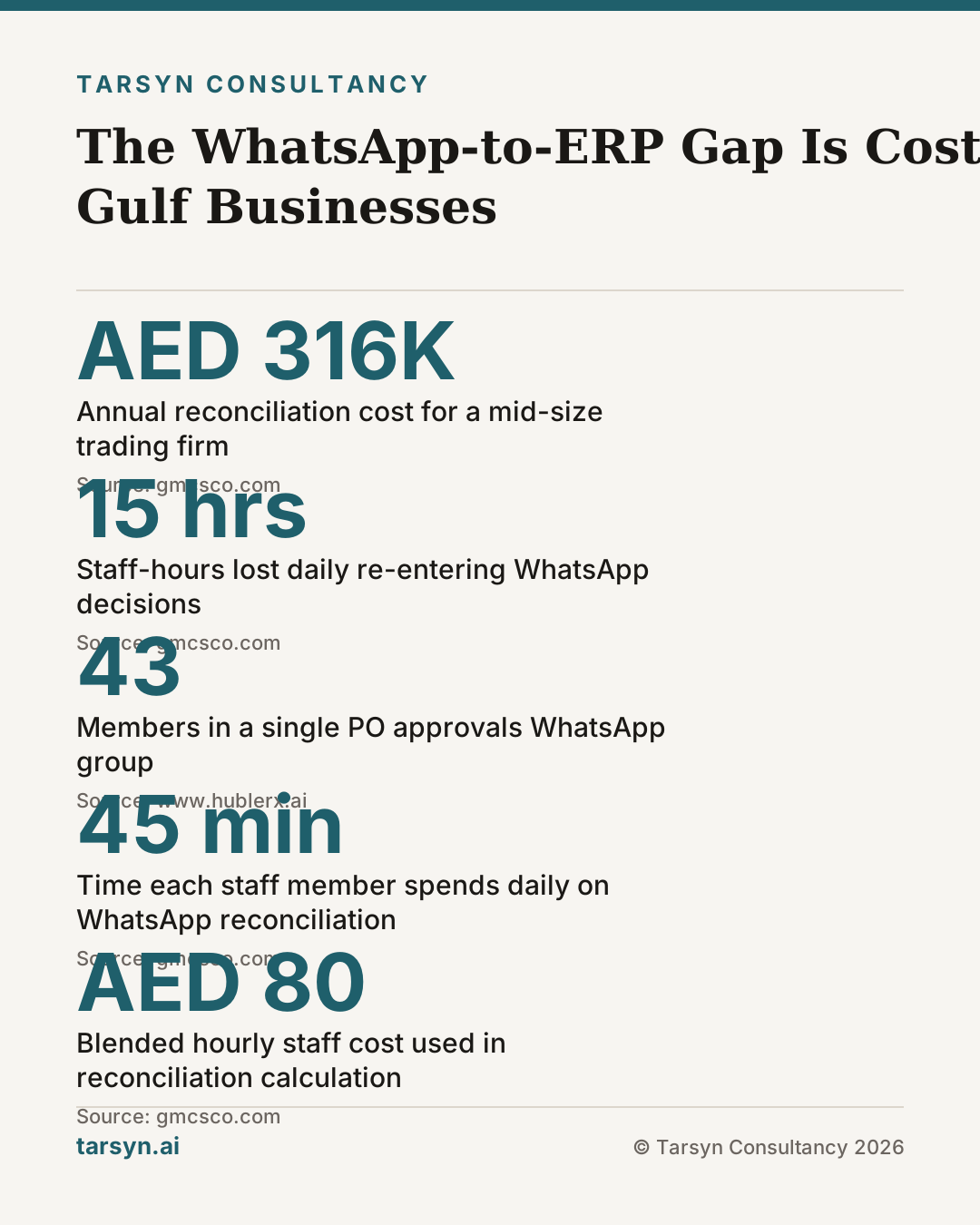
Picture a procurement manager at a Jebel Ali trading company. She has an ERP — licensed, implemented, and technically live. She also has a WhatsApp group called "PO Approvals - Urgent" with forty-three members. Every significant purchase order this week moved through the group, not the system. By Friday, someone on the finance team will spend most of their morning reverse-engineering the chat history to figure out what was actually agreed, by whom, and when. This is not an edge case. This is how the Gulf works.
WhatsApp is the real ERP — and that's not entirely the user's fault
The premise sounds like a complaint. It shouldn't. WhatsApp became the operational backbone of GCC business for rational reasons: near-universal adoption, instant delivery even on patchy mobile data, and — critically — the ability to get a decision from a senior approver without navigating a corporate ticketing system they've never opened [^skip].
Suppliers in Saudi Arabia send delivery confirmations by voice note. Logistics coordinators in Dubai share POD photos directly in client groups. Price negotiations between a distributor and a Jebel Ali freight desk happen in a thread that neither party's ERP will ever see. The ERP is where data should live. The WhatsApp group is where it does live — and closing that gap requires understanding it as an integration problem, not a training problem [1].
The WhatsApp Business API, now widely available to enterprises in KSA and UAE, is the bridge most operators haven't crossed yet [1]. Once a business account is API-connected, every message becomes a programmable event — something a webhook can catch, parse, and route into a structured system. But most mid-market Gulf businesses haven't connected that wire. The result is a manual reconciliation burden that compounds silently every week.
What the reconciliation gap actually costs
Nobody publishes a clean line item called "WhatsApp reconciliation cost." It hides inside other numbers: overtime in the finance team during month-end close, duplicate purchase orders raised because a chat confirmation was never logged, inventory discrepancies caught too late to reorder in time for a Ramadan freight cutoff.
Walk through the arithmetic on a mid-size trading operation. Assume twenty staff who each spend forty-five minutes per day re-entering or cross-checking decisions made in WhatsApp — delivery confirmations, price adjustments, approval sign-offs. That's fifteen staff-hours per day. At a blended cost of AED 80 per hour, you're at AED 1,200 per day, AED 26,400 per month, AED 316,800 per year — before you account for the errors. A single duplicate PO on a high-value shipment can exceed that annual figure in one incident.
The error cost is harder to measure but more consequential. A stock discrepancy discovered at month-end isn't just an accounting problem — it's a procurement decision that was made on bad data three weeks earlier [2]. By the time the ERP catches it, the damage (missed sales, excess inventory, wrong supplier payment) is already done. A dashboard will faithfully report the discrepancy. It will not tell you that the root cause was a delivery confirmation that lived only in a WhatsApp thread [see also: A Dashboard Is Not a Decision].
The three automation patterns that close the gap
There is no single fix. The WhatsApp-to-ERP gap has three distinct shapes, and each needs its own pattern. Importantly, none of them require staff to stop using WhatsApp [2].
1. Webhook capture — the passive listener
A webhook sits on the WhatsApp Business API and watches for specific message patterns: a supplier typing "delivered," a logistics partner sending a POD image with a standard caption, a staff member typing an order number in an approval group. When the pattern matches, the webhook fires — calling your ERP's API to create or update the relevant record in real time.
This is the lowest-friction pattern. Staff change nothing about how they communicate. The automation runs invisibly between WhatsApp and the ERP. The main implementation work is defining the patterns to watch for and mapping them to ERP fields — ideally after a proper audit of which chat workflows carry the highest financial volume [see: The ERP AI Readiness Audit].
2. Approval bots — structured sign-off inside the chat
The approval-bot pattern goes one step further. Instead of passively listening, a bot actively prompts for structured input. A PO reaches a threshold; the bot sends a formatted message into the approval group: "PO #4471 — AED 87,500 — Supplier: Al Futtaim Logistics. Reply APPROVE or REJECT with your name." The reply is captured, timestamped, written to the ERP, and triggers the next workflow step.
This solves an audit-trail problem that regulators in both UAE and KSA are increasingly attentive to: verbal approvals in chat have no formal record. A bot reply is a structured record — logged, timestamped, attributable. The cultural change required is minimal: approvers still use WhatsApp, they just reply to a formatted prompt instead of a free-text message [1].
3. Document ingestion — photos become ERP lines
The most tactile WhatsApp data is photos: invoices photographed on a warehouse floor, delivery notes held up to a phone camera, LPO copies shared as JPEGs. This data is currently inert — it exists in a chat thread and nowhere else.
Document ingestion pipelines change that. An image sent to a dedicated WhatsApp Business number is intercepted, passed through an OCR and document-parsing model, and the extracted fields (vendor, amount, line items, date) are pushed as a draft record into the ERP for human review. The finance team isn't re-keying data; they're reviewing a pre-populated record and approving or correcting it. Processing time drops from minutes to seconds per document [2].
This pattern pairs naturally with AI agent capabilities — the parser can flag anomalies (an invoice total that doesn't match the PO, a vendor number not in the master file) before the human reviewer even opens the record [see: AI Agents for Business Operations].
Why "change management" is the wrong frame
Most ERP consultants will tell you the WhatsApp problem is a change management problem. Get the users to use the system properly. Run training. Enforce compliance.
This advice fails for a simple reason: the ERP was not designed for how decisions are made in the Gulf. Approval hierarchies are flatter in practice than on an org chart. Senior approvers are often travelling between Riyadh and Dubai and will not log into a desktop ERP to release a PO. Suppliers are not enrolled in your portal. The social contract of Gulf business runs through WhatsApp [1].
Trying to eliminate that is a war you will lose slowly and expensively. The three automation patterns above treat WhatsApp as a legitimate input channel — which it already is — and build a bridge to the ERP instead of a wall around it. Staff adoption is near-instant because nothing changes for them. The ERP data quality improves because the capture is automated, not dependent on manual compliance.
We've seen this repeatedly in GCC deployments: the businesses that tried to mandate ERP use for approvals spent six months in conflict and ended up with workarounds. The ones that integrated WhatsApp as an input layer had structured ERP records within weeks [see also: Most Companies Don't Need More AI].
Choosing the right pattern for your operation
Not every WhatsApp workflow deserves the same treatment. A quick prioritisation framework:
| Workflow type | Volume / day | Financial exposure | Recommended pattern | |---|---|---|---| | PO approvals | Low (5–20) | High (AED 50k+) | Approval bot | | Delivery confirmations | High (50–200) | Medium | Webhook capture | | Invoice / document receipt | Medium (10–50) | High | Document ingestion | | Price negotiations | Low | Variable | Human + structured summary bot |
Start with the workflow that has the highest financial exposure and the clearest message structure. Webhook capture on delivery confirmations is often the fastest win — it requires the least behavioural change and produces immediate ERP data quality improvements [2].
Before committing to any tooling, map the workflows first. Which groups? Which message patterns? What ERP fields do they map to? This is an operations question, not a software question — and getting it wrong means building an integration that captures the wrong data with impressive efficiency [see: When Automation Reports Success and Your Business Fails].
Tarsyn's view
The WhatsApp-to-ERP gap is one of the most consistent sources of hidden cost we find when we run an operations audit for a GCC business. It's also one of the most fixable — not because the technology is simple, but because the fix doesn't require persuading fifty people to change how they work.
Multiply chaos by intelligence and you get articulate chaos. The point of these automation patterns is not to add AI on top of a broken data flow — it's to capture the data that already exists in your chat groups and put it somewhere the business can act on it.
If you're evaluating ERP AI features before you've solved the WhatsApp capture problem, you are optimising the wrong layer [see: Odoo vs SAP: Which ERP's AI Features Actually Work for GCC Operations?]. Fix the input data first. The intelligence layer becomes genuinely useful once the ERP is receiving real-time, structured data from the channels where your business actually runs.
The honest version: sometimes the right answer is two days of mapping work and a webhook, not a six-figure integration platform. We charge the same either way — which is why we'll tell you which one you actually need. Start with the five-step audit before the software conversation.
Frequently asked questions
Why do GCC businesses use WhatsApp instead of their ERP for approvals?+
Speed and familiarity. A WhatsApp message reaches a decision-maker in seconds; an ERP workflow ticket might sit unread for hours. In the Gulf, where relationships and verbal confirmation carry commercial weight, the chat group became the de facto approval layer long before the ERP was configured to replicate it. The problem isn't culture — it's that the ERP was never designed for how approvals actually happen here.
What does WhatsApp-to-ERP reconciliation actually cost?+
The direct cost is staff time: someone manually copying chat decisions into system fields. The indirect cost is harder to see — duplicate purchase orders raised because a WhatsApp confirmation was never logged, stock discrepancies discovered at month-end, and audit trails that exist only in a group chat archive. Across a mid-size trading or distribution operation, this routinely consumes several finance-team days per month.
What is a WhatsApp ERP integration webhook and how does it work?+
A webhook is a real-time HTTP push: when a specific message pattern appears in a WhatsApp Business API conversation — say, a supplier confirming a delivery — the webhook fires, parses the message, and writes the relevant fields directly into the ERP. No human re-entry. The ERP record is created at the moment the chat confirmation lands, not two days later during a reconciliation session.
Do I need to replace WhatsApp to fix the ERP data gap?+
No — and attempting to replace it will fail. The goal is to make WhatsApp a structured input channel, not to eliminate it. Approval bots, document ingestion pipelines, and webhook listeners all sit between WhatsApp and the ERP, translating conversational messages into structured records. Staff keep using the tool they prefer; the ERP finally gets the data it was missing.
Sources
- 1. WhatsApp ERP Integration for KSA & UAE Enterprises (2026) — gmcsco.com
- 2. WhatsApp to ERP Integration for Manufacturers | HublerX — www.hublerx.ai
Mohammed Z
Founder, Tarsyn
Mohammed builds the systems behind modern businesses — automation, AI decision layers, and the unglamorous plumbing that makes them work. He founded Tarsyn in Abu Dhabi.
Find out where your operation actually stands.
The AI Opportunity Audit maps your workflows, your data, and your decision bottlenecks — and tells you honestly whether AI is worth it yet.
Start the audit