26 July 2026 · 8 min read
The ERP AI Readiness Audit for GCC Operators
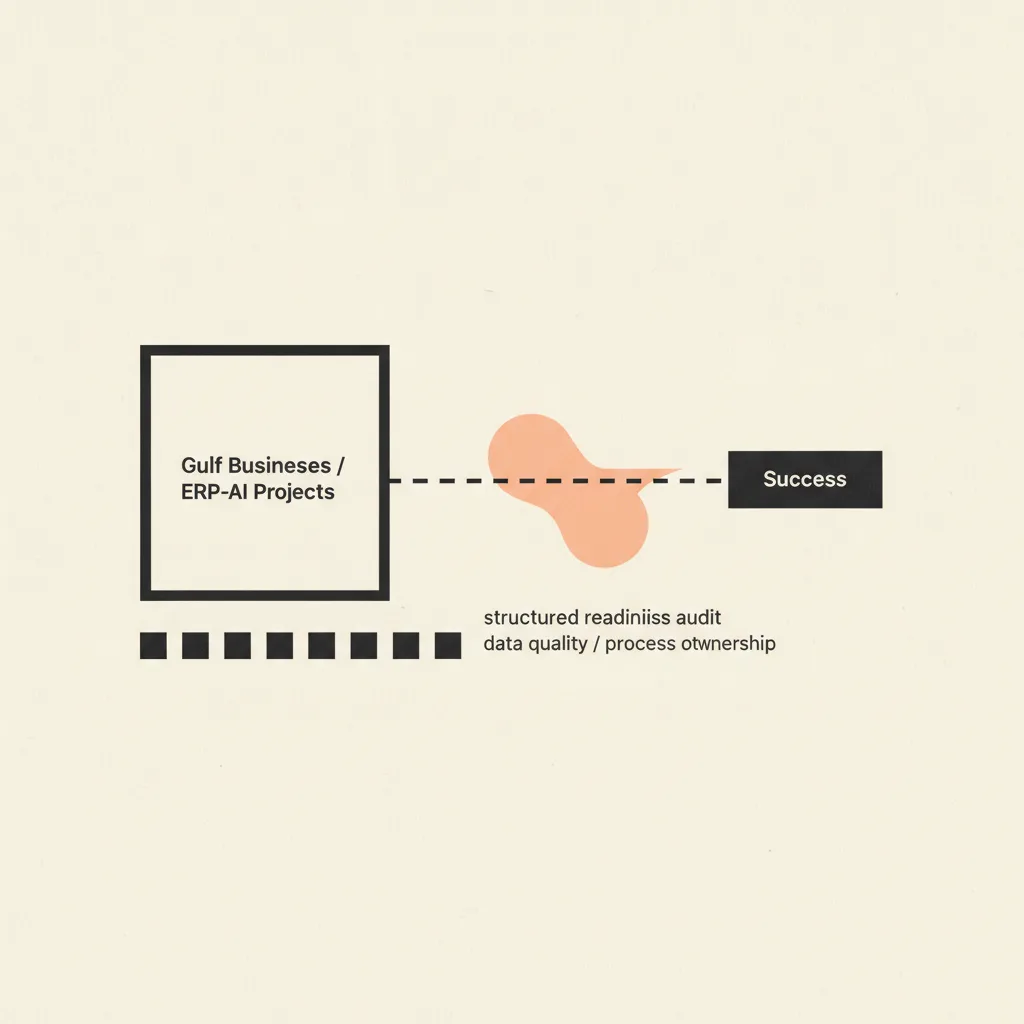
Before any GCC business buys ERP-AI software, five audit areas decide success or failure: data quality, process ownership, approval-chain logic, bilingual structure, and VAT entity mapping.
Key takeaways
- 80% of AI initiatives fail before scaling — not because of the technology, but because the organisation skipped a structured readiness assessment before deployment.
- GCC-specific risks — multi-entity VAT structures, Arabic/English bilingual master data, and WhatsApp-driven approval chains — are invisible to generic AI readiness frameworks built for Western enterprises.
- Five audit areas determine ERP-AI success: data completeness, process ownership, approval-chain documentation, entity/VAT structure mapping, and bilingual data integrity.
- A readiness audit costs a fraction of a failed ERP-AI rollout; the audit output is a prioritised gap list, not a slide deck that reassures leadership while real problems go unaddressed.
A finance manager at a mid-size Gulf trading group recently told us she'd spent three months preparing a board paper on AI for their SAP environment. The vendor demos were impressive. The IT team was enthusiastic. Then someone asked a simple question: which entity do we book the AI's recommendations against? Nobody in the room could answer it cleanly. The project stalled for four months while the team tried to untangle seven years of inter-company transactions that had never been properly mapped in the ERP.
That is not an edge case. It is the default outcome when a GCC operator treats an ERP-AI project as a software purchase rather than an organisational readiness problem.
According to BCG and MIT Sloan research cited by Infomineo, 80% of AI initiatives fail to deliver their intended business outcomes — and the most common cause is not the technology itself, but the absence of an honest baseline assessment before deployment begins [1]. McKinsey data suggests over 88% of companies now use AI in at least one business function [2], which means the pilot phase is largely over. What separates the groups extracting value from those burning budget is preparation, not product selection.
This piece operationalises what that preparation looks like for GCC operators specifically — the multi-entity VAT structures, the bilingual master data, the approval chains that live in WhatsApp threads rather than workflow engines.
Why generic AI readiness frameworks miss the GCC
Most AI readiness frameworks were written for single-entity Western enterprises with clean organisational charts and English-only databases. They ask reasonable questions about data governance, infrastructure maturity, and executive sponsorship. They do not ask:
- How many legal entities share one chart of accounts and how are intercompany eliminations handled?
- Are Arabic and English item descriptions in the ERP populated consistently, or does one language contain the real data and the other contain placeholders?
- Does your purchase approval process exist in the system, or does it live in a senior manager's WhatsApp inbox?
- How many VAT registrations do you hold across the GCC, and can your ERP currently attribute a transaction to the correct registration without manual override?
These are not exotic edge cases. They are the operating reality for most Gulf businesses of meaningful scale. A readiness framework that does not surface them is, as Infomineo puts it, "a questionnaire" — not an assessment [1].
Generic tools also ignore what we at Tarsyn call the reconciliation gap: the distance between what the ERP records and what actually happened, bridged daily by a finance team member copying numbers between a report and a spreadsheet. Multiply that gap by an AI layer and you get articulate chaos — fast, confident, wrong outputs.
The five audit areas that actually matter
A structured ERP AI readiness audit for a GCC operator should cover exactly five areas. Not nine. Not fourteen. Five, with specific, answerable questions in each.
1. Data completeness and field-level quality
Pull a sample of 500 purchase orders, 500 sales invoices, and 500 inventory records from the past 24 months. For each dataset, measure: what percentage of mandatory fields are populated; what percentage of item codes resolve to a single, consistent description; and what percentage of supplier/customer master records have a valid VAT registration number attached. If any of those numbers is below 85%, an AI layer will amplify the gaps, not paper over them. This is not a judgement — it is arithmetic.
2. Process ownership
Every business process you intend to automate or augment with AI needs a named human owner who can answer three questions: what does a correct output look like, what does an exception look like, and who has authority to override the system? In our experience running automation audits across Gulf operators, roughly half of the processes flagged for AI augmentation have no single owner — they are managed by whoever happens to be available. An AI system handed an ownerless process will make decisions nobody signed off on and nobody can reverse cleanly.
3. Approval-chain documentation
This is the one most ERP-AI vendors never check and the one most likely to kill a rollout. In the GCC, approval authority frequently flows through personal relationships rather than documented delegation matrices. A procurement manager in Riyadh may need verbal clearance from a Group CFO in Dubai before committing to any purchase above AED 50,000 — but the ERP workflow caps are set at a different number from three years ago, and the actual rule exists only in institutional memory.
Before any AI can route, flag, or automate an approval, that approval logic must be documented, agreed, and loaded into the system. This step alone typically takes three to six weeks in a mid-size GCC group. As we covered in the audit piece, the work that determines AI success is almost never the AI work itself.
4. Multi-entity and VAT structure mapping
A GCC business of moderate complexity might hold a UAE mainland LLC, a JAFZA entity, a KSA company under the Saudi VAT regime, and a Bahrain entity. Each has different VAT treatment, different filing calendars, and potentially different charts of accounts. An AI recommendation engine trained on consolidated data without entity-level labelling will produce recommendations that are directionally interesting and legally dangerous.
The audit question here is simple but the answer is rarely clean: can you, today, filter any ERP transaction by legal entity and have confidence the classification is correct? If the answer involves the phrase "we usually do a manual check at month-end," the AI readiness work starts there — not with the model selection.
5. Bilingual data integrity
This is uniquely important in the GCC and uniquely absent from global frameworks. Arabic is the operating language of government filings, many supplier contracts, and most internal communications. English is the language of ERP interfaces, international trade documentation, and most AI models. When the two do not match in the master data, the AI cannot reliably reconcile them.
A practical test: take your top 100 inventory items by transaction volume. Do the Arabic description, the English description, and the item code all resolve to the same physical item with no ambiguity? In most GCC ERPs we encounter, somewhere between 20 and 40 of those 100 items have a discrepancy — a transliteration instead of a translation, a legacy code that was never updated, or an Arabic field that was left blank because the original data entry was done by an English-speaking contractor.
As we noted in the piece on dashboards versus decisions, a reporting layer that cannot distinguish between two items is not a minor inconvenience — it is a structural error that propagates through every downstream output.
How to structure the audit output
An audit that produces a traffic-light slide deck has failed. The output of a rigorous ERP AI readiness audit is a prioritised gap list with four columns: the gap, the entity or data domain it affects, the remediation action, and a realistic timeline.
The gaps should be ranked not by severity in the abstract but by their specific impact on the AI use cases the business has prioritised. A bilingual data problem that affects inventory valuation is more urgent than one affecting a rarely-used cost centre. An approval chain gap in procurement matters more than one in HR if the AI project is a procurement co-pilot.
A reasonable timeline for remediation before an ERP-AI project can proceed:
| Gap category | Typical remediation time | |---|---| | Missing mandatory fields | 2–4 weeks (bulk data clean) | | Approval chain documentation | 3–6 weeks (workshops + system config) | | Multi-entity VAT mapping | 4–8 weeks (legal + finance alignment) | | Bilingual master data | 4–10 weeks (scope-dependent) | | Process ownership assignment | 1–2 weeks (governance workshop) |
These are not conservative estimates. They are the actual timelines we see in the field. Any vendor promising AI value in 90 days without this work completed first is pricing their optimism into your implementation risk.
Tarsyn's view
We say this plainly to every GCC operator who approaches us about ERP-AI: the audit is the project. Not the first phase of the project — the thing that determines whether there is a project at all.
The five areas above are not bureaucratic overhead. They are the minimum viable picture of organisational reality that an AI system needs before it can produce a trustworthy output. Skip data completeness and you get confident hallucinations at ERP scale. Skip approval-chain documentation and you get automated decisions with no human accountable for them. Skip multi-entity mapping and you get AI recommendations that are commercially coherent and tax-filing violations waiting to happen.
Generic AI readiness assessments — the self-administered kind — are almost always insufficient. Gartner data cited by Infomineo notes fewer than 30% of organisations that complete a self-administered AI readiness exercise identify their actual critical gaps [1]. The other 70% find them during implementation, which is the worst time to find them.
The honest version of this advice: sometimes the audit will tell you not to proceed with the AI project yet. That is a good outcome. Knowing that in week three is worth more than discovering it in month eight of a live rollout.
We charge the same either way. What we do not do is tell you the technology is ready when the organisation is not. If you want a structured readiness check that speaks to GCC operational reality — not a generic maturity scorecard — start with the audit. The five areas above take most operators two to four weeks to assess properly. That is not a long time to avoid a very expensive mistake.
And if you are still buying AI tools before fixing the spreadsheet sprawl underneath your ERP, this piece will still be here when you are ready to read it again.
Frequently asked questions
What is an ERP AI readiness audit and why does it matter in the GCC?+
An ERP AI readiness audit is a structured diagnostic that measures whether your data, processes, governance, and organisational setup can actually support an AI layer on top of your ERP. In the GCC context, it matters because regional realities — multi-entity VAT, bilingual data, and informal approval chains — create failure points that generic global frameworks miss entirely.
What are the five areas a GCC ERP AI readiness audit must cover?+
The five areas are: (1) data completeness and field-level quality inside the ERP; (2) process ownership — is every automated workflow owned by a named human; (3) approval-chain documentation — are decisions recorded in the system or living in WhatsApp threads; (4) multi-entity and VAT structure mapping; and (5) bilingual data integrity, ensuring Arabic and English master data are consistent and machine-readable.
How long does an ERP AI readiness audit typically take?+
A focused audit covering the five GCC-specific areas typically runs two to four weeks for a mid-size operator with one to three legal entities. Larger groups with Jebel Ali free-zone arms, mainland entities, and KSA branches may need six weeks to properly map approval chains and reconcile bilingual master data before a gap analysis is reliable.
Can a business skip the readiness audit if they already have an ERP in place?+
Having an ERP does not mean being ready for AI. Most GCC operators running SAP, Oracle, or Microsoft Dynamics have years of inconsistent data entry, unmapped inter-entity transactions, and approval logic that exists only in senior managers' heads. The audit surfaces exactly those gaps — before an AI vendor's pilot surfaces them instead, at far greater cost.
Sources
- 1. AI Readiness Assessment: Framework & Checklist | Infomineo — infomineo.com
- 2. AI Readiness Checklist: Simple 9-Step Guide (2026) — rtslabs.com
Mohammed Z
Founder, Tarsyn
Mohammed builds the systems behind modern businesses — automation, AI decision layers, and the unglamorous plumbing that makes them work. He founded Tarsyn in Abu Dhabi.
Find out where your operation actually stands.
The AI Opportunity Audit maps your workflows, your data, and your decision bottlenecks — and tells you honestly whether AI is worth it yet.
Start the audit