12 June 2026 · 7 min read
A dashboard is not a decision
GCC operations have never had more charts, and the decisions still happen in meetings — late, and from memory. The fix is not another dashboard. It is a decision layer.

Key takeaways
- Dashboards report; they do not decide. The gap between seeing a number and acting on it is where most operations lose money.
- A decision layer is the set of rules, thresholds, and automations that turn data into a specific next action — with a named owner.
- Managers at a typical Fortune 500 company waste 530,000 days a year on ineffective decision-making. The instrument panel was never the bottleneck.
- Start by writing down ten recurring decisions, not by buying software. Most GCC operations can automate three of them with the systems they already own.
Walk into any mid-market operation in the Gulf and count the screens. Sales has a dashboard. Finance has three. Operations has one nobody opens since the analyst who built it left. The company has never been better instrumented — and the decisions that actually move money still happen the old way: in a meeting, a week late, argued from memory.
The dashboard arms race
The last decade of "digital transformation" mostly produced reporting. Reporting is useful. It is also finished — as a competitive edge, it expired the moment everyone had it. When every competitor can see their numbers, seeing your numbers is table stakes, not strategy.
Here is the uncomfortable arithmetic underneath all that instrumentation: McKinsey's survey of more than 1,200 executives found that managers spend 37% of their time making decisions, and believe more than half of that time is used ineffectively. At an average Fortune 500 company, that adds up to roughly 530,000 lost working days — about $250 million in wasted labor cost — every single year [1]. The instrument panel was never the bottleneck. The decision was.
Meanwhile, most of the raw material never gets used at all. IDC research commissioned by Seagate found that 68% of the data available to enterprises goes unleveraged [2]. Two-thirds of what your systems already capture never informs a single action.
What a decision layer actually is
A decision layer — what vendors call an AI decision support system — is not another chart. It is the set of rules, thresholds, and automations that turn data into a specific next action with a named owner.
The difference is easiest to see side by side:
- A dashboard says: stock cover for SKU 114 is at 19 days, trending down.
- A decision layer says: reorder 4,000 units from supplier B today — supplier A's last three lead times missed, Ramadan freight cutoffs are in 11 days, and here is the draft PO awaiting one click.
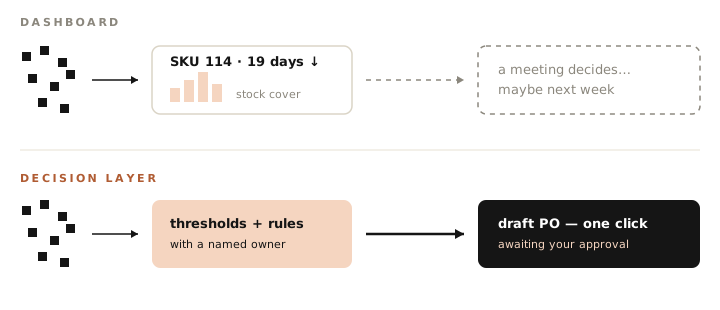
The first leaves the hard part — so what? — to whoever happens to be looking. The second encodes the so what. The thresholds, the supplier logic, the seasonal calendar: all of that already exists in your operation today. It just lives in the head of your best operations manager, applied whenever they are not in a meeting, on leave, or answering WhatsApp.
That is the honest definition of a decision layer: institutional judgment, written down, wired to live data, and given permission to act — or at minimum, to recommend with reasons attached.
Predictive is cheap. Prescriptive is the product.
Most "AI for business" pitches stop at prediction: demand will rise, this customer may churn, that machine might fail. Prediction without a wired-in response is just a more anxious dashboard.
The valuable layer is prescriptive: given the forecast, given your constraints, given who is allowed to approve what — do this, today, in this order. Prescription requires something no vendor can sell you: your own rules, made explicit. Which is why the real work of building a decision layer is two-thirds governance and one-third technology. Companies skip the governance because it involves meetings with the COO, and buy the technology because it involves a demo. Then they wonder why the AI initiative produced a chatbot.
Why this bites harder in the Gulf
Three patterns make decision latency more expensive in GCC operations than almost anywhere else.
- Multi-entity structures. A trading arm in Jebel Ali, a factory in KSA, a holding company in Abu Dhabi — each with its own systems, each consolidated monthly in a spreadsheet. By the time the group sees a number, it is history.
- Approval chains as culture. Decisions route upward by default. Every layer adds days. A decision layer does not flatten your hierarchy — it pre-packages the decision so the person at the top approves in one glance instead of one meeting.
- The WhatsApp ERP. A real share of regional operations runs on voice notes. The data exists; it is just unqueryable. Capturing those decisions into a system is not bureaucracy — it is the only way the next decision gets faster.
We wrote before about why most companies need fewer spreadsheets, not more AI. The decision layer is what you build after that cleanup — it is the reason the cleanup pays.
Where AI fits — and where it does not
AI earns its place in a decision layer in exactly three roles: ranking (which of these 400 overdue invoices to chase first), prediction (what demand looks like in 8 weeks), and drafting (the PO, the email, the exception report — written, awaiting approval).
What AI cannot do is tell you what you are optimizing for. It cannot resolve the argument between sales and finance about when a customer goes on credit hold. It cannot decide your risk appetite during a Red Sea freight disruption. Those are governance questions, and they are yours. Any vendor who says otherwise is selling you their defaults and calling them intelligence.
Tarsyn's view
We build decision layers for a living, and our honest advice is: do not start by buying one.
Start with a page. List the ten decisions your operation makes every week — reorder points, credit holds, quote approvals, dispatch priorities, hiring sign-offs. For each: what data does it need, who owns it, how long does it take today. That single page will embarrass at least three of those decisions into automation candidates — usually with systems you already own.
This is the sequence we run in the AI Opportunity Audit: decisions first, data second, AI third. Sometimes the result says build the layer now. Just as often it says fix two integrations and revisit in a quarter. We charge the same either way, because the expensive mistake is not missing AI — it is automating a decision nobody wrote down.
A dashboard shows you the fire. A decision layer hands you the extinguisher, pre-aimed. In a market moving as fast as this one, the gap between those two is the margin.
Frequently asked questions
What is an AI decision support system?+
A system that turns live business data into specific, recommended actions instead of charts — for example, flagging which purchase orders to expedite and which customer balances to chase today, with the reasoning attached. The AI part ranks, predicts, and drafts; the rules and thresholds stay yours.
How is a decision layer different from a BI dashboard?+
A dashboard answers "what happened?" and leaves the next step to whoever is looking at it. A decision layer answers "what should we do next, and who does it?" — it encodes the thresholds and routing a human currently keeps in their head, then executes or recommends.
Do we need to replace our ERP to add a decision layer?+
No. A decision layer sits on top of the systems you already run — ERP, CRM, spreadsheets — and reads from them. Replacing core systems before you have written down your decision rules usually just migrates the chaos.
What is the first step for a GCC operation?+
List the ten decisions your team makes every week — reorder points, credit holds, quote approvals, dispatch priorities. For each one, write down what data it needs and who owns it. That one-page exercise tells you more than any vendor demo, and it is the first thing we do in an audit.
Sources
- 1. Decision making in the age of urgency — McKinsey & Company, 2019
- 2. Rethink Data report: 68% of data available to businesses goes unleveraged — Seagate / IDC, 2020
Mohammed Z
Founder, Tarsyn
Mohammed builds the systems behind modern businesses — automation, AI decision layers, and the unglamorous plumbing that makes them work. He founded Tarsyn in Abu Dhabi.
Find out where your operation actually stands.
The AI Opportunity Audit maps your workflows, your data, and your decision bottlenecks — and tells you honestly whether AI is worth it yet.
Start the audit