26 July 2026 · 7 min read
Odoo vs SAP AI Features for GCC Operations
SAP and Odoo both promise AI-powered ERP. We stress-test their shipped features against four real GCC scenarios: multi-currency trading, Ramadan cutoffs, cross-border VAT, and Arabic documents.
Key takeaways
- Odoo 19 ships prompt-based Server Actions and contextual AI assistants as first-class features—not bolt-ons—which makes them faster to configure for mid-market GCC operators.
- SAP Business AI offers 230+ AI-powered scenarios expanding to 400, built for large-enterprise data volumes—but that depth assumes clean, single-currency master data most GCC trading arms don't have.
- Arabic document OCR and auto-routing in Odoo 19 reduce manual data-entry overhead for Arabic-language purchase orders and customs clearance forms.
- Before choosing either platform, a structured data and process audit almost always reveals that the bottleneck is dirty master data, not missing AI—fix that first.
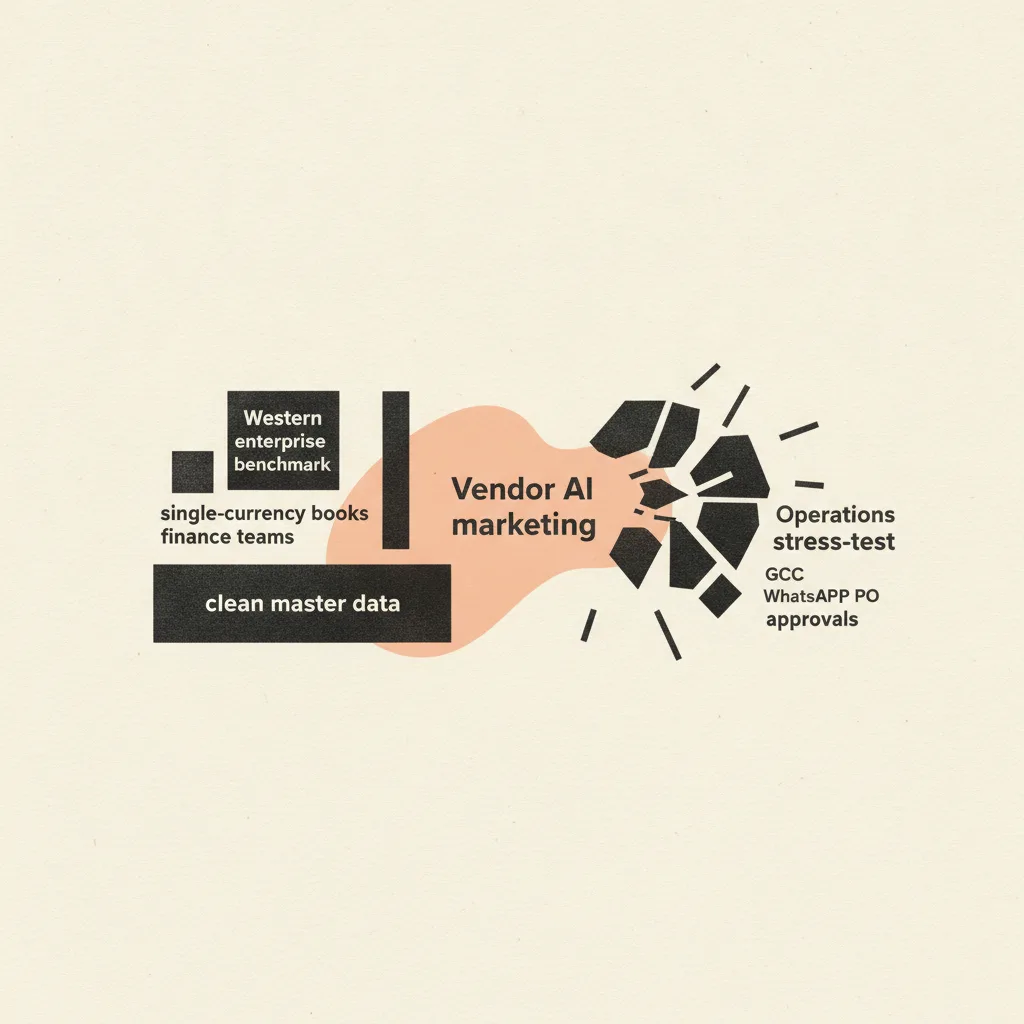
A GCC trading arm running three legal entities, two currency pairs, and a finance director who approves purchase orders over WhatsApp is not the customer SAP and Odoo wrote their AI marketing for. That customer lives in a European headquarters with clean master data, a single chart of accounts, and an IT team that reads release notes. The marketing still lands in Jebel Ali—and the gap between the brochure and the reality is where ERP projects go wrong.
This piece doesn't rehash feature lists. It stress-tests what Odoo and SAP have actually shipped—not roadmap promises—against four operational scenarios that are unremarkable in the Gulf and exotic to the ERP vendors' default assumptions.
What each vendor has actually shipped
Odoo 19 adds prompt-based Server Actions that convert natural-language intent into automation, contextual AI assistants embedded where teams already work, document intelligence with OCR and auto-routing, call transcription and summaries, and predictive models for sales and inventory. [1] The architecture matters: Odoo 19 rebuilt AI as a first-class feature woven through the platform rather than a bolt-on for isolated tasks like invoice OCR. [2] That single data model across apps means one AI capability can propagate across CRM, inventory, and accounting simultaneously—useful when those three functions are entangled in a typical GCC trading operation.
SAP Business AI operates at a different scale. SAP offers over 230 AI-powered scenarios, with plans to expand to 400, embedded across its enterprise suite via the Joule AI assistant. [3] The Q4 2025 release made the Agent Builder in Joule Studio generally available, enabling developers to build custom agents tailored to specific business requirements. [3] SAP's sovereign cloud direction—uniting AI and cloud offerings under a single framework for data residency compliance—is notable for GCC entities subject to data localisation rules. [3]
The honest framing: Odoo's AI is more immediately configurable for mid-market operators. SAP's AI is more comprehensive but assumes the enterprise data discipline to use it. Neither vendor solves the underlying data problem for you.
Scenario 1: Multi-currency trading arms
A holding company in the Gulf might consolidate AED, SAR, and USD books across a free zone entity, an onshore LLC, and an offshore procurement vehicle. The AI forecasting promise—predictive inventory reordering, cash flow projection—collapses quickly if the currency translation layer is inconsistent across entities.
Odoo 19's predictive models for sales and inventory operate within its single data model. [1] If your multi-entity setup is clean and properly configured in Odoo, the AI has coherent data to work with. If your entities are on separate Odoo instances with manual month-end consolidation (common in GCC group structures), the AI sees three partial pictures.
SAP's 230+ scenarios include financial consolidation AI, but they are calibrated for enterprises where the data architecture is already unified. [3] For a GCC group that grew by acquisition and has four different COA structures, those scenarios require significant pre-work before they produce anything useful.
The verdict: Neither AI layer rescues a broken consolidation structure. Fix the multi-entity data model first—the AI becomes useful after that, not before.
Scenario 2: Ramadan procurement cutoffs
Ramadan compresses a month of procurement activity into roughly two weeks of normal working tempo, then shuts the window. Suppliers in South Asia go offline. Freight capacity tightens at Jebel Ali. Finance teams are running truncated approval cycles during shortened working hours.
Odoo 19's inventory predictive models and automated reorder suggestions are genuinely useful here—if the demand history they train on captures Ramadan seasonality correctly. [1] The Server Actions feature allows operators to configure natural-language automation rules: "flag any purchase order with a lead time beyond March 15 for director approval." That kind of rule is fast to configure without a developer. [1]
SAP's AI scenarios for supply chain are more sophisticated, but the configuration overhead to encode Ramadan-specific business rules in a large SAP environment typically requires a certified consultant and a change request cycle that outlasts the procurement window it was meant to solve.
The verdict: Odoo's lower configuration overhead wins for Ramadan-specific rule creation. SAP wins if you have a dedicated team running it year-round and the rules are already encoded.
Scenario 3: Cross-border VAT and tax compliance
GCC VAT is not simple. Saudi Arabia is at 15%. The UAE is at 5%. Cross-border transactions between KSA and UAE entities require careful treatment. E-invoicing mandates (Fatoora in KSA, e-invoice in UAE) add document compliance requirements on top of the tax calculation.
Odoo's document intelligence and OCR features can auto-route incoming invoices and extract fields. [1] The AI-assisted classification is useful for reducing manual matching. What it does not do automatically is apply the correct VAT treatment to a cross-border supply between your KSA and UAE entities—that requires correct configuration of the tax engine by someone who understands GCC VAT rules.
SAP's AI scenarios include tax compliance tooling, and its scale means there is more SAP-certified GCC tax expertise in the partner ecosystem. [3] For large entities running Fatoora compliance, the SAP partner network depth is a real advantage.
The verdict: SAP has the ecosystem advantage for complex GCC tax compliance. Odoo works well if the tax configuration is set up correctly by a qualified local partner—the AI layer assists human work, it does not replace the tax expertise.
Scenario 4: Arabic document processing
Purchase orders from Gulf suppliers arrive in Arabic. Customs declarations are in Arabic. Supplier contracts are in Arabic. The promise of AI document intelligence is that it reads and routes these automatically.
Odoo 19's document intelligence with OCR and auto-routing inherits the platform's native Arabic UI support. [1] [2] The practical result: Arabic-language POs and customs clearance forms can be ingested, field-extracted, and routed to the correct workflow without manual re-keying. Prompt tuning for regional Arabic dialect variance—Gulf Arabic vs. Modern Standard Arabic in formal documents—will still require configuration by a local partner.
SAP's Joule assistant and document AI also support Arabic, and SAP's sovereign cloud direction is relevant for GCC entities with data residency requirements. [3] The enterprise-grade document processing at scale is SAP's strength. The time and cost to configure it for a mid-market GCC operator is the constraint.
The verdict: Both platforms can process Arabic documents. Odoo gets there faster for mid-market. SAP scales better for high-volume document processing at enterprise level.
The four scenarios side by side
| Scenario | Odoo 19 | SAP Business AI | |---|---|---| | Multi-currency consolidation | Good if data model is unified | Comprehensive but assumes data discipline | | Ramadan procurement rules | Fast to configure, lower overhead | More powerful, higher setup cost | | Cross-border GCC VAT | Requires qualified partner config | Stronger ecosystem depth | | Arabic document processing | Faster for mid-market deployment | Better at enterprise scale |
Tarsyn's view: the AI is not the problem you think it is
Vendors write AI marketing for their best-case customer. That customer has seventeen clean data tables, not seventeen spreadsheets. Every ERP comparison we run for GCC clients follows the same pattern: the conversation starts as "which AI features does vendor X have" and ends as "our supplier master has 4,000 duplicate records and our approval workflow lives in a group chat."
Odoo 19's prompt-based automation and AI assistants are genuinely useful—for a team that has already cleaned its item codes, aligned its chart of accounts, and stopped running approvals over WhatsApp. [1] [2] SAP's 230+ AI scenarios are impressive—for an enterprise that has the implementation budget, the partner ecosystem access, and the data architecture to use them. [3]
Multiply chaos by intelligence and you get articulate chaos.
The honest question before any ERP AI purchase is not "which vendor has better AI." It is "are our processes and data good enough that AI will make things better rather than faster-wrong." We wrote about this dynamic in detail in our piece on dashboards vs. decision layers—the same logic applies here. A predictive reorder model that runs on bad demand history will confidently order the wrong things.
If you are at the start of this decision, the right move is a structured audit of your data and processes before any vendor conversation. We have done this for manufacturing groups in Dammam, trading arms in Jebel Ali, and professional services firms in Abu Dhabi—the audit almost always reveals that the real constraint is not missing AI, it is missing process discipline. We charge the same whether the answer is "buy Odoo," "buy SAP," or "not yet—clean your data first."
That said, when the data is ready, the AI features in both platforms are real and worth having. The five-step evaluation we use is documented in the audit that decides if AI is worth it. It takes one week and costs far less than a bad ERP implementation.
If you want to run it for your operation, start with the Tarsyn Audit.
By Mohammed Z, Tarsyn — Abu Dhabi & Khobar
Frequently asked questions
Does Odoo 19 support Arabic language AI features?+
Odoo 19 includes document intelligence with OCR and auto-routing that can process Arabic-language documents such as purchase orders and customs forms. It also ships contextual AI assistants and call transcription. Native Arabic UI support has existed for several versions, so the AI layer inherits that locale. Custom prompt tuning for Arabic dialect variance will still require partner configuration.
Is SAP Business AI suitable for mid-market GCC companies?+
SAP Business AI is designed for large-enterprise data volumes and offers 230+ AI-powered scenarios. For mid-market GCC operators—often running multi-entity books, mixed currencies, and approval chains over WhatsApp—the implementation complexity and licensing cost frequently outweigh the AI benefit. A structured audit before any purchase decision is the honest starting point.
How do Odoo and SAP handle multi-currency AI forecasting?+
Odoo 19 adds predictive models for sales and inventory within its single data model across apps, which simplifies multi-currency consolidation for modular deployments. SAP's AI scenarios are broader in count but assume cleaner master data. Neither platform eliminates the foundational data-quality work required before AI forecasting produces reliable output in multi-currency GCC trading environments.
What should a GCC business do before buying an AI-powered ERP?+
Run a structured data and process audit first. Identify how many currency pairs you consolidate, whether your approval workflows live in the ERP or in WhatsApp threads, and how clean your supplier master is. AI multiplies what's already in your data—if that data is fragmented across seventeen spreadsheets and three group chat threads, the AI output will be confidently wrong.
Sources
- 1. Odoo 19 AI Features — From Automation to Autonomous Decisions: The Next Generation ERP Blueprint — www.aalogics.com
- 2. Odoo 19 AI Features: Setup, Agents & Automation Use Cases — www.certumsolutions.com
- 3. SAP Business AI | SAP Community — pages.community.sap.com
Mohammed Z
Founder, Tarsyn
Mohammed builds the systems behind modern businesses — automation, AI decision layers, and the unglamorous plumbing that makes them work. He founded Tarsyn in Abu Dhabi.
Find out where your operation actually stands.
The AI Opportunity Audit maps your workflows, your data, and your decision bottlenecks — and tells you honestly whether AI is worth it yet.
Start the audit