23 August 2026 · 8 min read
Workflow Automation for ERP: What n8n Means for Gulf Ops
Gulf operators overpay for ERP integrations that n8n could handle cheaply — but open-source automation has real limits. Here's the honest framework for where it fits.

Key takeaways
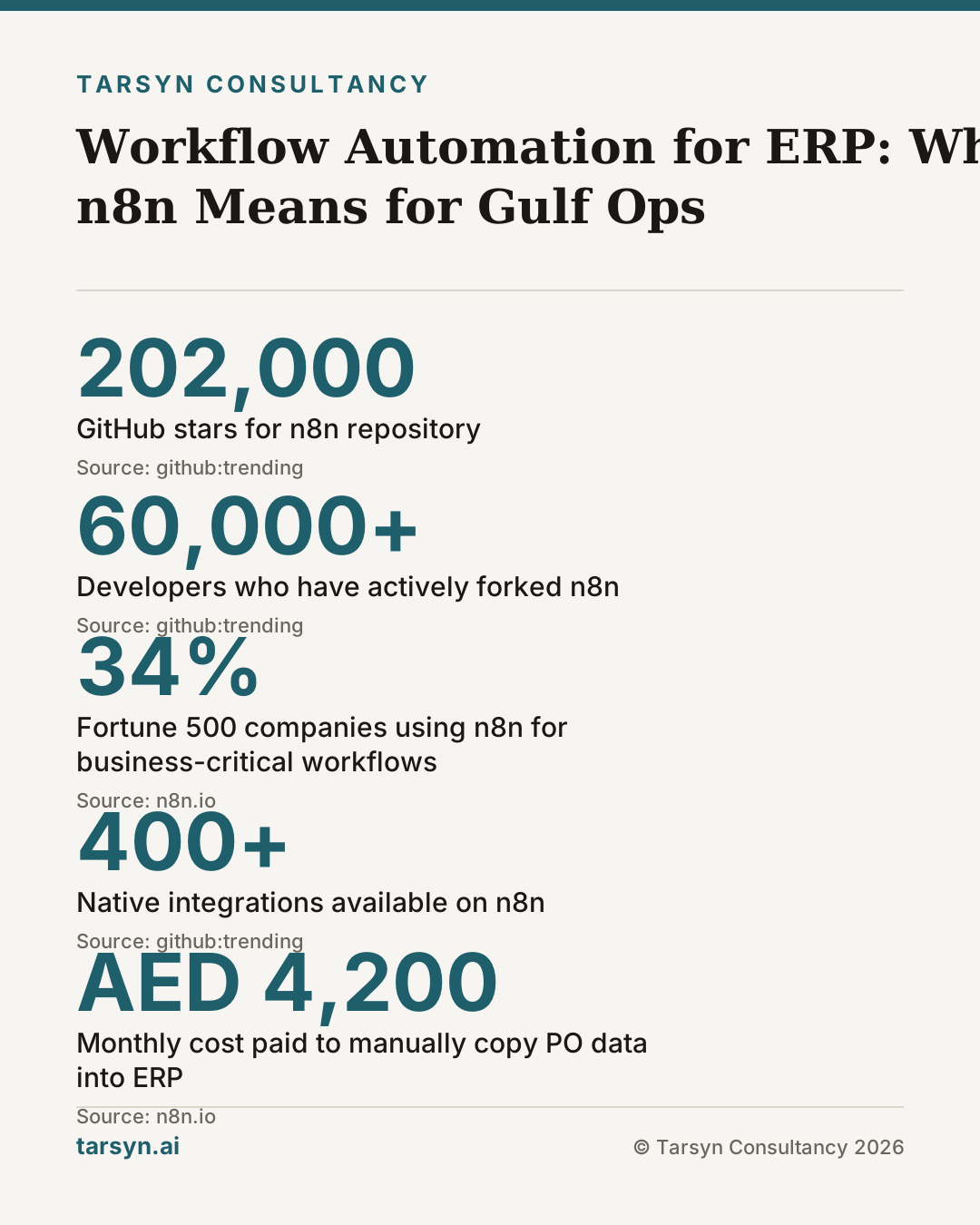
- n8n has crossed 202,000 GitHub stars and is used by 34% of Fortune 500 companies for workflow glue logic — its traction is real, not hype.
- The biggest automation gap in Gulf ERP deployments isn't the ERP license; it's the manual handoffs between systems that no one budgeted for.
- n8n fits best in five edge-of-ERP scenarios — WhatsApp-to-ERP data capture, approval notifications, cross-system reporting triggers, vendor portal syncing, and lightweight AI routing — not in financial posting or compliance workflows.
- Conflating open-source automation tools with an ERP strategy or an AI strategy is how six-figure projects fail; the rule is automate the edges, not the core.
A Gulf logistics company running Odoo for warehousing recently discovered it was paying a system integrator AED 4,200 a month to manually copy purchase-order confirmations from a vendor portal into its ERP. The task took forty minutes a day. A junior developer built an n8n workflow that did the same thing in an afternoon. The integrator's contract ran for another eight months before anyone noticed.
That story is not an argument against system integrators. It is an argument for knowing what your automation gaps actually cost — and for having a framework to decide which tool closes which gap.
n8n is having a moment. With over 202,000 GitHub stars and active forks from more than 60,000 developers [1], it is the most-starred workflow automation repository on GitHub. Enterprise adoption is real too: 34% of Fortune 500 companies already use n8n's advanced security and DevOps features for business-critical workflows [3]. If you run operations in the Gulf and you haven't been asked about it by your IT team yet, you will be soon.
The question is not whether n8n is legitimate. It is. The question is whether the problem you're trying to solve is the problem n8n actually solves.
What n8n Actually Is — and Why It's Trending
n8n describes itself as a "fair-code workflow automation platform with native AI capabilities" [1]. In plain terms: it is a visual canvas where you connect triggers, logic nodes, and actions. An event happens somewhere (a form submission, a webhook, a database row update), n8n intercepts it, applies whatever logic you configure, and pushes the result somewhere else.
What makes it different from older tools like Zapier:
- You can self-host it entirely, keeping data inside your own infrastructure [3] — relevant for Gulf operators with data residency concerns or regulated data
- You can drop raw JavaScript or Python into any node, escaping the limits of point-and-click automation
- It connects natively to ERP systems including Odoo and ERPNext [2], plus over 400 other integrations [1]
- The enterprise tier adds SSO, SAML, LDAP, HashiCorp Vault and AWS Secrets Manager integration, and SOC 2 audit support [3]
The GitHub traction comes partly from the AI wave: n8n added AI agent workflow nodes that let you chain LLM calls, tool use, and memory into visual pipelines [1]. Developers building internal AI tooling find it faster than writing orchestration code from scratch.
That last point matters for Gulf operators, but not in the way most vendor pitches suggest. More on that below.
The Real Automation Gap in Gulf ERP Deployments
Most Gulf mid-market operators run at least two primary business systems — an ERP plus one or more of: a WMS, a CRM, a vendor portal, a government reporting platform, a bank's payment API, or a WhatsApp-based approval chain. The ERP license is budgeted. The integrations between systems are frequently not.
The result is predictable: employees become the integration layer. Data gets re-keyed. Approval requests go out on WhatsApp and come back as screenshots that someone types into the ERP. A dispatch confirmation from a Jebel Ali freight forwarder arrives as a PDF that lands in someone's inbox and gets entered manually three days later, after the finance team has already made assumptions about the shipment status.
This is expensive in ways that don't show up cleanly on a P&L. The cost is latency, errors, and the staff hours absorbed by tasks that require no judgment — just data movement. As we argued in The WhatsApp-to-ERP Gap Is Where GCC Businesses Leak Money, the financial exposure here is material and largely invisible until something breaks badly.
n8n exists to close exactly these gaps. The mistake Gulf operators make is either ignoring it entirely (and continuing to pay for manual re-keying) or over-extending it into territory where it is the wrong tool (and creating fragile automation that fails quietly).
For a deeper look at how automation failures go undetected, see When Automation Reports Success and Your Business Fails.
Where n8n Fits: Five Use Cases That Make Sense
These are the scenarios where n8n sits naturally alongside Odoo, SAP, or Dynamics without creating compliance or reliability risk:
1. WhatsApp-to-ERP data capture (with a human confirmation step) WhatsApp messages from suppliers or customers contain structured information — PO numbers, quantities, delivery windows. n8n can parse incoming webhook data from the WhatsApp Business API, extract fields, and create draft records in the ERP for a human to confirm and post. The key word is draft. The human remains in the loop on the actual transaction. n8n handles the transcription.
2. Approval notification routing Most ERPs generate approval requests internally. Most Gulf businesses run approvals over WhatsApp or email because the ERP's notification system doesn't match how managers actually work. n8n can intercept the ERP's outbound webhook or API event and push a formatted message to the right WhatsApp group or email thread, with a link back to the ERP record. Cheap, reliable, and entirely outside the ERP's financial logic.
3. Cross-system reporting triggers When a purchase order is marked received in the ERP, someone needs to update the freight tracker, notify the finance team, and log the event in the vendor scorecard. These are three separate actions in three separate systems. n8n listens for the ERP event and fans out to the other systems automatically. No custom ERP development required. The native Odoo and ERPNext integration nodes make this straightforward [2].
4. Vendor portal synchronisation Government procurement portals, marketplace platforms, and large-customer supplier portals often have their own data entry requirements that don't map cleanly to the ERP. n8n can run scheduled sync workflows that pull data from the ERP's API and push it to the portal's API on a schedule — eliminating the daily manual export-and-upload routine.
5. Lightweight AI routing on incoming documents A PDF lands in an email inbox. Is it a vendor invoice, a delivery note, or a compliance document? n8n can call an LLM to classify the document and route it to the right folder, team, or ERP queue — without the LLM ever touching the posting logic. This is the correct use of AI inside an automation workflow: classification and routing, not transaction execution.
Where n8n Doesn't Fit: Limits Buyers Must Understand
n8n is not an ERP module. It has no ledger, no audit trail that satisfies VAT or Zakat requirements, no approval hierarchy that a regulator will accept, and no rollback logic when a financial transaction goes wrong. Using n8n to automate financial postings, inventory adjustments, or compliance filings is not a cost saving — it is a liability transfer from the vendor to you, with no safety net.
Four specific limits matter for Gulf operators:
Self-hosting is a commitment, not a one-time setup. The enterprise tier offers managed cloud [3], but many teams opt for self-hosted to control data residency. Self-hosted n8n requires someone to manage uptime, apply security patches, rotate credentials, and monitor workflow failures. If that person leaves, the automations become a liability. The enterprise features around log streaming and observability help, but only if you actually configure them.
Silent failures are the most dangerous risk. An automation that fails visibly is a problem. An automation that reports success while your data didn't actually move is a crisis you discover three weeks later during a bank reconciliation. n8n's enterprise tier supports streaming workflow logs to observability stacks [3], but the monitoring architecture has to be designed deliberately. Most teams skip this until after the first incident.
It is not an AI strategy. n8n added AI agent capabilities [1], and the demos look impressive. But wiring an LLM into a workflow automation tool does not produce an AI strategy — it produces an AI-augmented automation, which is useful but narrow. If your team is describing n8n as your AI implementation, that conversation needs resetting. See Most Companies Don't Need More AI for why the spreadsheet problems come first.
Governance and compliance workflows belong in the ERP. Any workflow that produces a record a regulator, auditor, or bank might inspect should live inside the ERP's native workflow engine — not in a third-party automation layer. The ERP's workflow engine is slow and sometimes painful. That is the correct tradeoff for regulated processes.
Tarsyn's View: Automate the Edges, Not the Core
The honest framing is this: n8n is a legitimate, well-maintained tool for automating the connective tissue between systems. Its GitHub traction reflects genuine developer satisfaction, not marketing spend [1]. Its enterprise tier is mature enough for serious production use [3]. Gulf operators who dismiss it entirely are leaving real efficiency gains on the table.
But the projects that fail with n8n fail for a consistent reason: the team confused "automate the handoffs" with "replace the system." They use n8n to route around ERP limitations instead of fixing the ERP configuration. They chain ten workflows together and call it a data pipeline. They add an LLM node and call it AI. Multiply complexity by enthusiasm and you get brittle infrastructure that one developer understands and everyone else fears.
Our working principle: automate the edges, not the core. Edges are the data movement, the notifications, the routing, the format conversions, the cross-system triggers. The core is the ERP's financial logic, its inventory engine, its approval hierarchy. The core stays inside the ERP. The edges can live in n8n, in Power Automate, or in a purpose-built microservice — whichever the team can actually maintain.
Before you buy any automation tooling — open-source or enterprise — the first step is mapping where your manual handoffs are and what they cost. That mapping takes a day or two. It frequently reveals that the highest-value fix is not a new tool; it is a configuration change in the ERP you already own.
If you want that mapping done honestly, start with the Tarsyn Audit. We will tell you whether n8n solves your actual problem or whether something else does. We charge the same either way.
For a broader framework on where automation investments actually pay off in GCC operations, the ERP AI Readiness Audit and our piece on hiring a workflow automation consultant in Saudi Arabia are the logical next reads.
By Mohammed Z, Tarsyn — Abu Dhabi & Khobar
Frequently asked questions
What is n8n and how is it different from Zapier or Power Automate?+
n8n is a fair-code, self-hostable workflow automation platform with over 400 native integrations, including Odoo and ERPNext. Unlike Zapier, it lets you write custom code inside workflows and keeps data on your own infrastructure. Unlike Power Automate, it isn't locked to the Microsoft ecosystem. The tradeoff: it requires a technically capable person to maintain it.
Can n8n replace an ERP system for a Gulf SME?+
No. n8n is glue logic — it moves data between systems and triggers actions based on events. It has no ledger, no inventory engine, no compliance module, and no audit trail that satisfies VAT or Zakat requirements. It should sit alongside an ERP like Odoo, SAP, or Dynamics, not instead of one.
What are the self-hosting risks of running n8n in a GCC business?+
Self-hosting n8n requires you to manage uptime, security patching, secret management, and workflow monitoring yourself. Silent failures — automations that report success while your data didn't actually move — are the most dangerous risk. Gulf operators running n8n without proper observability logging are essentially flying without instruments. The enterprise tier adds SOC 2 audit support and third-party secret vaults, which matters for regulated industries.
How do I know if my team is ready to implement n8n alongside our ERP?+
Three signals suggest readiness: your team includes at least one person who can write basic JavaScript or Python, you have documented the manual handoff you want to automate (not just described it verbally), and you have a monitoring plan for when the automation breaks. If any of those three are missing, start with an honest audit of your workflow gaps before touching any tooling.
Sources
- 1. n8n-io/n8n (GitHub trending) — github:trending
- 2. ERPNext | Nodes | n8n Docs — docs.n8n.io
- 3. Enterprise Workflow Automation Software & Tools | n8n — n8n.io
Mohammed Z
Founder, Tarsyn
Mohammed builds the systems behind modern businesses — automation, AI decision layers, and the unglamorous plumbing that makes them work. He founded Tarsyn in Abu Dhabi.
Find out where your operation actually stands.
The AI Opportunity Audit maps your workflows, your data, and your decision bottlenecks — and tells you honestly whether AI is worth it yet.
Start the audit