7 August 2026 · 7 min read
Hiring a Workflow Automation Consultant in Saudi Arabia: 9 Questions
Vision 2030 flooded Saudi Arabia with automation consultants. This rubric gives procurement and IT leads 9 questions to separate genuine operators from expensive demo artists.

Key takeaways
- ZATCA Phase 2 compliance requires real-time clearance or reporting workflows — ask every consultant for a named production reference, not a sandbox demo.
- Approval chains averaging 3 days in a Saudi inbox are the single highest-ROI automation target; a good consultant maps time-waste before proposing any tool.
- Arabic locale handling — right-to-left PDFs, Arabic numeral formats, bilingual audit logs — is a technical requirement, not an afterthought; most generalist consultants skip it.
- The honest answer to 'which tool?' is sometimes 'none yet' — a consultant who leads with a platform name before mapping your process is selling software, not solving problems.
Your procurement team shortlisted three automation consultants last month. All three demoed n8n. All three used the phrase "end-to-end transformation." None of them mentioned ZATCA, Arabic locale, or which Saudi ERP they had connected in production. This is the market Vision 2030 built: a flood of capable-looking vendors selling a generic capability to buyers who don't yet have a rubric to separate the real ones.
This piece gives you that rubric — nine concrete questions, and what a good answer sounds like.
Why the Saudi market is harder than it looks
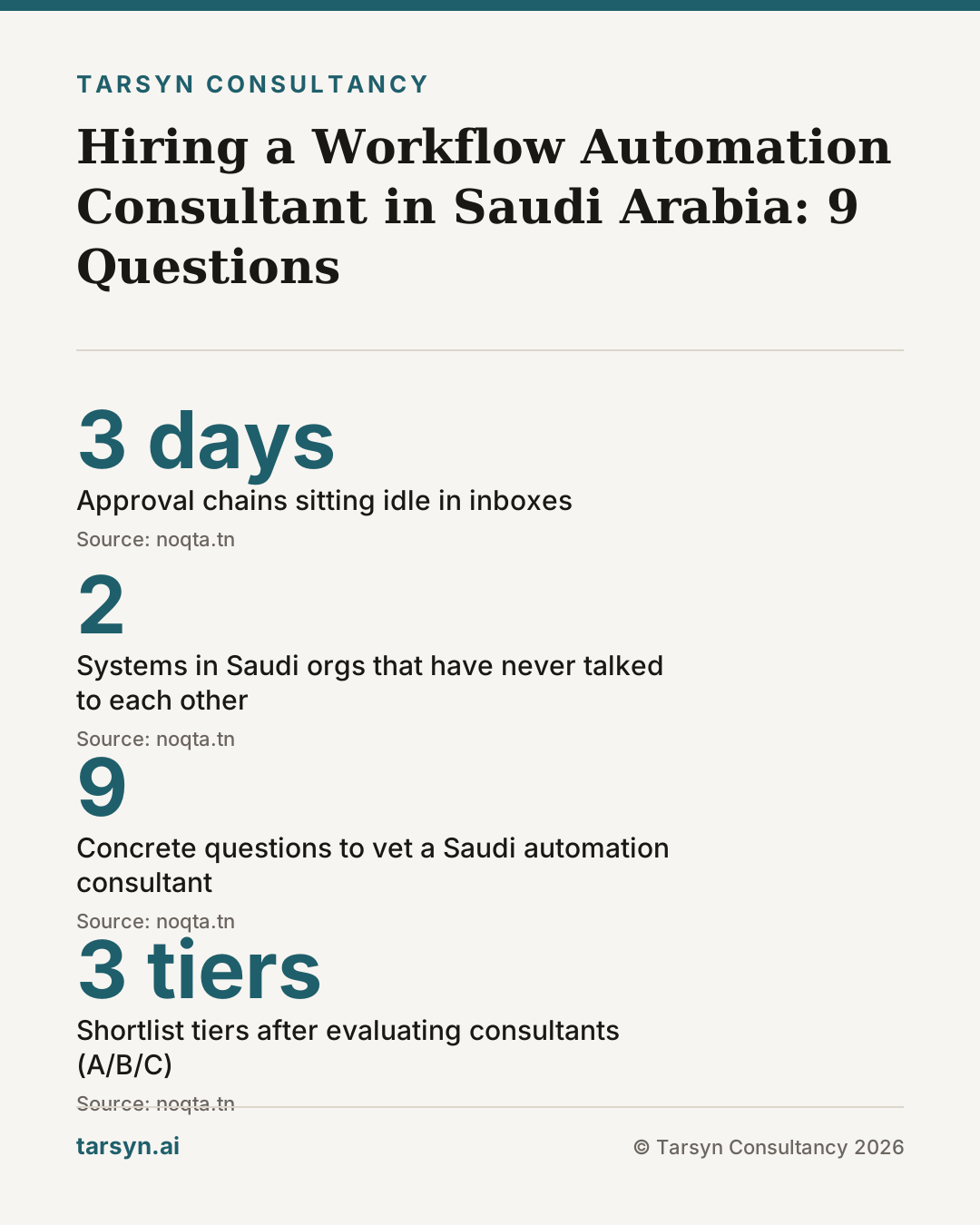
The Vision 2030 spending mandate pushed almost every Saudi organisation to launch transformation programmes simultaneously. [2] The backlog underneath those programmes is unglamorous: approval chains sitting three days in an inbox, monthly regulatory reports rebuilt by hand, two systems that have never talked to each other. [2] That backlog is real, the opportunity is genuine, and it attracted a lot of consultants — including ones whose entire Saudi experience is a sandbox environment.
The problem is not bad intent. It is mismatch. A consultant who has automated approval workflows for a European SaaS company faces a different set of constraints in Riyadh: ZATCA e-invoicing compliance, Arabic-first document requirements, government portal integrations, and ERP configurations that reflect local chart-of-accounts structures. Generic automation skills do not automatically transfer.
Before you read the nine questions, one framing note: we run the same evaluation on ourselves. If a client's process isn't ready to automate, we say so. The /Audit exists precisely for that — to map before we build, so we don't automate the wrong thing at speed.
The 9 questions — and what separates a good answer from an expensive one
1. Walk me through the last workflow you automated for a Saudi entity. What broke in production?
Every honest practitioner has a war story. Consultants who describe a seamless first deployment either haven't shipped enough to have problems yet, or they're editing the narrative. What you want is specificity: which system, which failure mode, how they caught it. Silent failures in automation — workflows that report success while the underlying data is wrong — are the single most expensive category of outcome. A full article on that pattern is worth reading before any vendor meeting.
2. How have you handled ZATCA Phase 2 compliance in a live integration?
ZATCA's Phase 2 e-invoicing requirement mandates that invoices pass real-time clearance or reporting through the FATOORA platform, with valid XML structure, QR codes, CSID onboarding, and compliant seller VAT data. [1] A consultant whose automation touches your billing, procurement, or finance workflows needs to have built or integrated these pipelines before — not learned about them on your budget. Ask for the client name or sector. Ask what the CSID onboarding process looked like. Vague answers here are disqualifying.
3. How do you handle Arabic locale in documents and audit logs?
This sounds like a detail. It isn't. Arabic document generation requires right-to-left layout, correct Arabic numeral formatting, and bilingual audit trails — especially for any workflow that touches regulatory reporting or external stakeholders. [2] A consultant who has only worked in English-language environments will generate PDFs that render incorrectly, audit logs that mix directionality, and approval notifications that confuse Arabic-speaking approvers. Ask to see a sample output, not a slide about "multi-language support."
4. Which Saudi ERP instances have you connected in production — and what were the integration constraints?
Oracle Fusion, SAP ECC/RISE, Odoo with the Saudi localisation pack, Microsoft Dynamics 365 with the Arabic language module — each of these has different API behaviours, different authentication models, and different quirks at the field level for Saudi-specific data (CR number, VAT number, Hijri date fields). A consultant who has worked in production on one of these knows the constraints. One who has only worked in sandboxes will discover them on your timeline and at your cost. If you're evaluating SAP specifically, this piece on SAP RISE timing provides useful context on the pressure to migrate before the infrastructure is ready.
5. What's your approach when the process itself is broken before we automate it?
This is a values question dressed as a technical one. The correct answer is: we map first, we don't build until we understand the process, and sometimes we tell clients the answer is to fix the process rather than automate it. [2] If the consultant's answer skips to tooling, they are optimising for billable hours, not your outcome. We've written about this pattern directly — multiply chaos by intelligence and you get articulate chaos.
6. How do you monitor for silent failures after go-live?
Most automation projects are evaluated at launch. The harder problem is what happens at week six, when a workflow silently stops triggering because an upstream field name changed, and nobody notices for three months because the error never surfaced in a dashboard. Your dashboards reporting success is not the same as your business succeeding. A mature consultant has an answer here: alerting thresholds, scheduled sanity checks on output volumes, named human accountability for each automated process. If their monitoring answer is "we'll set up error notifications," that's the beginning of an answer, not the end of one.
7. How do you handle approval chain design for Saudi organisations — including multi-level hierarchy and out-of-office escalation?
Saudi approval structures are often multi-tiered, involve senior leadership sign-off on thresholds that would be automated elsewhere, and break visibly during Ramadan and Hajj periods when key approvers are unavailable for extended stretches. An automation consultant who hasn't thought about Eid-al-Adha escalation paths has not shipped a Saudi approval workflow in production. Ask specifically: how did you handle the Ramadan freight or approval cutoff problem for your last client?
8. What does your audit trail look like — and can you show me a real one?
Regulatory environments in Saudi Arabia are tightening across VAT, e-invoicing, and sector-specific compliance. Any automated workflow that touches financial data, procurement approvals, or document routing needs a full audit trail: every run logged, every decision recorded, the human accountable for each output named. [2] "We log everything" is not an audit trail. Ask to see an exported log from a previous engagement. The format, the granularity, and the human-readability of that log will tell you more about the consultant's production maturity than any case study.
9. What would make you tell a client not to automate something?
This is the most important question on the list. Consultants who can't answer it are selling automation as an end in itself. Good answers include: the process changes too frequently to make a stable workflow viable; the data quality upstream is too poor to trust automated outputs; the volume doesn't justify the maintenance cost; the exception rate is high enough that human judgment is cheaper. If the consultant has never told a client "not yet," either they're very lucky or they're not being straight with you.
What a shortlist should look like
After running nine questions, a useful shortlist has three tiers:
| Tier | What you found | Next step | |------|---------------|-----------| | A — deploy | Production ZATCA reference, Arabic locale samples, named monitoring approach, honest "no" story | Scope a pilot process together | | B — conditional | Strong on process methodology, weak on Saudi-specific technical depth | Pair with internal Saudi IT lead; pilot a non-compliance process first | | C — pass | Demo-only experience, no production Saudi ERP reference, tooling-first answers | Politely decline |
Most markets have a majority of C, a minority of B, and a handful of A. That ratio is tighter in Saudi Arabia right now because demand outpaced supply faster than in most GCC markets.
Tarsyn's view
We are an automation and AI studio operating in Abu Dhabi and Khobar. We work across the GCC, and Saudi Arabia is where we see the sharpest gap between consultant supply and production readiness.
Our honest position: we don't win every evaluation, and we don't expect to. What we push back on is the framing that any automation consultant who can demo a tool is ready to ship a ZATCA-compliant, Arabic-locale, ERP-connected workflow in a Saudi production environment. Those are different capabilities.
The nine questions above are the ones we'd want a client to ask us. If a consultant discourages you from asking them, that's your answer.
If you want a structured process before you hire anyone — including us — the /Audit is the right starting point. We map where the time goes, identify which processes are ready to automate, and tell you what the build will actually cost. If the answer is "not yet," we'll say so. We charge the same either way.
For teams earlier in the evaluation — still deciding whether automation or AI is the right next investment — the five-step audit framework here covers the broader question before any vendor conversation begins.
Frequently asked questions
What should I look for in a workflow automation consultant in Saudi Arabia?+
Prioritise consultants who map your process before recommending a tool, can demonstrate ZATCA-compliant e-invoicing workflows in production, handle Arabic locale requirements (RTL documents, bilingual audit logs), and have connected to a Saudi ERP instance — Oracle, SAP, or Odoo — in a live environment. References from comparable Saudi organisations matter more than a polished demo.
How does ZATCA compliance affect workflow automation projects?+
ZATCA's Phase 2 e-invoicing mandate requires invoices to pass real-time clearance or reporting through the FATOORA platform, with valid XML structure, QR codes, and CSID onboarding. Any automation consultant touching your finance or billing workflows must understand these requirements and be able to build or integrate compliant pipelines — a generic integration tool configured without this knowledge creates regulatory risk.
What does a workflow automation engagement typically cost in Saudi Arabia?+
Cost varies widely. A single-process automation audit and build for an approval chain or reporting workflow sits at a different scale than a multi-system ERP integration programme. The honest answer: a consultant who gives you a price before mapping your process is guessing. Expect a scoped discovery phase first — that scoping should itself have a fixed, transparent fee.
Should we build automation in-house or hire a consultant?+
In-house makes sense if you have developers with ERP API experience, capacity to maintain integrations, and someone accountable for monitoring silent failures. Consultants add value when that capacity doesn't exist, when compliance requirements (ZATCA, VAT reporting) need specialist knowledge, or when speed matters. The build-vs-buy framing applies to the team as much as the tool.
Sources
- 1. Saudi E-Invoicing and ZATCA Compliance ERP | Xfatora — www.xfatora.com
- 2. Workflow Automation & Digital Transformation | Saudi Arabia | Noqta — noqta.tn
Mohammed Z
Founder, Tarsyn
Mohammed builds the systems behind modern businesses — automation, AI decision layers, and the unglamorous plumbing that makes them work. He founded Tarsyn in Abu Dhabi.
Find out where your operation actually stands.
The AI Opportunity Audit maps your workflows, your data, and your decision bottlenecks — and tells you honestly whether AI is worth it yet.
Start the audit