21 August 2026 · 8 min read
When AI Autofix Becomes a Security Hole in Your ERP Stack
A Copilot-assisted pull request opened Snowflake's Jira to full compromise. Here's what Gulf businesses running Odoo, SAP, or Dynamics must do before any AI copilot touches a production workflow.
Key takeaways
- A Wiz Red Agent exploited a shell-injection flaw in Snowflake's GitHub Actions workflow — one that Copilot participated in reviewing and did not flag — granting read access to internal Jira engineering, security, and bug-bounty projects.
- The attack required no compromised account: any internet user could trigger it by placing shell syntax in a GitHub issue title, exposing a Jira API token within seconds of payload delivery.
- AI-assisted code review does not replace human security review; LLMs are trained on a large volume of insecure CI/CD examples and can produce logic that only appears safe in a narrow review context.
- Before any AI copilot touches an ERP or workflow automation integration, operators need three explicit trust boundaries: code provenance labelling, secrets-out-of-code policy, and a mandatory static-analysis gate in CI.
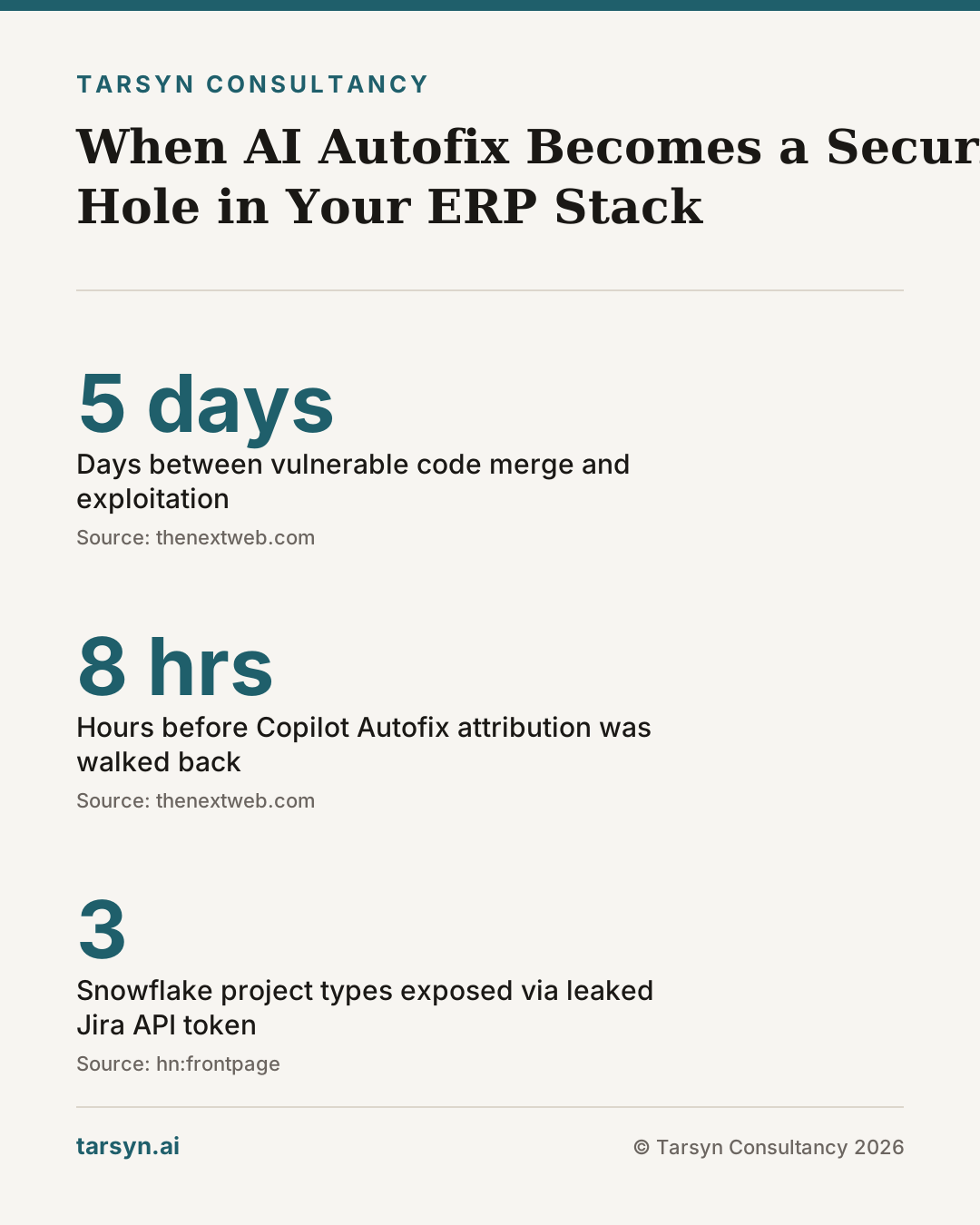
On 23 June, a security researcher opened a GitHub issue on a public Snowflake repository. The issue title contained shell syntax. A GitHub Actions workflow picked up that title, dropped it unescaped into a privileged inline script, and within seconds a Jira API token was exposed — giving read access to Snowflake's internal engineering, security compliance, and bug-bounty projects [1]. Nobody touched a keyboard on the attacker's side. Wiz's autonomous Red Agent did it all, five days after the vulnerable code was merged [4].
The part that travelled fastest on the internet: GitHub Copilot's Autofix feature had participated in the pull request and, according to Wiz, had not flagged the flaw [1]. The part that got walked back within eight hours: it is not clearly established that Copilot wrote the vulnerable line — the commit history is ambiguous, and GitHub disputed the framing [3] [4]. Wiz updated its report to reflect that uncertainty.
What is not in dispute: an AI coding assistant participated in reviewing a security-sensitive CI/CD change and did not catch a critical vulnerability. An unauthenticated user on the public internet could have triggered it. And Snowflake's automated security tooling did not catch it either — an offensive AI agent did [1] [4].
For Gulf businesses embedding AI copilots into Odoo, Dynamics, or SAP workflows, the ambiguity over who wrote the bad line is almost beside the point. The governance failure is identical either way.
What the attack path actually looked like
The mechanism is worth understanding precisely, because it maps almost directly onto how GCC ERP integrations are typically wired.
The vulnerable workflow fired whenever anyone opened a GitHub issue. It took the issue title and inserted it into a shell script meant to create a corresponding Jira ticket. The escaping logic was in the wrong order: GitHub's template engine substituted the title first, and the sanitising commands ran after — meaning a single quote in the title broke out of the shell string entirely [4].
A guard condition looked like protection. It compared a pull-request property against a known bot name. But on issue events, that pull-request property does not exist — GitHub evaluates it as null, null is never equal to the bot name, so the condition was always true, and every user on the internet walked straight through [4].
Red Agent's first attempt threw a syntax error. The agent read the error, inferred why, rewrote the payload, and tried again. Access confirmed in seconds [4].
The Hacker News thread added an important structural note: GitHub Actions is almost unique in combining a difficult-to-audit language with a privileged remote-code-execution environment, and the platform was released without a robust security linting solution, leaving that to the community [2]. AI models are trained on the existing corpus of Actions examples — which contains a large proportion of insecure patterns [2].
Why ERP and workflow environments face the same exposure
Replace "GitHub Actions workflow" with "Zapier zap," "Power Automate flow," or "Odoo server action" and the structure of the risk is identical. These are all event-triggered scripts that receive external input, pass it to privileged operations, and often store or reference API credentials inline.
In GCC operations specifically, the exposure is compounded by three habits we see repeatedly:
- WhatsApp as the trigger layer. A customer message or a warehouse update arrives on WhatsApp and a script routes it into the ERP. The script was written quickly, possibly with AI assistance, and the input is never sanitised [see also: The WhatsApp-to-ERP Gap].
- API tokens in automation configs. Connecting Odoo to a logistics provider or a payment gateway means storing credentials somewhere. That somewhere is often a workflow config file, not a secrets manager.
- Approval chains that skip review. Automation scripts in Gulf businesses frequently go live after a functional test — does the data move? — without a security review — who else could make the data move, and what could they carry out with it?
The Snowflake incident is a news story about a software company. For an operator running a manufacturing or trading business in Jebel Ali or Khobar, the equivalent scenario is an AI-assisted automation that routes supplier invoices, carries an ERP admin token, and fires on any inbound email matching a simple pattern. The blast radius is not Jira. It is your purchasing ledger.
The three trust boundaries your team must draw before deploying a copilot
Security researchers summarise the core problem clearly: AI-generated code can contain insecure defaults, brittle error handling, and logic that only appears safe in a narrow review context — and if teams do not scan and review that code like any other external input, they create a path for insecure logic to enter production without the usual controls [5].
Three boundaries make that concrete:
Boundary 1 — Code provenance labelling. Any code written or modified by an AI assistant must be labelled as such in the commit and in the PR description. This is not a blame mechanism. It is a triage mechanism: it tells reviewers to treat the change as they would a contribution from an unknown external developer, not a trusted colleague. Copilot-assisted code that ships without this label is indistinguishable from human-reviewed code in your audit trail. After an incident, that matters.
Boundary 2 — Secrets out of automation configs, always. No API token, database password, or webhook secret lives in a workflow file, an automation script, or a low-code platform config. Use a secrets manager — Azure Key Vault, AWS Secrets Manager, HashiCorp Vault, or the equivalent your cloud provider supports. Reference the secret by name at runtime. This is not new advice; the Snowflake incident is a reminder that AI-assisted development does not automatically implement it.
Boundary 3 — A static-analysis gate in CI before any merge. The community tool cited in the post-incident Hacker News discussion, zizmor, would have flagged the template-injection pattern in the Snowflake workflow as a high-confidence finding [2]. Static analysis for CI/CD security is not exotic. It is a checkbox that the Snowflake workflow did not have. For ERP automation teams, the equivalent is running a linter or security scan on any automation script before it is promoted to a production integration — regardless of whether AI assisted in writing it.
These three boundaries are the minimum. They do not make AI-assisted development safe. They make the failures detectable before an autonomous offensive agent finds them for you.
How to evaluate any AI automation vendor's security posture
When a vendor pitches an AI copilot, an automation platform, or an agentic workflow tool for your ERP environment, the procurement conversation should include these questions — not as a gotcha, but as a filter:
- Where does the tool store the credentials it needs to act? If the answer is "in the integration config" or "in our platform," ask for the technical architecture of that storage. A secrets manager reference is acceptable. An inline encrypted string is not.
- Does the tool generate or modify code that auto-applies to production? If yes, what is the human review gate? Auto-apply to a staging environment with a mandatory human approval step before production promotion is defensible. Auto-apply to production is not, for any system that handles financial, identity, or inventory data.
- What static analysis or security scanning runs on AI-generated code before it executes? If the vendor cannot name the tool, the answer is probably none.
- What is the blast radius if the tool's credentials are compromised? This is the question the Snowflake incident answers most vividly. The Jira token gave read access to engineering, security, and bug-bounty projects [1]. What would an equivalent token from your ERP integration give access to? Map it before you sign.
- Has the vendor undergone a third-party security audit of the AI components specifically? General SOC 2 compliance does not cover the specific risk profile of AI-assisted code generation and auto-application.
For a structured way to run this evaluation internally before engaging any vendor, our ERP AI Readiness Audit covers the operational and security questions in sequence.
Tarsyn's view: copilots for non-critical workflows, not systems of record — yet
The honest version of this situation is that the Snowflake incident is simultaneously more specific and more general than the headlines suggested. More specific: the attribution to Copilot Autofix is genuinely unclear, and Snowflake patched fast [3] [4]. More general: the structural conditions that allowed a five-day window for exploitation — AI participation without a security gate, a guard condition that failed open, credentials reachable by workflow logic — are present in ERP automation projects across the Gulf right now.
We are not arguing that AI copilots are too dangerous to use. We use them ourselves. But we have a working principle: AI-assisted code is a draft, not a decision. It earns the same scrutiny as any external contribution. It does not touch secrets. It does not auto-apply to production integrations.
For Gulf operators, the practical cut is this: AI copilots are ready to accelerate non-critical workflow automation — report generation, notification routing, data transformation between non-privileged systems. They are not ready to be the unreviewed authors of scripts that carry ERP admin tokens, touch financial ledgers, or fire on unvalidated external input. That boundary is not permanent. It is where the tooling and the governance practices are today.
Before you procure any AI automation layer for your operations, run the audit first. Not because the technology is bad, but because the governance around it is almost always underdeveloped — and as the Snowflake incident shows, the gap between "AI reviewed this" and "this is secure" can be exploited in five days by a tool that reads its own error messages.
Start with our operations audit before any copilot touches a production integration. The five questions above take less than a day to answer internally. The Snowflake incident took five days to exploit and could have taken much longer to detect without autonomous offensive testing on the other side.
If you want a broader frame on where AI automation genuinely earns its keep versus where it creates organised confusion, our piece on AI agents for GCC operations covers the specific use-case breakdown. And if you are evaluating whether any AI spend is justified before you have sorted the fundamentals, the audit that decides is still the right starting point.
Multiply chaos by intelligence and you get articulate chaos. The Snowflake incident is a demonstration of that principle running in production.
Frequently asked questions
What exactly happened in the Snowflake Copilot security incident?+
Wiz's autonomous Red Agent found a shell-injection flaw in a public Snowflake GitHub Actions workflow five days after a vulnerable version was merged. The workflow dropped a GitHub issue title directly into a privileged shell script. Any internet user could place shell syntax in that title to expose a Jira API token. Copilot participated in the pull request and, per Wiz's report, did not flag the flaw. Snowflake patched it the same day Wiz reported it.
Does this mean AI copilots are too dangerous to use in development workflows?+
Not categorically. The lesson is narrower: AI participation in code review does not substitute for dedicated security review, especially in CI/CD pipelines that handle credentials or privileged API tokens. Copilots are useful for non-critical automation tasks. They are not a replacement for static analysis tools, secrets management, and a human security gate on anything that touches production systems of record.
How does this affect businesses running Odoo, SAP, or Dynamics in the Gulf?+
ERP integrations in the Gulf often rely on workflow automation scripts that connect WhatsApp bots, approval chains, and third-party APIs — all similar in structure to the vulnerable GitHub Actions file. If an AI copilot writes or reviews those scripts without a trust boundary policy, a logic error or misplaced credential can sit undetected for days or weeks, just as the Snowflake flaw did before autonomous offensive testing found it.
What is a trust boundary policy for AI-generated code?+
A trust boundary policy defines three things: which code the AI is authorised to write or modify, whether that code must pass a static-analysis gate before merging, and how secrets are stored and referenced. It means AI-generated code is labelled as such, scanned like external input rather than trusted output, and never allowed to self-apply to production integrations without a human approval step on security-sensitive paths.
Sources
- 1. AI-Generated GitHub Copilot “Autofix” Allowed Compromise of Snowflake's Jira — hn:frontpage
- 2. AI-Generated GitHub Copilot “Autofix” Allowed Compromise of Snowflake's Jira (discussion) — Hacker News
- 3. What the Snowflake Jira Incident Actually Says About Copilot | NxCode — www.nxcode.io
- 4. GitHub disputes Wiz’s claim that Copilot Autofix wrote a Snowflake flaw — thenextweb.com
- 5. What breaks when organisations treat AI-generated code as automatically trusted? — nhimg.org
Mohammed Z
Founder, Tarsyn
Mohammed builds the systems behind modern businesses — automation, AI decision layers, and the unglamorous plumbing that makes them work. He founded Tarsyn in Abu Dhabi.
Find out where your operation actually stands.
The AI Opportunity Audit maps your workflows, your data, and your decision bottlenecks — and tells you honestly whether AI is worth it yet.
Start the audit