12 August 2026 · 7 min read
AI Agents for GCC Operations: Reality vs. Vendor Claims
GCC vendors promise AI agents that autonomously run your supply chain. Here's what production-grade agents actually do—and the six-week path to deploying one that works.
Key takeaways
- Most enterprise AI agent pilots never reach production scale — the gap is between demo-room capabilities and operational integration with GCC ERP and approval workflows.
- A production-grade AI agent does 3 specific things: monitors a defined data source, triggers a rule-based alert, and drafts a human-reviewed action — not 'autonomously manage' anything end-to-end.
- GCC finance teams typically spend the majority of their time on data gathering rather than analysis; a targeted agent attacking that bottleneck alone justifies the build cost.
- A Jebel Ali shipment-monitoring agent — watching customs status, matching against delivery commitments, and drafting supplier messages — can be operational in six weeks without replacing your ERP.
A logistics manager in Dubai gets a vendor demo: an AI agent that "autonomously manages your inbound supply chain." It shows a clean dashboard, green checkmarks, and a single button that resolves a customs delay. The manager buys the pitch. Eight months later, the agent is still running on the vendor's test data, and the real customs queue at Jebel Ali is still managed by a team of three people with a shared WhatsApp group and seventeen spreadsheets.
This is not an edge case. Across the GCC, the distance between what AI agents are shown doing and what they actually do in production is wide enough to park a container in. This piece draws that line clearly — and then shows what a real agent looks like when it's built to survive contact with an actual GCC operation.
What "Autonomous" Actually Means in a Vendor Demo
Vendor demonstrations share a common structure: clean input data, a single system of record, no approval chains, no Arabic-language documents, and a problem that has already been correctly framed. The agent looks autonomous because every hard precondition has been silently satisfied.
Production GCC operations look nothing like this. Finance functions typically run on a patchwork of ERP systems, spreadsheets, and manual approval chains [1]. A Jebel Ali trading arm might have customs data in one system, delivery commitments in a spreadsheet owned by a sales manager, and supplier communication happening entirely over WhatsApp — none of which the demo agent has ever seen.
Agentic AI, in principle, understands goals, makes decisions, coordinates workflows, and executes tasks with minimal human intervention [2]. That's accurate for narrow, well-defined tasks with clean data pipelines. It is not accurate for "manage my supply chain," which is not a task — it's a career.
The failure mode isn't that AI agents are useless. It's that the scope sold is not the scope deliverable. And most enterprise AI pilots never reach production scale [1] precisely because the gap between demo scope and production scope is never honestly negotiated.
The Three Things a Production Agent Actually Does
Strip away the marketing and a production-grade AI agent does exactly three things:
- Monitors a defined data source — a customs portal, an ERP table, an email inbox, a logistics API.
- Evaluates conditions against explicit rules — "if shipment status = delayed AND delivery commitment date < 3 days away, trigger."
- Produces a human-reviewed output — a drafted supplier message, a flagged exception report, a pre-filled escalation form.
Notice what is not on that list: closing purchase orders autonomously, renegotiating contracts, or making payment decisions without sign-off. Those steps remain with humans — not because the technology is immature, but because GCC businesses have multi-level approval chains that exist for regulatory, audit, and relationship reasons that no agent should bypass unilaterally.
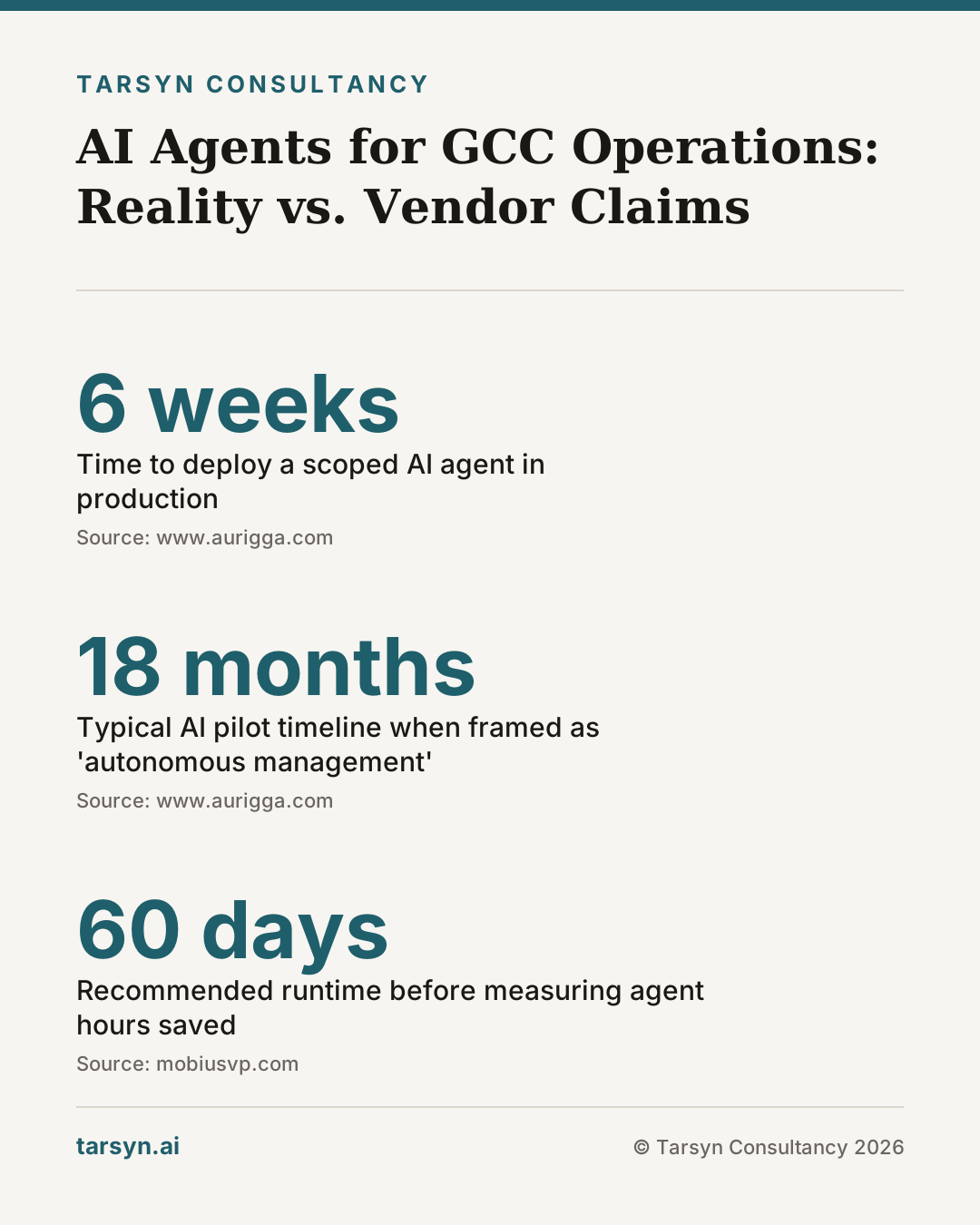
The moment you frame an AI agent as "monitor, evaluate, draft" rather than "autonomously manage," the implementation timeline collapses from eighteen months to six weeks. And the failure rate collapses with it.
Real Use Cases That Work in GCC Logistics and Finance
The following are production-ready agent patterns, not aspirations. Each maps to a specific GCC operational pain point.
Jebel Ali shipment delay monitor. The agent polls customs status via a logistics provider API or portal scrape, matches each shipment against a delivery commitment table in your ERP or spreadsheet, and — when delay risk crosses a defined threshold — drafts a supplier message in English and Arabic and routes it to the relevant relationship owner for one-click send. No autonomous action. One human decision per event. Deployable in four to six weeks.
Invoice-matching exception agent. GCC finance teams spend the majority of their working time on data gathering rather than analysis [1]. An agent that pulls invoices from email, matches line items against purchase orders in the ERP, flags mismatches above a value threshold, and queues them for a finance reviewer cuts that gathering time without removing the human from the approval decision.
Ramadan freight cutoff alerter. The agent holds a rules calendar of regional freight cutoffs — Ramadan, Eid, national holidays across UAE, KSA, Qatar — and cross-references your open purchase orders and committed ship dates sixty, thirty, and seven days in advance. Output is a flagged list with a draft email to the relevant supplier. This is a repeating seasonal problem with a predictable structure, which makes it ideal agent territory.
Payment terms breach detector. The agent monitors accounts receivable aging against contractually agreed terms, identifies breaches by counterparty, and drafts a dunning communication calibrated to the payment culture of the specific market — different tone for a Saudi government entity versus a Dubai trading company. Draft goes to the finance manager; nothing sends without approval.
These are not futuristic. They are boring, specific, and effective — which is precisely what makes them deployable. For a broader view of which industries are actually running agents in production versus just talking about it, see our piece on which industries are actually automating and which just talk about it.
Why GCC Agents Fail: The Integration Debt Problem
The most common reason a GCC AI agent dies in pilot is not the AI. It's what the AI has to connect to.
A demo agent runs in isolation on structured sample data. A production agent for a Jebel Ali trading operation must read customs PDFs in Arabic, match shipment references that exist in three different formats across two systems, respect a five-person approval chain with different authorities by transaction value, and operate without touching data that cannot leave the UAE under local data-residency requirements.
Each of those constraints is solvable. None of them is free. And none of them appears in the vendor's six-slide deck.
The structural approach that works is what GCC 4.0 frameworks call an orchestrator-agent model [3]: a coordinating layer that manages task routing, human approval triggers, and system integration, while individual task agents handle specific operations within guardrails. This architecture also makes it possible to expand agent capabilities incrementally — starting with the Jebel Ali monitor, adding the invoice matcher three months later — without rebuilding from scratch.
Before buying or building any agent, the prerequisite work is data plumbing: clean, consistent, API-accessible sources. If your delivery commitments live in a spreadsheet that three people maintain with different column headers, the agent will produce garbage. As we argue in fix your spreadsheets before buying AI, the transformation readiness problem is almost always upstream of the AI decision.
What "Six Weeks to Production" Actually Requires
Six weeks is achievable for a scoped agent. It is not achievable without specific preconditions being met on day one:
- A single, clearly defined trigger condition. Not "monitor our supply chain" — "flag any shipment where customs dwell time exceeds 48 hours AND committed delivery is within 5 days."
- One primary data source already accessible via API or structured export. If the data source requires a new integration to be built first, add four weeks.
- A named human owner for every agent output. The agent drafts; a specific person reviews and sends. Without that named owner, outputs accumulate unreviewed and the agent becomes noise.
- A rollback protocol. If the agent starts flagging everything or nothing, what happens? Who resets the threshold? This question must be answered before go-live, not after.
For a structured approach to evaluating whether your operation is ready for this, our ERP AI readiness audit covers the infrastructure and data prerequisites specific to GCC ERP environments.
Tarsyn's View: Boring Agents Win
The most dangerous thing a GCC operator can do right now is buy an AI agent platform because the demo was impressive. The second most dangerous thing is avoid agents entirely because the demos felt unreliable.
The useful path is narrow and unglamorous: pick one operational pain point where the data is clean, the trigger condition is specific, and the output is a draft that a human approves. Build that. Run it for sixty days. Measure how many hours it saves the person who used to do that task manually. Then scope the next agent.
Multiply ambition by messy data and you get articulate chaos. Multiply a specific trigger condition by a reliable data source and you get a tool your team will actually use.
We are not selling you a platform or a transformation roadmap. We are telling you that the Jebel Ali shipment monitor is more valuable than the autonomous supply chain manager — because it exists in your production environment instead of a vendor's demo room.
If you want a grounded assessment of which agent patterns are viable in your specific operation before you commit budget, our operations audit starts with the data and approval-chain reality, not the vendor's slide deck. We charge the same whether the answer is "build this now" or "fix the spreadsheets first."
For operators already running an ERP and weighing AI additions, our analysis of how to add AI decision support to Odoo without breaking it and the build vs. buy decision framework for GCC AI agents give the next level of detail.
Frequently asked questions
What does an AI agent actually do in GCC business operations?+
A production AI agent monitors a specific data source, evaluates conditions against defined rules, and either alerts a human or drafts an action for review. In GCC logistics, that means watching customs queues at Jebel Ali, matching delays against your committed delivery dates, and preparing a supplier message. It does not autonomously close purchase orders or renegotiate contracts without human sign-off.
Why do most AI agent pilots in the GCC fail to reach production?+
The usual cause is integration debt. A demo agent runs on clean sample data in isolation. A production agent must connect to your ERP, read Arabic and English documents, respect multi-level approval chains, and operate inside your data-residency rules. Finance teams in the GCC often run on patchwork ERP and spreadsheet combinations that require significant pre-work before any agent can function reliably.
How long does it take to deploy a working AI agent for GCC logistics or finance?+
A tightly scoped agent — one data source, one trigger condition, one output action — can reach production in four to six weeks. Broader scope, multiple system integrations, or custom Arabic NLP typically extends that to three to four months. The six-week path requires a clean problem definition before any code is written, and a clear human-review step that keeps the agent out of autonomous territory.
Should I buy an off-the-shelf AI agent platform or build a custom one?+
For standard finance workflows like invoice matching or payment reminders, off-the-shelf agents configured to your ERP are usually faster and cheaper. For GCC-specific logistics problems — Ramadan freight cutoffs, multi-currency Jebel Ali clearances, WhatsApp-based supplier communication — custom agents built on open or closed LLMs typically outperform generic platforms. The decision framework comes down to data specificity and workflow idiosyncrasy.
Sources
- 1. AI Agents in GCC Finance: A CFO&#039;s ROI Guide | Aurigga Technology — www.aurigga.com
- 2. How Agentic AI Is Changing the Economics of GCCs - Online Customer Feedback Tools — mobiusvp.com
- 3. GCC 4.0: AI Agent-Powered Global Capability Center | AI for Business — ariefwara.github.io
Mohammed Z
Founder, Tarsyn
Mohammed builds the systems behind modern businesses — automation, AI decision layers, and the unglamorous plumbing that makes them work. He founded Tarsyn in Abu Dhabi.
Find out where your operation actually stands.
The AI Opportunity Audit maps your workflows, your data, and your decision bottlenecks — and tells you honestly whether AI is worth it yet.
Start the audit