9 August 2026 · 6 min read
Which Industries Are Actually Automating in the GCC
Logistics, manufacturing, and government contractors in Saudi Arabia and the UAE are quietly buying automation. Here's why the loud voices aren't the buyers — and what that means for your ops.
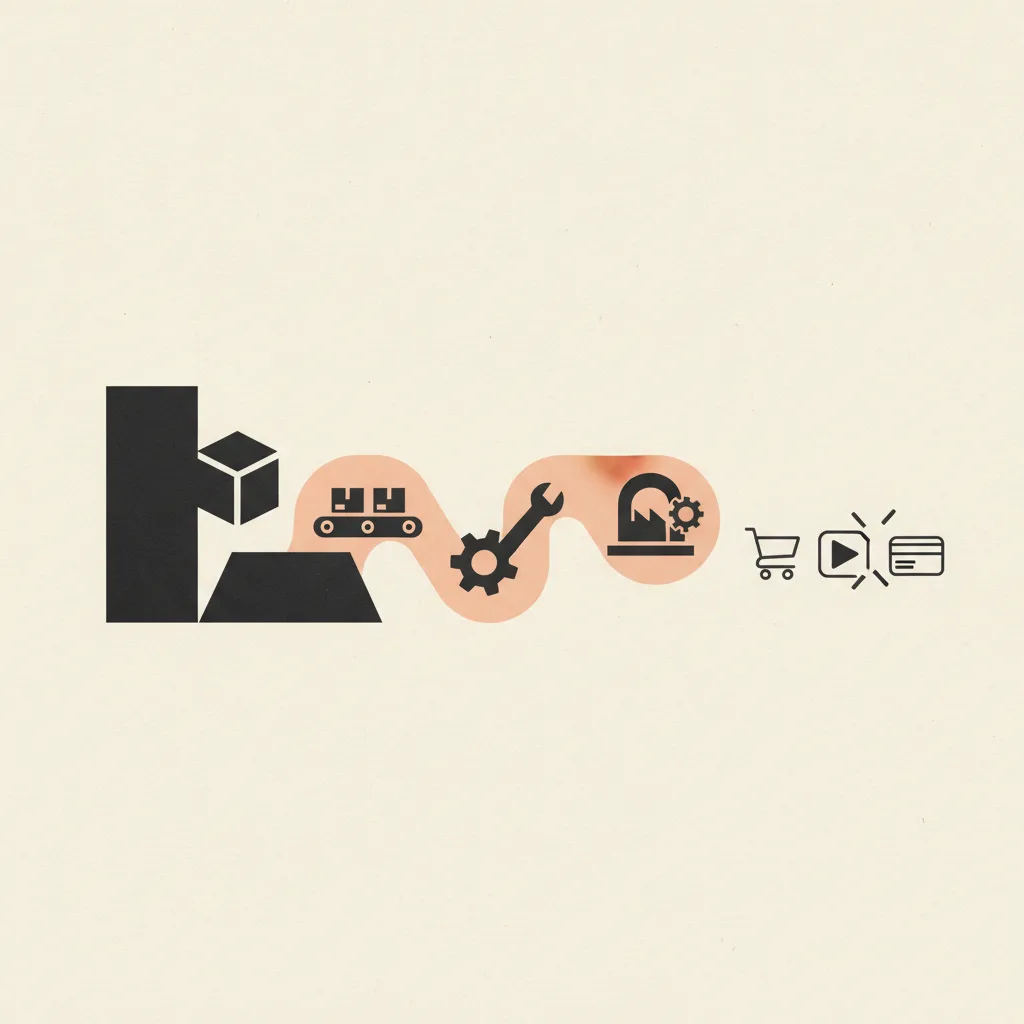
Key takeaways
- Logistics, manufacturing, and government-linked contractors in KSA and UAE are the dominant buyers of process automation — not the startups headlining Gulf tech panels.
- Margin pressure, compliance audit trails, and ERP integration mandates drive spending decisions faster than any innovation agenda.
- Operators who automate their ugliest back-office processes first — purchase approvals, inventory reconciliation, compliance reporting — build the data foundation that makes AI useful later.
- Fragmented production visibility and disconnected inventory systems are the two most common entry points for manufacturing automation in the GCC, according to observed industry deployments.
At every Gulf tech conference this year, the same pattern repeated: a retail brand, a fintech startup, or a media company took the stage to announce an AI strategy. Meanwhile, a logistics operator in Jebel Ali quietly signed off on a purchase-order automation module. The logistics operator will see results in ninety days. The panel speaker is still workshopping the roadmap.
The gap between automation talk and automation spend is one of the clearest signals in GCC enterprise technology right now. Understanding it tells you more about how operational transformation actually happens than any keynote will.
The Gap Between Automation Talk and Automation Spend
Conference energy is not a reliable proxy for deployment activity. The sectors that dominate Gulf tech event agendas — consumer retail, media, fintech startups — tend to operate in environments where the pain of manual processes is real but diffuse. A broken approval chain slows things down; it rarely produces a line-item loss that lands on the CFO's desk by Friday.
The sectors that don't get much stage time are different. A manufacturer running batch costing across disconnected systems can calculate exactly what a one-day production delay costs. A logistics company managing Jebel Ali clearances on spreadsheets can count the demurrage charges. A government-linked contractor working under Vision 2030 procurement frameworks faces mandatory audit trail requirements that manual workflows simply cannot satisfy.
When the cost of not automating is a number — not a feeling — budget moves.
The Industries Quietly Buying Right Now
Across KSA and UAE, three sectors are consistently initiating and completing process automation engagements rather than just discussing them.
Logistics and freight. The Jebel Ali corridor and Saudi land freight networks operate on thin margins with high coordination complexity. WhatsApp remains the de facto communication layer for dozens of handoffs per shipment — driver confirmation, customs clearance updates, warehouse receiving, invoice approval. Each of those handoffs is a candidate for structured automation. Operators who have connected these into ERP-integrated workflows report faster invoice cycles and fewer write-offs from undocumented adjustments.
Manufacturing. Factories across KSA and UAE face a specific cluster of operational gaps [2]: production reporting delayed across shifts and spreadsheets, raw materials and finished goods tracked without synchronized inventory visibility, and costing workflows that span disconnected procurement and finance systems. These are not glamorous problems. They are also precisely the kind of structured, repetitive, high-stakes processes that respond immediately to workflow automation. ERP modernization in manufacturing typically starts with connecting production planning, inventory control, and costing approvals into a single controlled environment [2].
Government-linked contractors. Entities operating under Saudi Vision 2030 delivery mandates or UAE federal procurement frameworks carry compliance requirements that elevate audit trails from a nice-to-have to a contractual necessity. Structured approval chains, role-based access, and documented workflow histories are not optional [1]. The path from a WhatsApp-and-spreadsheet operating model to that standard is rarely elegant, but it is being walked by a significant number of mid-market contractors right now.
Why the "Boring" Sectors Move Faster
The honest answer is that they have less room to philosophize.
A logistics operator cannot run a design sprint on freight clearance. A manufacturer cannot ship a minimum viable product for batch costing. The operational environment is live, the consequences of failure are immediate, and the ROI of fixing a broken process is measurable before the project closes.
Compare that to the retail brand considering AI-powered personalization. The upside is real but probabilistic. The current state — fragmented customer data, manual campaign approvals, no single view of inventory — needs to be fixed first anyway. But because no single failure mode produces a catastrophic P&L line, the urgency is lower and the project keeps getting pushed to the next quarter.
This is not a criticism of ambitious sectors. It is an observation about how operational necessity shapes technology adoption. Multiply ambition by a weak operational foundation and you get articulate chaos. The boring sectors avoid that trap because they cannot afford it.
What These Deployments Actually Look Like in Practice
Real automation deployments in GCC logistics and manufacturing share a few structural features that distinguish them from the slide-deck variety.
They start with one broken handoff. Not "digital transformation" — one specific process where manual intervention creates delay, error, or missing documentation. A purchase approval that routes through four WhatsApp groups. A shift report that gets re-keyed from a paper form into a spreadsheet into an ERP. That single handoff gets structured, tested, and connected.
They are built around the ERP, not around it. Operators in these sectors use ERP systems as the operational source of truth. Automation that bypasses the ERP — routing data through a separate SaaS tool that never writes back — creates a second, uncontrolled data layer. The deployments that last integrate directly: connecting operational workflows, dashboards, approvals, and reporting into one scalable ecosystem [1].
They produce an audit trail as a byproduct. Structured workflows generate documented approval histories, timestamp records, and role-based access logs. For a government-linked contractor, this is a compliance output. For a manufacturer, it is a costing input. For a logistics operator, it is the evidence trail that resolves invoice disputes. The audit trail is not an add-on; it falls out of a correctly designed workflow [1].
They do not start with AI. The deployments seeing real results in these sectors begin with structured data capture and workflow control. Once purchase orders, inventory movements, and production reports are flowing through a connected system consistently, there is a data layer worth reasoning over. Before that point, deploying AI produces confident-sounding answers derived from incomplete inputs — which is worse than no answer at all.
If you're evaluating where AI fits in your stack, the ERP AI Readiness Audit is worth reading before any vendor conversation.
Tarsyn's View: Automate the Ugly Process First
The clients we work with who see the clearest returns share one trait: they started with their worst process, not their most impressive one.
The worst process is almost always obvious. It is the one that everyone has a workaround for. The one where a specific person's absence for three days causes a backlog. The one that generates the most WhatsApp arguments. It is usually a purchase approval, an inventory reconciliation, or a compliance report — nothing that would make a conference keynote.
That process, once structured and connected to the ERP, does something more valuable than saving time. It creates a reliable data record. Approval dates. Quantities confirmed. Vendor responses. Invoice timestamps. That record is the foundation on which everything useful — analytics, AI-assisted decision support, predictive reordering — actually stands.
We have seen operators skip this step, deploy AI on top of their existing chaos, and arrive at what we'd call articulate chaos: automated reports that are consistently, confidently wrong because the inputs were never clean. The dashboard-versus-decision-layer problem is a version of this — reporting tools that describe a state without acting on it, because the underlying data was never structured enough to support action.
The sectors that are actually deploying — logistics, manufacturing, government contractors — are not doing so because they are more technologically sophisticated than the fintech panel at a Gulf AI summit. They are doing it because they cannot afford to wait for the perfect strategy. Their operational pain is immediate, their compliance requirements are non-negotiable, and their margins leave no room for manual coordination at scale.
If you are in a sector that has been talking about automation for two years without a single completed process to show for it, the right question is not "which AI tool should we buy?" The right starting point is an honest look at which process is costing you the most right now — and whether your data is clean enough to automate it. Our Audit is designed to answer exactly that, and the honest outcome sometimes is: fix the spreadsheets first.
That is the same conclusion we reached in Most Companies Don't Need More AI. The companies quietly buying process automation in Riyadh and Abu Dhabi already know it. The conference circuit is still catching up.
Before hiring anyone to automate your operations, the nine questions for vetting a workflow automation consultant in Saudi Arabia will save you an expensive mistake.
Frequently asked questions
Which industries are spending the most on workflow automation in Saudi Arabia and the UAE?+
Logistics, manufacturing, and government-linked contractors are the leading buyers. Their drivers are concrete: thin margins, compliance audit requirements, and ERP integration mandates from principal clients or regulators. Retail and fintech talk loudly at conferences but deploy slowly, typically because their operational pain is less immediate and their data foundations are weaker.
Why do 'boring' sectors automate faster than tech-forward ones?+
Because their cost of not automating is visible and measurable. A logistics operator running Jebel Ali clearances on seventeen spreadsheets can count the demurrage charges. A media startup experiencing workflow chaos faces a fuzzier P&L hit. When the pain has a number attached, budgets move. Automation spend follows operational urgency, not innovation ambition.
What does a real workflow automation deployment look like in GCC manufacturing?+
Typically it starts with one broken handoff: production reporting delayed across shifts, or raw materials and finished goods tracked in disconnected systems. The first deployment connects those two data points into a single operational view. That alone reduces manual coordination, cuts approval lag, and creates the audit trail needed for costing and compliance — before any AI layer is considered.
Should a company automate before investing in AI?+
Almost always, yes. AI applied to fragmented, manually-maintained data produces confident-sounding wrong answers. The operators in logistics and manufacturing who are seeing real returns automated their back-office processes first — purchase approvals, inventory reconciliation, compliance reporting — and built a clean data layer. That foundation is what makes an AI layer worth anything later.
Sources
- 1. ERP and Business Systems | Nexain Arabia ERP, AI, Cybersecurity, GRC, UAE & KSA — www.nexainarabia.com
- 2. Manufacturing ERP & AI Automation GCC | Nexain Arabia ERP, AI, Cybersecurity, GRC, UAE & KSA — www.nexainarabia.com
Mohammed Z
Founder, Tarsyn
Mohammed builds the systems behind modern businesses — automation, AI decision layers, and the unglamorous plumbing that makes them work. He founded Tarsyn in Abu Dhabi.
Find out where your operation actually stands.
The AI Opportunity Audit maps your workflows, your data, and your decision bottlenecks — and tells you honestly whether AI is worth it yet.
Start the audit