17 August 2026 · 7 min read
Why AI ROI Takes Longer Than You Think
AI ROI outside tech takes 2–4 years, not months. Gulf operators buying ERP copilots without fixing data foundations are especially exposed. Here's how to sequence correctly.

Key takeaways
- 85% of organisations increased AI investment last year, yet only 6% saw payback in under 12 months, per a Deloitte survey of 1,854 executives across Europe and the Middle East.
- A typical AI use case takes 2–4 years to show ROI — three to four times longer than most traditional tech investments — with data quality and siloed platforms as the leading culprits.
- Gulf operators running approvals over WhatsApp or relying on seventeen manual spreadsheets compound the timeline problem: AI layered on broken workflows produces articulate chaos, not savings.
- Measuring intermediate signals — process cycle time, error rates, manual handoff counts — gives operators real evidence of progress before any revenue line moves.
A logistics manager in Jebel Ali buys an AI copilot for her ERP in Q1. By Q4, she cannot explain to her CFO why procurement cycle times have not moved. The vendor's demo was convincing. The implementation was textbook. The data was — and this is the part nobody mentioned — a disaster.
This is not a rare story. It is the modal outcome.
The ROI gap is real — and wider in operations-heavy industries
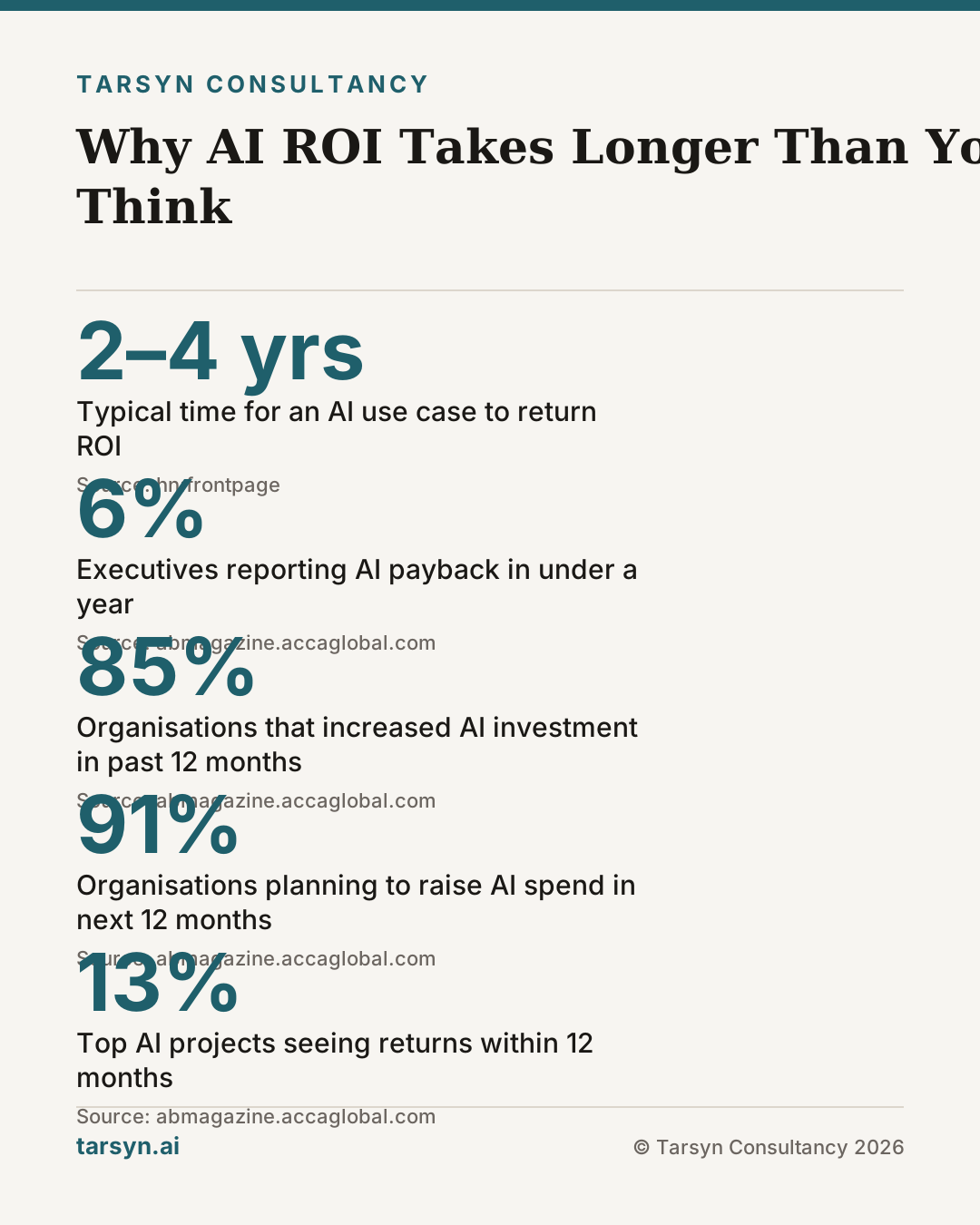
A Deloitte survey of 1,854 senior executives across fourteen countries in Europe and the Middle East found that a typical AI use case takes two to four years to realise a return on investment — not the seven to twelve months that most traditional technology investments yield. Only 6% of respondents reported payback in under a year. Even among the most successful AI projects, just 13% saw returns within twelve months. [3]
Outside the technology sector, the runway is longer still. [1] Technology firms can wire AI directly into the products their customers already pay for, creating a short feedback loop between investment and revenue. A manufacturer in Jubail, a trading house in Dubai, a facilities operator in Riyadh — none of them have that luxury. Their AI investment has to surface value through operational processes that were built over decades, often without a data layer that AI can actually read.
The headline from the Deloitte data is sobering: 85% of organisations increased AI investment in the past twelve months, and 91% plan to do so again in the next twelve. [3] Investment appetite is not the problem. Sequencing and measurement are.
Why ERP and workflow AI disappoint: four root causes
The same Deloitte survey identifies the culprits clearly. [3] In our work across the GCC, we see the same four patterns, often compounded by regional operating conditions:
-
Data quality and siloed platforms. Two warehouses, three purchase-order formats, and a supplier master that nobody has cleaned since the system went live in 2019. An AI copilot sitting on top of that data will produce confident-sounding answers built on contradictions. A dashboard built on the same data has exactly this problem — it reports fluently and decides nothing.
-
Buying tools before foundational architecture is ready. Organisations over-invest in AI tooling before the data and workflow foundations are stable. The tool is not the bottleneck; the environment is. This pattern is especially sharp in GCC businesses that have added ERP modules incrementally — sometimes layering a new system on top of a half-migrated legacy one. Wondering if your ERP is AI-ready? Check what the audit covers first.
-
Measurement metrics that lag reality. AI initiatives get embedded inside broader transformation programmes, making it almost impossible to isolate what the AI piece contributed. When the revenue line eventually moves — or doesn't — nobody can confidently attribute it. New tools also change expectations mid-project, so the original success criteria become obsolete before the project closes. [3]
-
Cultural resistance and low workflow adoption. The human factor is real. [3] In GCC operations, approval chains are often informal, relationship-driven, and routed through WhatsApp rather than the ERP itself. The WhatsApp-to-ERP gap is where GCC businesses leak money — and AI cannot bridge a gap it cannot see. If the new tool requires staff to change fifteen years of ingrained behaviour, adoption will be slow even when the technology works perfectly.
Multiply those four problems together and you get the modal outcome: an AI implementation that works in demos, disappoints in production, and generates a difficult conversation with the CFO eighteen months later.
What fast movers do differently: sequence over speed
The organisations that see early operational wins from AI — even if full financial ROI still takes years — share one discipline: they fix process foundations before layering intelligence on top.
In practice, this means:
- Audit before you buy. Map where data actually lives, who owns it, how clean it is, and whether the core workflows are documented at all. The five-step audit before any AI spend is not a delay tactic — it is the reason some implementations succeed while comparable ones stall.
- Start with the highest-data-quality process, not the highest-value one. The highest-value process in a trading operation might be demand forecasting. But if the demand data is inconsistent across three warehouse locations, the AI forecast will be wrong in ways that are hard to detect. Start with accounts payable matching, where the data is structured and the error rate is already measurable.
- Design the measurement framework before go-live. Agree on three to five operational metrics — cycle time, error rate, exception volume — and log baselines before the system switches on. This is the only way to have a defensible answer when the CFO asks what changed.
- Treat change management as a technical requirement, not a soft add-on. If the new workflow requires bypassing the WhatsApp approval chain, budget for the transition explicitly. Which industries are actually automating versus just talking about it often comes down to this: the ones succeeding treated adoption as an engineering problem, not a communications problem.
How to measure AI value before the revenue line moves
The honest answer to "what is our AI return?" in year one is almost never a revenue number. It is an operational signal. The organisations that survive the multi-year ROI runway are the ones that track leading indicators — not lagging ones.
Useful intermediate metrics, specific to operations-heavy GCC businesses:
| Metric | What it tells you | Typical baseline source | |---|---|---| | Purchase-order-to-goods-receipt cycle time | Whether AI is reducing procurement friction | ERP transaction logs | | Invoice exception rate | Whether data quality improvements are taking hold | Finance system reports | | Manual handoff count per process | Whether automation is replacing human relay steps | Process observation or workflow logs | | Approval turnaround time | Whether the informal approval chain is moving into the system | ERP/workflow tool timestamps |
None of these are revenue. All of them are evidence. When cycle time drops by two days and the exception rate falls by 30%, you have a directional signal that the investment is working — even if gross margin has not moved yet.
This is not a workaround. It is what good programme management looks like. Dashboards that report these signals without building decision logic on top of them are still just dashboards. The next step is making those signals actionable — routing exceptions automatically, triggering reorder points, flagging approval bottlenecks before they become delays.
The AI agent question: copilot or autonomous agent?
Many Gulf operators are now being sold AI agents — tools that don't just suggest actions but take them. The distinction matters for ROI timelines. What AI agents actually do versus what vendors claim is a significant gap. An agent operating on clean, well-structured data in a contained workflow can compress the ROI timeline materially. The same agent operating on fragmented data across siloed systems will create new failure modes that are harder to detect than the old ones.
Dynamics 365 Copilot's real-world limits are a useful reference point: the tool is capable, but its outputs are only as reliable as the data and process structure underneath it. The demo environment has clean data. Your production environment probably does not — yet.
Tarsyn's view: stop defending the timeline, start owning it
The 3–5 year ROI runway for AI outside tech is not a vendor problem or a technology limitation. [1] [3] It is a sequencing problem, and sequencing is something operators can control.
The honest version of this, which we tell clients directly: if your data is in poor shape and your core workflows run through informal channels, the right answer is not to wait for AI to mature. It is to spend the next six months fixing the foundations so that when you do deploy, the AI has something solid to work on. We charge the same for that conversation either way.
What we see failing consistently across the region is the opposite approach: buying the most visible AI tool (often an ERP copilot or a generative AI assistant), discovering that it cannot operate reliably on existing data, and then either abandoning the project or running a parallel process that defeats the efficiency case entirely.
Most companies don't need more AI — they need fewer spreadsheets. Seventeen manual reconciliation steps do not become seventeen automated steps just because you add an AI layer. They become seventeen AI-assisted steps that still require a human to catch the errors the AI generates with more confidence than the spreadsheet ever did.
The sequence that works: audit the process and data landscape first (start here), fix the top three data and workflow problems, deploy AI in a contained scope with clear baseline metrics, measure operational signals for ninety days, then expand. That path takes longer to begin. It takes far less time to deliver a defensible return.
The 2–4 year ROI window is not fixed. [3] It is the average outcome when sequencing is wrong. When sequencing is right, the intermediate signals arrive in weeks. The financial return still takes time — but you are not flying blind for two years waiting for a revenue line that may never move the way the vendor projected.
Own the timeline. Don't defend it.
Frequently asked questions
How long does AI ROI actually take for non-tech businesses?+
According to a Deloitte survey of 1,854 senior executives across Europe and the Middle East, a typical AI use case takes two to four years to realise a return on investment. Only 6% of respondents saw payback in under a year, and even among the most successful projects, just 13% achieved returns within 12 months. Traditional tech investments typically yield returns in seven to twelve months.
Why do ERP AI add-ons and copilots so often disappoint?+
Four root causes dominate: poor data quality, siloed platforms, cultural resistance to new workflows, and organisations buying AI tools before foundational architecture is ready. When master data is inconsistent across sites or approvals still flow through WhatsApp rather than the ERP itself, an AI layer has nothing solid to act on. The tool works; the environment it operates in does not.
What should Gulf businesses do before buying AI tools?+
Run an honest readiness check before any vendor conversation. Map where data actually lives, count the manual handoffs in your top five workflows, and identify which processes already have clean, consistent records. Fix those foundations first. An AI copilot on a clean workflow delivers measurable value quickly; the same tool on a broken workflow accelerates the mess. Our /Audit engagement starts exactly here.
How do you measure AI value before revenue improves?+
Track intermediate operational signals: process cycle time (how long from purchase order to goods received?), error and rework rates, manual handoff counts, and exception volumes. These move within weeks of a properly sequenced deployment, giving you leading indicators well before any revenue or cost line shifts on a financial report. Set baselines before go-live, not after.
Sources
- 1. AI: The ROI Runway Could Be Long Outside the Tech Sector — hn:frontpage
- 2. AI investment returns elusive — abmagazine.accaglobal.com
Mohammed Z
Founder, Tarsyn
Mohammed builds the systems behind modern businesses — automation, AI decision layers, and the unglamorous plumbing that makes them work. He founded Tarsyn in Abu Dhabi.
Find out where your operation actually stands.
The AI Opportunity Audit maps your workflows, your data, and your decision bottlenecks — and tells you honestly whether AI is worth it yet.
Start the audit