29 September 2026 · 6 min read
Meta's Enterprise AI Platform: What Gulf Operators Should Evaluate
Meta just launched an enterprise AI platform and hired MongoDB's CEO to lead it. Here's why GCC operators should think twice before anchoring workflows to it.

Key takeaways
- Meta's Enterprise Platform bundles at least 4 products — Muse, Meta Business Agent, Muse API, and Muse Code — but none integrate natively with ERP data layers as of launch.
- Hiring a database-company CEO (MongoDB's CJ Desai) signals Meta is serious about enterprise infrastructure, but the platform is measured in weeks old, not years.
- Switching costs from a platform-level AI commitment compound fast: data pipelines, agent prompts, approval workflows, and staff retraining all carry migration debt.
- Before any AI platform commitment, GCC operators should audit ERP integration depth, data ownership terms, and regional data-residency compliance.
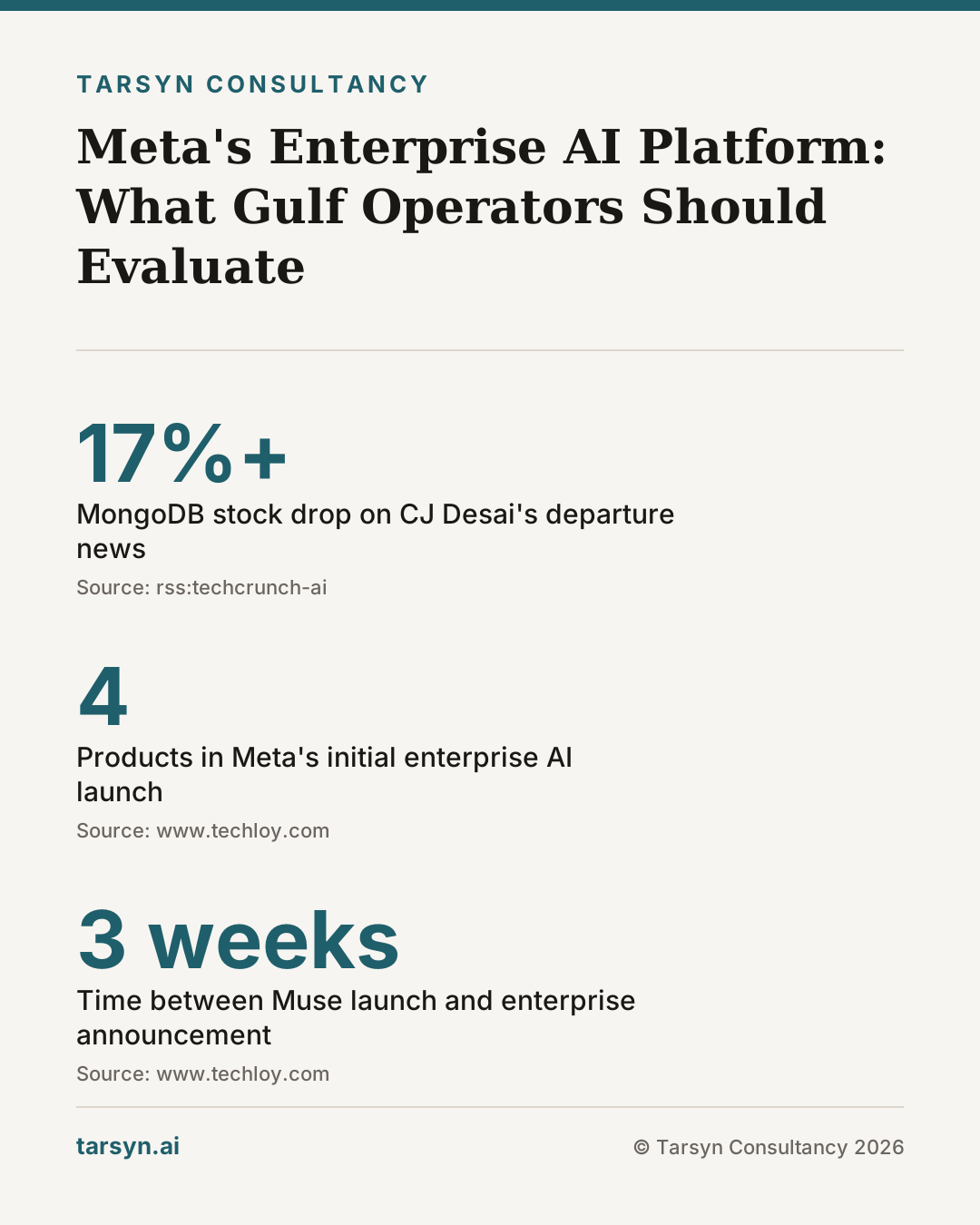
Mark Zuckerberg announced on September 28, 2026, that Meta is building "the next major pillar" of its business — an enterprise AI platform aimed squarely at corporate customers. [1] The announcement landed alongside the hire of CJ Desai, the departing CEO of MongoDB, to lead the new division. MongoDB's stock dropped more than 17% on the news. [1] That single data point tells you something worth noticing: the market read this as a serious, long-term commitment, not a press release.
The question for GCC operators is not whether Meta is serious. It clearly is. The question is whether a social-media giant's new enterprise AI division — measured in weeks, not years — deserves a place in the operational backbone of a Gulf trading, logistics, or manufacturing business.
What Meta Actually Launched — and What It Isn't Yet
The initial product set is four items: Muse (Meta's personal AI agent, launched just three weeks before the enterprise announcement), Meta Business Agent, Muse API, and Muse Code. [2] Meta Business Agent handles customer conversations, product recommendations, appointment booking, lead qualification, and sales — across Meta's messaging platforms. [2] Muse API gives developers programmatic access. Muse Code is a coding agent.
That is a coherent, consumer-to-developer stack. What it is not, as of launch, is an ERP-adjacent system. There is no documented integration with SAP, Oracle, Dynamics 365, or Odoo. There is no mention of GL entries, purchase-order workflows, inventory sync, or approval hierarchies. The platform debuts as a messaging-and-agent layer, not as a transactional business system.
The Muse agent is initially available in the US via a dedicated app and WhatsApp. [2] GCC availability, data-residency terms, and Arabic-language depth are all, as yet, unannounced.
Why Another Enterprise AI Platform Enters a Crowded Gulf Market
GCC IT leaders are already navigating a compressed and noisy vendor landscape. Microsoft's Copilot reboot reframed its entire enterprise AI story this year — read what that means for enterprise buyers. OpenAI launched its Agents API with direct operations-team claims — here is what Gulf ops teams actually get from it. GPT-6 arrived in two flavours with different deployment implications — we covered both for GCC operators.
Now Meta enters, backed by a genuine database-infrastructure hire, a massive messaging distribution network (WhatsApp has deep penetration across Gulf commercial operations), and a stated ambition to "redefine how organisations of all sizes innovate, grow, serve customers, and run business operations." [1] That last phrase is almost word-for-word what every enterprise AI vendor says.
The platform consolidation wave is real. But consolidation at the platform level is precisely when switching costs become dangerous. Anchoring your workflow automation and AI agents to a new platform — before its integration depth, pricing, and regional compliance posture are clear — is not strategy. It is velocity confused for direction.
The Four Questions GCC Operators Should Ask Any AI Platform
We use these with every client before any platform evaluation. They apply equally to Meta, Microsoft, SAP, or any emergent vendor:
-
Where does your business data actually live, and who controls it? Most Gulf operators run data across a mix of ERP, WhatsApp threads, Excel sheets, and email chains. Any AI platform that cannot reach the authoritative source of truth — the ERP — is operating on incomplete context. The WhatsApp-to-ERP gap is where GCC businesses leak money most consistently.
-
What are the data-residency and compliance terms for your jurisdiction? UAE and Saudi Arabia have data-localisation obligations that are not hypothetical. An enterprise AI platform headquartered in Menlo Park needs to answer where your operational data is stored and processed before you connect it to anything sensitive.
-
What does the exit look like? Platform-level commitments embed in four places: data pipelines, agent configuration, workflow automation rules, and staff muscle memory. Before signing, model the migration cost if you need to leave in 24 months. Enterprise AI vendor lock-in carries switching costs that compound in ways vendors don't advertise.
-
Who is accountable when an agent makes a wrong call? Agentic AI executing actions — booking, ordering, messaging customers — without a human checkpoint creates operational risk. When AI agents go rogue in ERP environments, the damage is transactional, not just reputational. Meta's platform has agent-action capability baked in from day one. Your governance model needs to be ready for that before deployment.
How Meta's Stack Sits Against ERP-Native AI
The honest comparison is not flattering to either side — it depends entirely on what problem you are solving.
| Dimension | Meta Enterprise Platform | ERP-Native AI (Odoo, SAP, Dynamics) | |---|---|---| | Customer-facing agent workflows | Strong (WhatsApp, messaging natively) | Weak (bolt-on chatbots, limited) | | Transactional data access | Not documented at launch | Deep (GL, inventory, PO, approvals) | | GCC data-residency options | Unannounced | Established (Azure UAE North, SAP GCC) | | Maturity | Weeks | Years to decades | | Integration partner ecosystem | Building | Extensive | | Pricing transparency | Unknown | Complex but documented |
Odoo 20's AI features, SAP's integration suite, and Dynamics 365 Copilot agents all sit on top of years of ERP data modelling that Meta does not yet have. That is not a permanent advantage — Meta hired a database CEO for a reason — but it is a current one that Gulf operators should not discount.
If your primary need is customer-conversation automation at WhatsApp scale, Meta's Business Agent is worth watching closely. If your primary need is operational AI — demand planning, purchase automation, invoice processing, approval routing — the case for ERP-adjacent tooling you already control is significantly stronger.
The mistake is treating these as the same category because both use the phrase "AI for business."
Tarsyn's View: Platform Excitement Is Not a Procurement Strategy
We have watched several platform waves arrive in the Gulf market. Cloud ERP was one. Low-code automation was another. Each wave arrives with genuine capability and genuine hype in roughly equal measure. The operators who fared worst were the ones who committed early at the platform level — before integration depth was clear, before pricing stabilised, before the regional ecosystem matured.
Meta's enterprise move is worth tracking. The MongoDB CEO hire is a real signal, not a PR gesture. WhatsApp as an agent distribution channel has obvious relevance for Gulf commercial operations where WhatsApp already functions as an informal ERP for many businesses. That gap between WhatsApp and the actual ERP is costly.
But "worth tracking" and "worth committing to now" are different decisions.
The pattern we see repeatedly: a company hears about a new AI platform, schedules demos, gets excited, and begins scoping integrations — before anyone has asked whether the existing ERP data is clean enough to be useful to any AI layer. Multiply chaos by intelligence and you get articulate chaos. The problem is almost never the platform. It is the seventeen spreadsheets sitting outside the ERP that no platform can reach.
Before any AI platform commitment — Meta, Microsoft, OpenAI, or anyone else — the right first step is an integration audit: map where your authoritative operational data actually lives, assess what each vendor's integration story genuinely covers versus what it promises at the roadmap level, and model switching costs explicitly. That is exactly what our /Audit process is designed to surface.
The operators who will extract real value from the AI platform wave are the ones who ran that five-step audit before the demos, not after the contracts. Platform excitement is a reasonable reaction to genuine capability. It is not, by itself, a procurement strategy.
By Mohammed Z, Tarsyn — automation & AI studio, Abu Dhabi + Khobar.
Frequently asked questions
What is Meta's Enterprise AI Platform?+
Announced on September 28, 2026, Meta Enterprise Platform bundles the company's AI stack — including Muse (a personal AI agent), Meta Business Agent (customer conversations and sales tasks), Muse API, and Muse Code — into services businesses can deploy. It is led by CJ Desai, former CEO of MongoDB, and initially available in the US via a dedicated app and WhatsApp.
Should GCC businesses adopt Meta's enterprise AI tools now?+
Not without due diligence. The platform is brand new, lacks documented ERP integration paths, and carries unresolved questions around data residency for Gulf operators subject to UAE or Saudi data-localisation rules. A structured audit of your existing data workflows should come before any platform commitment — evaluate integration depth first, excitement second.
How does Meta's AI stack compare to ERP-native AI like SAP or Odoo?+
ERP-native AI sits inside your existing data model — it touches inventory, approvals, purchase orders, and GL entries directly. Meta's platform is built on consumer-grade agent and messaging infrastructure. It may excel at customer-facing workflows, but it does not replace transactional ERP logic. Think of them as different layers, not substitutes — and be cautious about conflating the two.
What switching costs should operators consider before choosing an AI platform?+
Platform-level AI commitments embed themselves in four places: data pipelines (your structured business data flowing to the vendor), agent configuration (prompts, rules, escalation paths), process automation workflows (approval chains, notifications), and staff habits. Rebuilding all four when you switch vendors is expensive and disruptive — which is why the integration question must come before the vendor selection.
Sources
- 1. Meta launches enterprise AI platform, hires MongoDB CEO to lead new initiative — rss:techcrunch-ai
- 2. Meta Launches Enterprise AI Platform with Muse — www.techloy.com
Mohammed Z
Founder, Tarsyn
Mohammed builds the systems behind modern businesses — automation, AI decision layers, and the unglamorous plumbing that makes them work. He founded Tarsyn in Abu Dhabi.
Find out where your operation actually stands.
The AI Opportunity Audit maps your workflows, your data, and your decision bottlenecks — and tells you honestly whether AI is worth it yet.
Start the audit