28 September 2026 · 7 min read
Microsoft Drops Personal Copilot. Enterprise Should Notice.
Microsoft killed the consumer AI chatbot and rebuilt Copilot for enterprise workflows. For GCC operators on Dynamics, SAP, or Odoo, the real question just shifted — sharply.

Key takeaways
- Microsoft merged its consumer and enterprise Copilot into a single product, with the new version's core features — agents, FinOps for AI, approval-workflow routing — designed exclusively for corporate buyers.
- Over 30 million paid Copilot subscriptions existed before the reboot, yet Microsoft still pivoted away from the consumer chatbot model — a signal that general-purpose AI assistants aren't delivering enough business value to defend.
- The new Copilot's FinOps layer lets admins set spending policies, route credit requests through existing approval workflows, and control which AI model families different user groups can access.
- Before any agent layer lands on a GCC ERP stack — Dynamics, SAP, or Odoo — operators must answer three process-readiness questions; buying the licence without answering them produces articulate chaos, not automation.
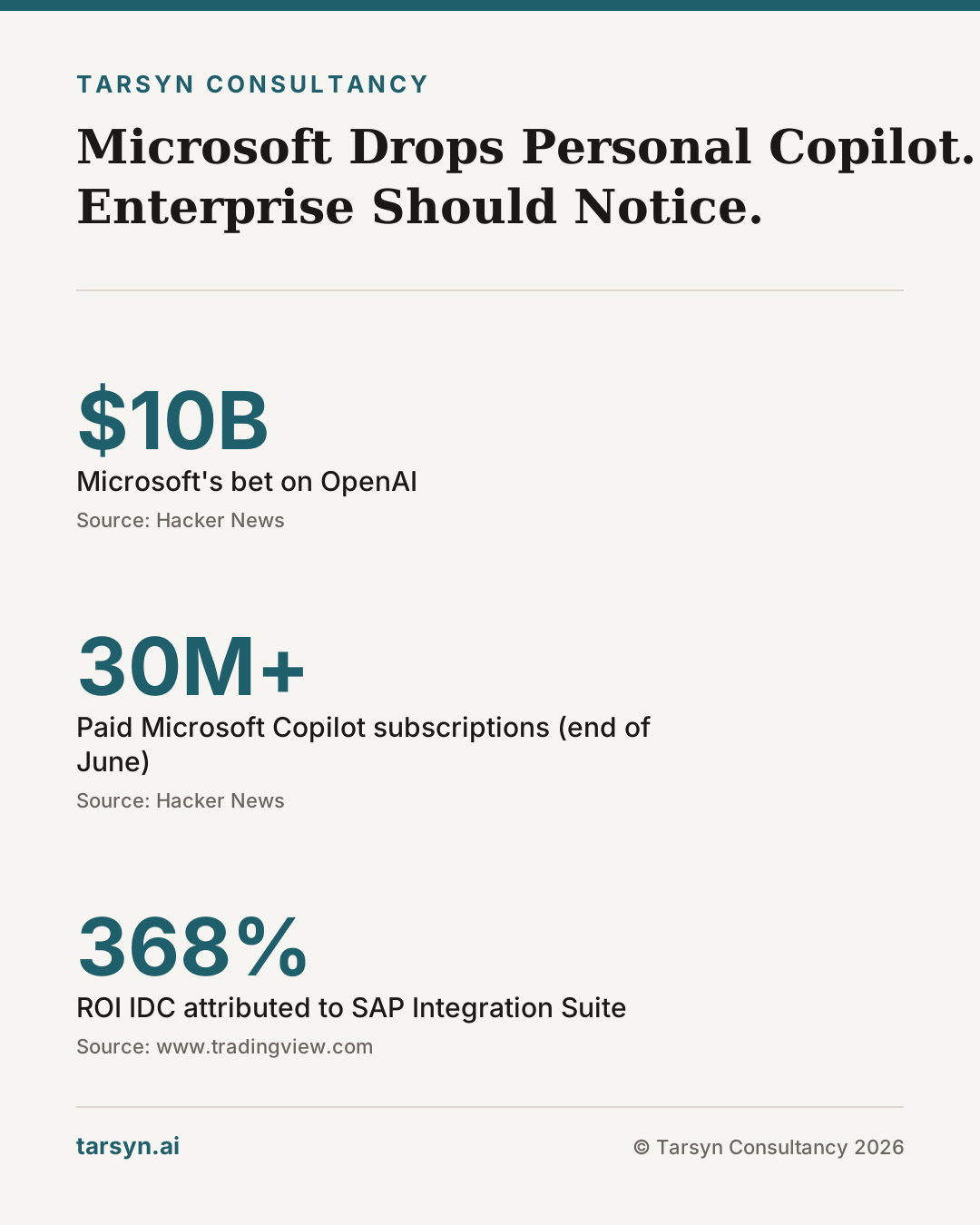
Six months of quiet engineering work inside Microsoft culminated last week in something the company framed as an upgrade. Read the signal more carefully and it looks like a confession: the general-purpose consumer AI chatbot was a dead end, and the company that bet $10 billion on OpenAI knows it better than anyone.
For operators running Gulf businesses on Dynamics 365, SAP, or Odoo, the reboot is not a product announcement to skim and file. It is a clarifying event that sharpens the only question that was ever worth asking: which business process do you automate first, and are your systems actually ready for an agent layer?
What Microsoft Actually Abandoned — and What It Kept
The new Copilot merges what were previously separate consumer and enterprise products into a single app [2]. The feature list that matters for enterprise buyers: a persistent agent called Autopilot (previously Scout), a Code environment built on GitHub Copilot technology, and — arguably the most telling addition — a FinOps for AI module [2].
That last one deserves attention. FinOps for AI lets admins set spending policies at scale via API, route AI credit requests through existing approval and automation workflows, and define which model families are available to which user groups [2]. Microsoft's chief marketing officer for AI at Work described it as "a shared discipline for managing AI spend and optimizing it for business value" [2].
A company that needed to build a spending-control layer into the core product is a company whose enterprise customers told it, loudly, that AI costs were escaping governance. That is an operational problem, not a technology problem.
What Microsoft kept: more than 30 million paid Copilot subscriptions were active as of the end of June [1], and individual users can still access a free tier. But the headline capabilities are reserved for Microsoft 365 corporate subscribers [1]. The consumer chatbot experiment didn't disappear — it got folded into the enterprise product and relegated to second-class status.
Why Consumer AI Chatbots Were Always the Wrong Bet for Enterprise
A chatbot that can discuss anything is, by definition, optimised for nothing. Gulf enterprise operations run on structured specificity: a three-way match between purchase order, goods receipt, and invoice; a Ramadan freight cutoff that moves every year; an approval chain for capital expenditure that lives in six WhatsApp threads and one shared Excel file. A general-purpose assistant engaging with that environment produces what we'd call articulate chaos — the same mess, expressed more fluently.
Meanwhile, Meta's personal AI agent app Muse was gaining traction in the consumer space at the exact moment Microsoft was pivoting away from it [2]. Qualcomm released device platforms for personal agents in the same week [2]. Microsoft looked at that competitive landscape and decided not to fight it. That is a strategically rational move, and the enterprise market should treat it as a signal rather than a setback.
The implication: if the world's largest enterprise software company concluded that role-specific, workflow-embedded agents beat open-ended chatbots for business use cases, that conclusion should inform every RFP and vendor conversation happening right now in Riyadh, Dubai, and Abu Dhabi.
We've made a version of this argument before — see AI Agents for GCC Operations: What They Actually Do vs. What Vendors Claim — but Microsoft's pivot makes it harder to dismiss as consultant opinion.
What the Copilot Reboot Means for Dynamics, SAP, and Odoo Buyers in the Gulf
The practical consequences differ by stack.
Dynamics 365 buyers are now on the clearest path. The enterprise Copilot is the agent layer; the roadmap investment is going here. Features like supplier communication drafting, demand forecasting nudges, and approval-routing automation will deepen over the next product cycle. The question is not whether Microsoft will build them — it's whether your Dynamics instance has the data hygiene and process definition to make them work. A Dynamics environment where item master records carry seventeen different naming conventions for the same SKU will produce seventeen different kinds of confident wrong answers from an agent. See our earlier piece on Dynamics 365 AI Agents: What They Do and Won't Do in 2025 for specifics on current capability gaps.
SAP buyers face a more complex picture. Microsoft's Copilot and SAP's Joule are competing agent layers for partially overlapping workloads. If you're on SAP S/4HANA and also running Microsoft 365, you have two vendors with agent ambitions and one set of business processes. The 368% ROI figure IDC attached to SAP Integration Suite is real under the right conditions — but "right conditions" means clean integration, not two agent layers issuing contradictory instructions to the same ERP.
Odoo buyers, particularly the mid-market operators common in the Gulf, have a different calculus. Odoo's tight integration between modules means an agent can act across procurement, inventory, and invoicing without crossing API boundaries. Odoo 20's AI features move in this direction. The risk is not capability — it's governance. An agent with write access to Odoo's procurement module needs guardrails that most mid-market implementations haven't designed yet.
One structural point applies across all three stacks: the FinOps for AI layer Microsoft introduced is a signal of where enterprise AI spend is going. Budget for AI model consumption separately from your ERP licence. These are different cost lines with different growth trajectories, and conflating them is how organisations end up with uncontrolled AI spend — the exact problem the new Copilot's admin controls were built to address [2].
The Three Questions Every Operator Should Answer Before Adopting Any AI Copilot
Before a licence is purchased, before a vendor demo is booked, three questions determine whether an agent deployment will generate value or generate a more sophisticated version of your existing problems.
1. Is your master data accurate enough for an agent to act on it?
Agents don't second-guess data — they act on it. An agent reading a supplier record that lists the same vendor under four entity names will generate four purchasing channels where you intended one. This isn't an AI problem; it's a data problem that AI amplifies. The WhatsApp-to-ERP gap that characterises many GCC operations means a significant share of business logic never reached the ERP at all — it lives in a group chat. An agent cannot automate what it cannot see.
2. Can you name the two or three processes generating the most manual friction?
"We want AI" is not a process requirement. If the answer to this question takes longer than ten minutes in a room with your operations manager and your finance lead, the organisation isn't ready to deploy an agent — it's ready for a process mapping exercise. We've written about what Gulf buyers actually mean when they say they want AI, and the answer is almost never "a chatbot" — see "We Want AI" — What Gulf Buyers Actually Mean.
3. Can your ERP expose the APIs an agent needs to do useful work?
An agent that can read your ERP but cannot write to it is an expensive reporting layer. An agent with write access but no approval workflow around that access is a liability. The ai copilot autofix risk article covers exactly this failure mode: AI autofix that becomes a security hole. Microsoft's new approval-routing capability in FinOps for AI suggests even they recognise that unconstrained write access is the wrong architecture [2].
Tarsyn's View: Your Processes Have to Be Ready Before the Agent Arrives
Microsoft's reboot is honest in a way that most vendor announcements are not. The company looked at the evidence, concluded that consumer AI chatbots are a feature war it doesn't need to win, and redirected to the problem enterprise actually pays to solve: getting specific work done faster, with fewer people touching it, with auditable outcomes.
That's the right framing. It's also not sufficient on its own.
The enterprise AI market is full of operators who bought the licence before they understood the workflow, or who deployed the agent before they cleaned the data, or who ran the demo on a well-structured test environment and then connected it to seventeen years of inconsistently formatted ERP records. The outcome is always the same: a delayed value realisation, a frustrated IT team, and an AI line item on the P&L that the CFO is starting to question.
Our position — unchanged since we first wrote Most Companies Don't Need More AI, They Need Fixed Spreadsheets — is that the right order of operations matters more than the right vendor choice. Fix the data. Map the process. Define the governance. Then choose the agent layer that fits the stack you already have.
Microsoft's enterprise Copilot is a credible option for organisations already on Dynamics and M365. SAP Joule is credible for deep S/4HANA shops. Odoo's native AI features are credible for integrated mid-market stacks. None of them will save a broken process; all of them can accelerate a working one.
If you're not certain which category your processes fall into, that question is worth answering before the next vendor demo. Our process and systems audit exists for exactly that sequence: understand what you have, decide what's worth automating, then choose the tool. The audit costs the same whether the answer is "you're ready" or "not yet." We charge the same either way, because the honest answer is the useful one.
The Microsoft news is useful context. The three questions above are the actual work.
Frequently asked questions
What exactly did Microsoft change in the Copilot reboot?+
Microsoft merged its consumer and enterprise Copilot apps into one product, adding an agents layer, a Code environment powered by GitHub Copilot, an Autopilot personal agent (formerly Scout), and a FinOps for AI module that helps organisations track and control AI spending. Individual users still have access, but the most powerful capabilities are reserved for corporate subscribers.
Does the Microsoft Copilot reboot affect Dynamics 365 users in the Gulf?+
Yes. If you're on Dynamics 365, the enterprise Copilot is the agent layer you'd be deploying. The reboot consolidates where Microsoft is investing, meaning Dynamics-embedded Copilot features — forecasting, approval routing, supplier messaging — will absorb the product roadmap. Whether those features work depends on how clean your data and processes are, not which licence tier you buy.
Why are general-purpose AI chatbots a poor fit for enterprise operations?+
Consumer chatbots are designed for broad, open-ended queries. Enterprise operations run on structured workflows — purchase orders, three-way matching, freight cutoffs, approval hierarchies. An agent that can't hook into those specific process steps adds a conversation layer on top of your existing complexity rather than removing it. Role-specific, workflow-embedded agents solve a defined problem; general chatbots don't.
What should a GCC operator do before buying any AI copilot licence?+
Three things: audit whether your master data is clean enough for an agent to act on (garbage in, confident garbage out); map which two or three processes generate the most manual delay or error; and confirm your ERP stack can expose the APIs an agent needs to do useful work. Skipping these steps means the licence spend precedes the value by eighteen months or more.
Sources
Mohammed Z
Founder, Tarsyn
Mohammed builds the systems behind modern businesses — automation, AI decision layers, and the unglamorous plumbing that makes them work. He founded Tarsyn in Abu Dhabi.
Find out where your operation actually stands.
The AI Opportunity Audit maps your workflows, your data, and your decision bottlenecks — and tells you honestly whether AI is worth it yet.
Start the audit