12 September 2026 · 6 min read
SAP Integration ROI: What the IDC Numbers Actually Mean
IDC's 368% ROI figure will appear in every vendor deck. The eight-month payback and four integration failure patterns are what Gulf ops buyers should read instead.

Key takeaways
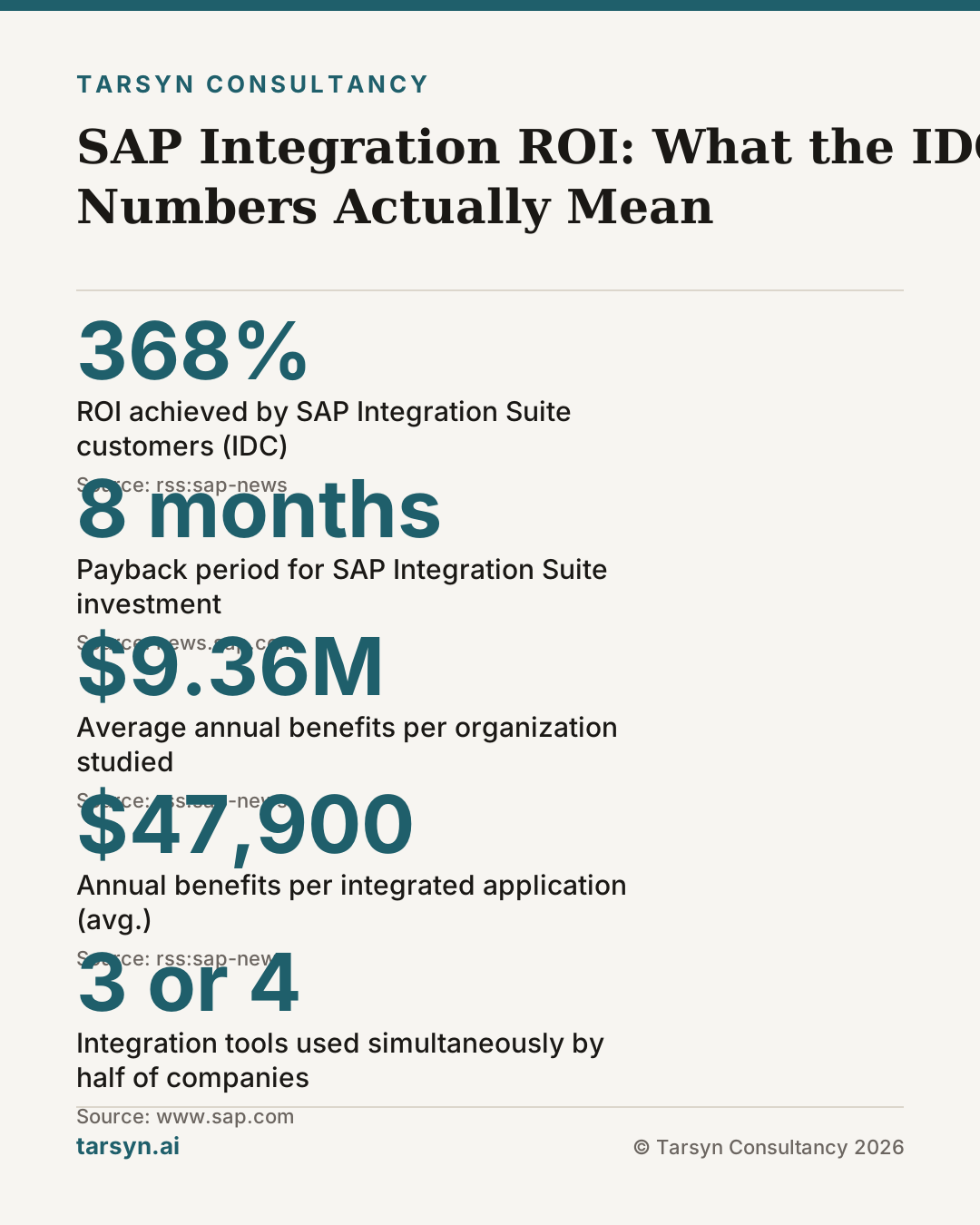
- IDC's study of eight enterprises found a 368% three-year ROI from SAP Integration Suite, but the more actionable number is the eight-month payback period that signals structural, not marginal, returns.
- The average benefit is $47,900 per integrated application annually — meaning fragmented stacks with dozens of point-to-point connections are leaking that figure per connection, per year.
- Half of companies run three or four integration tools simultaneously, a pattern IDC links directly to compatibility failures, brittle automation, and blocked AI adoption.
- For Gulf SAP shops on hybrid or ECC stacks, the IDC study is a diagnostic instrument — it reveals integration debt, not a ready-made procurement justification.
Every SAP sales conversation in the Gulf this quarter will open with the same slide: "368% ROI. Eight months to payback. IDC said so." And the number is real — IDC interviewed actual enterprises and quantified actual outcomes [1]. The question worth asking is what happens to that ROI when it lands on a stack that was never designed to capture it.
What IDC actually measured — and what the methodology assumes
The study is not a model. IDC conducted in-depth interviews with eight organizations across manufacturing, consumer products, energy, fintech, healthcare, retail, and transportation [1]. Average headcount: 48,529 employees. Average annual revenue: $14.53 billion. The geographies covered are the US, Germany, Denmark, India, and the UK [2].
That sample profile matters. These are large, well-resourced enterprises that had the budget and the IT capacity to deploy SAP Integration Suite properly. The $47,900 in annual benefits per integrated application — and the $9.36 million per organization — are averages across that cohort [1]. They are not a floor. A Gulf mid-market company running SAP ECC with a three-person IT department and a customs clearance workflow that still lives in WhatsApp is not the same starting point.
The study also covers SAP Integration Suite including its advanced event mesh capability, delivered on SAP Business AI Platform [2]. If your current architecture doesn't run that platform, you are not starting from where these eight enterprises started. You are starting earlier.
The eight-month payback is the real headline, not the 368%
ROI percentages compress over time. An eight-month payback period does not. It tells you something structurally important: the gains are not coming from a single optimised workflow. They are distributed across procurement, logistics, finance, reporting, and compliance simultaneously. Integration that pays back in eight months is touching every process it connects — which means every process it doesn't connect is a leak.
For Gulf enterprises running hybrid stacks — SAP on-premise alongside cloud ERPs, local WMS providers, customs portals, and approval chains managed through WhatsApp threads — the architecture gap between "integrated" and "connected" is wide. Connected means data can move. Integrated means the data moves correctly, with governance, at the right time, to the right system. The IDC cohort achieved integration. Many Gulf operations are still at connection.
Where the ROI leaks: four integration failure patterns that erase the gains
The IDC study documents what good integration delivers. IDC's separate Global State of Integration Survey (December 2024) documents what fragmented integration costs [4]. Read them together and four failure patterns emerge:
1. Tool sprawl without retirement. Half of companies use three or four integration tools simultaneously [4]. The reason is never bad planning — it is accumulated urgency. A new business initiative drives adoption of a modern tool, with every intention to retire the old one. Priorities shift. The legacy tool stays. The result is an architecture that requires niche skills for each layer, complicates every troubleshooting session, and makes centralised governance impossible [4].
2. Point-to-point connections that calcify. Legacy middleware built for batch processing and scheduled dataflows cannot support what agentic AI or even basic real-time reporting demands [2]. The connections work until the volume or frequency changes — then they become failure points. In a Gulf trading operation, this shows up as overnight batch syncs that miss intraday stock movements, or customs documentation that reaches the clearing agent twelve hours after the shipment.
3. Migration debt that never clears. IDC describes a consistent pattern: legacy integrations get postponed when new tools are introduced, then dropped altogether [4]. The old connections accumulate technical debt silently. Nobody maps them, nobody owns them, and they fail at the worst time — during a high-volume season, a system upgrade, or an audit. This is not a technology problem. IDC explicitly calls it "as much a change management problem as it is a business priority problem" [4].
4. Governance gaps that block AI. Autonomous agents need real-time access to data across the full application estate, with consistent governance [1]. An integration layer built on mismatched tools and undocumented point-to-point connections cannot provide that. The enterprises in the IDC study that achieved 368% ROI had already resolved this. Gulf enterprises that haven't will find that deploying AI on top of a fragmented stack produces something closer to articulate chaos than operational efficiency. As we wrote about the AI readiness audit, you cannot govern what you haven't mapped.
What this means for SAP shops in the Gulf running hybrid or legacy stacks
The SAP 2027 ECC deadline is compressing these decisions. Gulf enterprises that extend ECC beyond 2027 are not just deferring a migration — they are deferring the integration architecture that the IDC study assumes. Every year of deferral is a year of accumulating the exact tool sprawl and point-to-point debt that erodes the $47,900-per-application figure before it can be captured.
The specific Gulf context adds friction that the IDC methodology does not capture. Customs clearance workflows that depend on local portal APIs. Zakat and VAT compliance layers bolted onto ECC years after go-live. Warehouse management systems from regional vendors that were never designed to speak SAP natively. WhatsApp-to-ERP gaps where procurement approvals live in chat threads that no integration layer touches. That last gap alone is where significant money disappears in GCC operations.
None of these are unsolvable. But they are not captured in the IDC study's eight-enterprise average — and assuming that 368% lands automatically on a GCC hybrid stack is how organisations end up six months into an integration project with a live demo and a production environment that still doesn't talk to the WMS.
Tarsyn's view: use this study as a diagnostic, not a budget argument
The IDC number will be used to justify SAP Integration Suite licenses. That is not our concern. What we keep seeing in Gulf enterprise engagements is a subtler problem: companies treating systems integration ROI studies as procurement ammunition when they should be reading them as architectural pressure tests.
The honest diagnostic question is not "does integration generate 368% ROI?" — it clearly can. The question is: which of the four failure patterns above is currently active in your architecture, and how much of the potential return is already being eroded by it?
If you are running three or four integration tools, you are in the IDC sprawl pattern [4]. If your last integration project left legacy connections running in parallel, you have migration debt that will eventually fail. If your data governance is too fragmented to support a real-time reporting layer, your AI ambitions are ahead of your foundation.
Before the 368% headline makes it into your board deck, run the architecture through a structured integration debt audit. Map every connection. Identify which ones are governed and which are assumed. Find the WhatsApp threads that are doing data-entry work. Quantify the manual handoffs. That inventory is what determines whether your architecture is positioned to capture the return IDC documented — or whether you are paying for integration infrastructure and receiving the outputs of a fragmented one.
We charge the same whether the answer is "integrate now" or "fix the architecture first." But in our experience, Gulf SAP shops that skip the diagnostic and go straight to the integration platform procurement are the ones still troubleshooting in month eighteen. That pattern mirrors what we see across AI spending too — the return is real, but the timeline stretches when the foundation isn't ready.
The IDC study is valuable. Eight months payback on a clean integration architecture is a compelling operational argument. Just make sure you are reading the study as evidence of what good integration delivers — not as a guarantee that your current stack will deliver it automatically.
Frequently asked questions
What did IDC actually measure in the SAP Integration Suite study?+
IDC conducted in-depth interviews with eight enterprises across manufacturing, energy, fintech, healthcare, and retail — averaging 48,529 employees and $14.53 billion in annual revenue — operating across the US, Germany, Denmark, India, and the UK. The outcomes were quantified from actual reported results, not a modeled composite. The headline finding: 368% three-year ROI, eight-month payback, and $47,900 in annual benefits per integrated application.
Why does integration tool sprawl undermine ROI even after a platform upgrade?+
When new integration tools are adopted for a specific initiative, legacy tools rarely get retired. IDC observes that priorities shift and migration of old integrations gets postponed indefinitely. The result: businesses end up supporting multiple tools, each with its own quirks and niche skills. This sprawl creates brittleness, complicates troubleshooting, and blocks both AI adoption and process automation from delivering value.
What does the eight-month payback period mean for Gulf enterprises?+
Eight months is fast for enterprise infrastructure. It implies the gains aren't coming from one narrow workflow but from integration touching procurement, logistics, finance, and reporting simultaneously. For Gulf companies juggling SAP ECC, local WFMS, and WhatsApp-driven approval chains, the question isn't whether integration pays — it's how much integration debt is silently eroding the returns they should already be capturing.
How should a Gulf SAP shop use this IDC study practically?+
Use it as a pressure test, not a budget slide. Map your current integration architecture: count the point-to-point connections, identify which processes still require manual handoffs, and locate where data inconsistency forces rework. The study's $47,900-per-application figure gives you a per-connection benchmark. If your integration layer is fragmented, you now have an approximate cost of inaction per connection per year.
Sources
Mohammed Z
Founder, Tarsyn
Mohammed builds the systems behind modern businesses — automation, AI decision layers, and the unglamorous plumbing that makes them work. He founded Tarsyn in Abu Dhabi.
Find out where your operation actually stands.
The AI Opportunity Audit maps your workflows, your data, and your decision bottlenecks — and tells you honestly whether AI is worth it yet.
Start the audit