29 August 2026 · 7 min read
SAP 2027 Deadline: Extend ECC or Replace It?
Gulf SAP shops are deferring the 2027 ECC deadline assuming extended support buys unlimited time. It doesn't. Here's the five-year cost framework that changes the calculus.

Key takeaways
- SAP mainstream maintenance for ECC ends in 2027; extended support runs only to 2030 and costs an additional 22% of licence value annually.
- Migrating to S/4HANA typically costs 1.5–3× the original ECC implementation, with timelines of 12–36 months — not a contingency plan.
- For mid-market GCC operators under ~300 ERP users, Odoo or Dynamics 365 frequently wins on five-year TCO against both ECC extension and S/4HANA.
- The window for a considered platform decision — one that avoids crisis migration — closes roughly 18 months before your target go-live date.
A Gulf trading company's IT manager recently described their SAP ECC situation as "parked." The system works. The 2027 deadline is on the radar. The decision is not. That posture is about to get expensive.
SAP's end-of-mainstream-maintenance date for ECC is not a soft suggestion. It is a contractual boundary — and the extended support window that many Gulf operators are banking on is shorter, and costlier, than most boardrooms realise. [1] The clock is running, the options are narrowing, and a considered switch away from panic-mode migration requires starting now.
This piece gives you a concrete framework to score your three real options against GCC operational reality: not the vendor slide-deck version, the version that accounts for approval chains, Ramadan freight cutoffs, and the fact that half your procurement team runs on WhatsApp threads that never touch your ERP at all.
What the 2027 SAP deadline actually means for your ECC instance
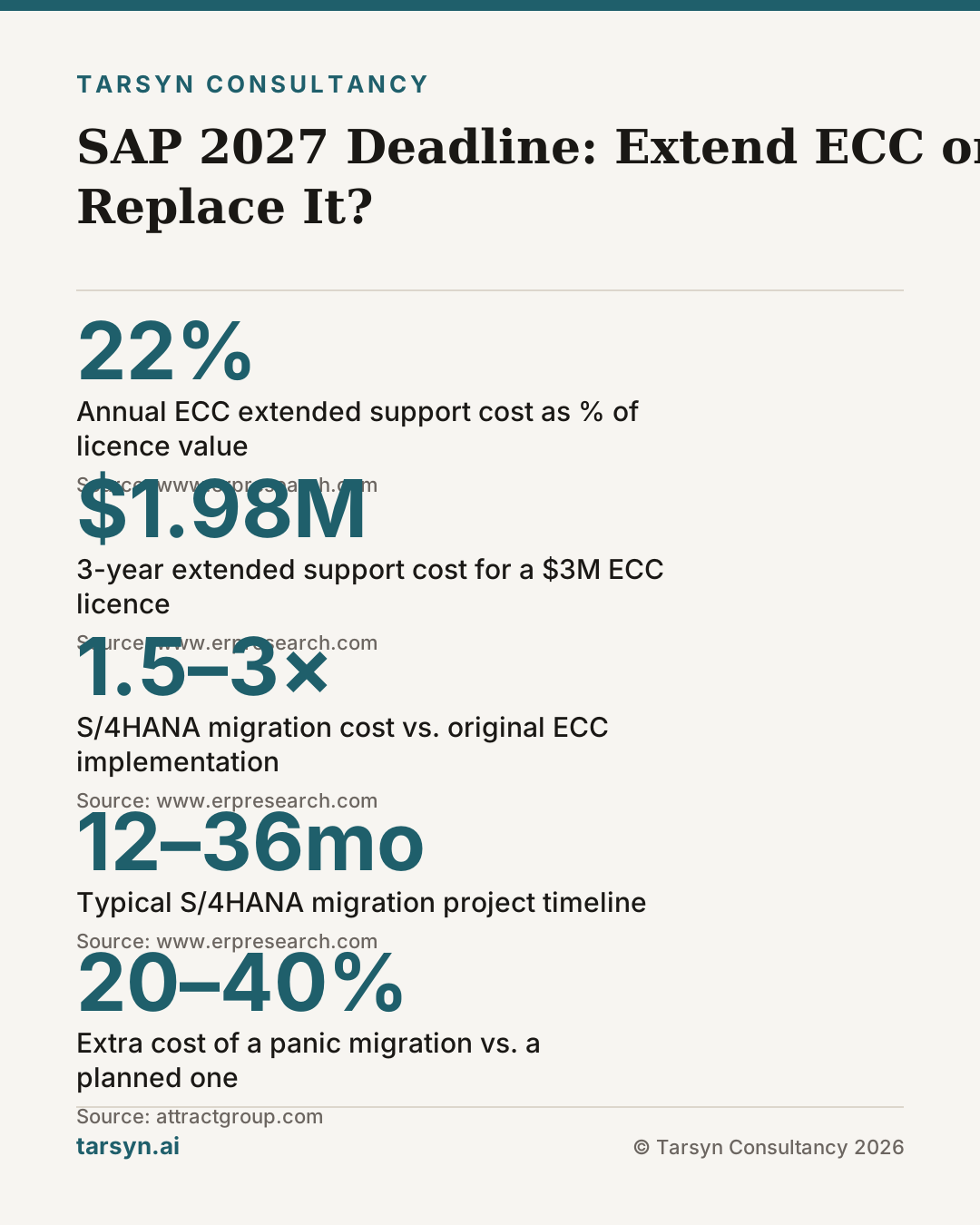
Let's be precise. SAP mainstream maintenance for ECC ends in 2027. That means no new legal or regulatory updates, no new functionality, and reduced support response commitments. [2] What you can buy is extended support — but only until 2030, and at a material cost: roughly 22% of licence value per year. [1]
That is not a runway. That is a three-year holding pattern with a hard wall at the end. Companies currently telling themselves "we'll extend and reassess" are not managing risk — they are compressing it. Every month of deferred decision is a month removed from the implementation timeline needed to migrate without crisis.
The 2027 date also has a secondary effect that rarely appears in vendor briefings: it affects your negotiating leverage. Vendors, integrators, and independent consultants are pricing GCC migration projects at a premium as the deadline approaches and demand concentrates. Clients who start conversations now are quoting meaningfully different numbers than clients who start in 2026.
The three paths on the table — and what each actually costs
Path 1: Extend ECC support to 2030
The annual bill is approximately 22% of your current licence value. [1] For a mid-size Gulf operator on a $3M licence, that is $660,000 per year for three years — $1.98M — to run a system that gets no new features, faces rising integration complexity as connected platforms evolve, and still requires a migration at the end of 2030. You are paying to defer, not to solve.
Path 2: Migrate to S/4HANA
Independent ERP research puts S/4HANA migration cost at 1.5–3× the original ECC implementation cost, with a project timeline of 12–36 months. [1] If your original ECC implementation ran $2M, budget $3–6M for S/4HANA. If it ran $10M, the ceiling is real and high. For large, complex GCC enterprises — multi-entity, multi-currency, operating across KSA, UAE, and other Gulf markets — S/4HANA often remains the right answer. The TCO math works when your existing SAP footprint is deep, your customisations are significant, and your compliance requirements demand certified SAP integrations.
Path 3: Switch platforms — Odoo or Dynamics 365
This option gets dismissed faster than it deserves, particularly for mid-market Gulf operators. For companies under roughly 300 active ERP users with trade, logistics, or light manufacturing workloads — the kind of operator running a Jebel Ali-linked trading arm or a regional FMCG distribution business — both Odoo and Dynamics 365 frequently deliver a lower five-year TCO than either extending ECC or migrating to S/4HANA. [2]
The GCC-specific case for Dynamics 365 is strengthened by its native Arabic-language support, VAT compliance localisations for KSA and UAE, and integration depth with Microsoft 365 tooling that most Gulf offices already use. For Odoo, the open-source licensing model eliminates the per-user cost compounding that makes SAP pricing progressively painful as headcount grows. For a deeper look at how AI capabilities stack up between the two, see Odoo vs SAP: Which ERP's AI Features Actually Work for GCC Operations?.
How to score each path against GCC operational reality
Generic ERP scoring matrices tend to ignore the specific friction points that make Gulf implementations succeed or fail. Here is a more honest five-factor framework:
-
Regulatory localisation — Does the platform have current, maintained VAT/Zakat/e-invoicing compliance for KSA (ZATCA Phase 2) and UAE? Gaps here are not configuration problems; they are legal exposure.
-
Arabic language depth — Not just RTL display. Field labels, reports, approval workflow notifications, and mobile interfaces. Half-localised systems create shadow processes in WhatsApp and Excel — the WhatsApp-to-ERP gap is already where GCC businesses leak money even on modern platforms.
-
Integration surface — How many third-party systems (customs portals, logistics partners, government APIs) currently talk to your ECC instance? Each integration is a migration workstream. S/4HANA preserves more of this footprint natively; platform switches require mapping it explicitly.
-
Customisation debt — ECC instances running for more than eight years in GCC often carry substantial ABAP customisation, some of it undocumented. Every custom object is a migration risk. An honest inventory before choosing a path is not optional; it is the decision.
-
Internal change capacity — A 24-month S/4HANA implementation running parallel to normal operations requires dedicated internal project resource. Many mid-market Gulf operators don't have that resource and will burn out the team they do have. This cost never appears in vendor TCO slides.
Score your current situation honestly against each factor before the path discussion goes further. If you have not done a structured assessment, the audit that determines your actual ERP readiness is the right starting point — not a vendor demo.
The hidden cost of "we'll extend for now"
The extend-and-defer option has a cost structure that feels manageable in isolation and brutal in aggregate. Three components that rarely surface in the initial budget conversation:
Opportunity cost of frozen functionality. Every month on ECC is a month your finance team cannot access the reporting structures, AI-assisted workflows, or modern mobile interfaces available on current platforms. Your competitors on Dynamics 365 or S/4HANA are not waiting. [2] For a longer look at why AI features inside ERP require the right foundation, see Agentic AI and ERP: What Changes, What Doesn't.
Integration maintenance creep. As your surrounding technology stack evolves — payment gateways, warehouse management systems, government portals — keeping ECC connected requires bespoke maintenance. Each new WMS integration or government API update is a project cost against a depreciating asset. [1] The practical implications of this are covered in detail in WMS Integration with Business Central: What Actually Works.
Compressed timeline premium. The later you start a platform decision, the more of the available implementation capacity in GCC is committed by competitors who started earlier, and the less leverage you have in negotiating implementation partner rates. Panic migration in 2029 — the likely outcome of a 2027 extension followed by another 2030 extension that SAP may or may not grant — typically costs 20–40% more than a planned migration starting now. That estimate is conservative.
A dashboard showing your ECC system uptime and transaction volumes will not surface any of this. As we've written before: a dashboard is not a decision. The data is there; the decision layer is not.
Tarsyn's view: when staying SAP makes sense — and when it doesn't
We work with Gulf operators across both SAP and non-SAP environments. The honest version of this question is not "SAP vs. the world"; it is "what does your specific situation actually cost across five years, and which path has the best risk-adjusted return?"
Stay SAP / move to S/4HANA when:
- Your ECC footprint is deep and your customisations are business-critical with no clean equivalent on other platforms.
- You operate in sectors where SAP certification is contractually required (some public sector and oil & gas supply chain work).
- You have the internal project capacity and budget headroom for a 12–36 month implementation without gutting your operations team.
- Your entity count, multi-currency complexity, and intercompany transaction volume genuinely stress the limits of mid-market platforms.
Seriously evaluate Odoo or Dynamics 365 when:
- You are under 300 active ERP users and your core workloads are trade, distribution, or light manufacturing.
- Your current ECC system has significant undocumented customisation — which often means a platform switch is actually cheaper than an S/4HANA migration that must unpick and re-implement all of it.
- Your team is already deep in Microsoft 365 tooling (strong signal for Dynamics) or you want open-source flexibility with a lower licence floor (strong signal for Odoo).
- You need ZATCA Phase 2 compliance and your current integrator's S/4HANA localisation timeline is uncertain.
One thing we see consistently across Gulf ERP evaluations: companies confuse "we've always used SAP" with "SAP is the right answer." Those are different statements. The first is inertia. The second requires evidence.
The 2027 deadline is not a crisis. It is a decision. The companies that treat it as a structured decision now — rather than a deferral now and a crisis in 2029 — will spend less, implement better, and carry a platform that actually matches their operational reality. If you haven't yet run a structured assessment of your current ERP position, start with the audit before any vendor conversation begins. And if the AI capabilities of your next platform are part of the brief, the ERP AI Readiness Audit covers that layer specifically.
The window for a considered decision is open. It will not stay that way.
Frequently asked questions
What happens to SAP ECC after 2027?+
SAP ends mainstream maintenance for ECC in 2027. Customers can purchase extended support through 2030, but this carries an additional annual fee of roughly 22% of licence value and does not include new functionality or regulatory updates for most markets. After 2030, no vendor-backed support path exists under current SAP policy.
How much does migrating from ECC to S/4HANA cost?+
Independent ERP research puts S/4HANA migration at 1.5–3× the cost of the original ECC implementation, with project timelines ranging from 12 to 36 months. Total ECC implementation and licensing historically runs from $500,000 to $50 million-plus depending on scope, so migration budgets vary widely but are rarely a small line item.
Is Odoo or Dynamics 365 a realistic alternative to SAP for Gulf companies?+
For mid-market GCC operators — typically under 300 active ERP users, with trade, logistics, or light manufacturing workloads — both Odoo and Dynamics 365 frequently deliver lower five-year total cost of ownership than either extending ECC or migrating to S/4HANA. The calculus shifts once you have deep SAP customisations or operate in regulated industries requiring certified SAP integrations.
When should a Gulf company start its ERP decision process to meet the 2027 deadline?+
A considered platform decision — one involving a proper discovery, vendor evaluation, and implementation — typically requires 18–24 months before target go-live. For a 2027 cutover, that window opened in 2025. Companies that have not started a structured review are not planning; they are defaulting, and defaulting here almost always costs more than deciding.
Sources
- 1. SAP ECC Cost & S/4HANA Migration Pricing | ERP Research — www.erpresearch.com
- 2. SAP ECC End of Support: 2027 Timeline and Modernization Options | Attract Group — attractgroup.com
Mohammed Z
Founder, Tarsyn
Mohammed builds the systems behind modern businesses — automation, AI decision layers, and the unglamorous plumbing that makes them work. He founded Tarsyn in Abu Dhabi.
Find out where your operation actually stands.
The AI Opportunity Audit maps your workflows, your data, and your decision bottlenecks — and tells you honestly whether AI is worth it yet.
Start the audit