12 September 2026 · 7 min read
Odoo 20 AI Features: What GCC ERP Buyers Need to Know
Odoo 20 embeds AI across accounting, sales, and manufacturing. Here's an honest read on which features deliver now — and which are still roadmap polish for GCC operators.

Key takeaways
- Odoo 20 shifts from AI-assisted suggestions (v17–v19) to autonomous multi-step workflow agents that execute across modules without human prompting.
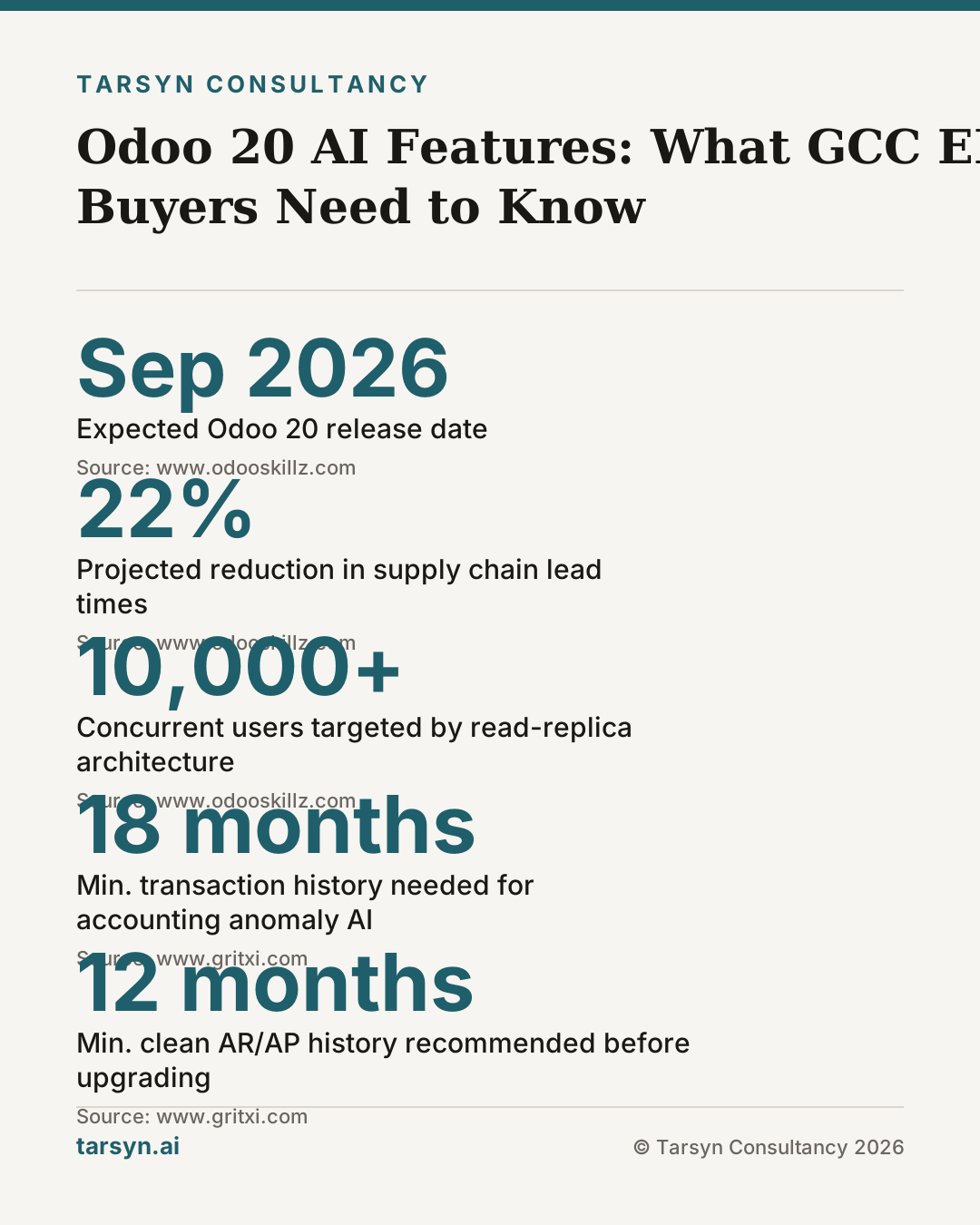
- The predictive supply chain module targets a 22% reduction in lead times — but only for companies whose inventory data is already clean and consistent.
- Read-replica database architecture is designed to push concurrent-user capacity past 10,000, making Odoo viable for larger Gulf enterprise deployments for the first time.
- For sub-500-employee GCC businesses, the AI layer is only as useful as the data beneath it — a messy Odoo instance produces articulate chaos, not decisions.
A finance manager in Dubai opens her Odoo dashboard on a Monday morning and sees a flag: three vendor invoices show anomalous payment terms compared to historical patterns. She didn't set up that alert. The system did. That is the promise of Odoo 20 in one sentence — and also the question: whose system is actually ready for it?
Odoo 20 is expected to land in September 2026, following the annual Odoo Experience conference in Brussels [2]. The trajectory from versions 17 through 19 has been deliberate: content-generation AI in v17, practical utility AI in v18, and a full AI infrastructure layer with natural language search in v19 [2]. Version 20 is positioned as the autonomous step — AI that does not wait to be asked [1]. For GCC businesses that have been watching this roadmap from the sidelines, the question is no longer "does Odoo have AI?" It is: "does my Odoo instance have the data quality to make that AI useful?"
What Odoo 20 Actually Ships: The AI Features Worth Noting
Based on roadmap presentations and partner briefings, four features anchor the Odoo 20 AI story [1] [2] [3]:
- Autonomous agentic workflows. The shift is from AI assistants that respond to queries to agents that plan and execute multi-step processes across modules without human prompting. A purchase approval that today requires three WhatsApp messages and a phone call could, in principle, be handled end-to-end by an agent.
- Predictive supply chain with demand forecasting. AI-driven demand signals replace static reorder rules. The projected benefit cited in pre-release analysis is a 22% reduction in lead times [2] — though that figure assumes clean, consistent inventory data as an input.
- Accounting anomaly detection. Automated flagging of transactions that deviate from historical norms. Think duplicate payment risks, unusual vendor terms, or VAT mismatches — before they hit the reconciliation step [1].
- Advanced CRM lead qualification. Faster filtering and scoring of inbound leads, with AI-ranked pipeline priorities replacing manual qualification workflows [1].
These are not decorative features. Each one touches a process that costs Gulf SMEs real money today. But "AI-powered" on a release note and AI that changes how a finance team makes decisions are two different things, and the gap between them is almost always a data problem.
Which Modules See the Biggest Change?
The impact is not evenly distributed. Accounting and supply chain are the clearest winners in this release cycle, followed by CRM [1] [3]. Manufacturing gets smarter replenishment signals but the agentic features are more mature in the front-office modules first.
For businesses running Odoo in the Gulf, here is the honest module-by-module read:
- Accounting: Anomaly detection is immediately useful if your chart of accounts is consistent and your transaction data goes back at least 18 months. If you migrated from a legacy system and the historical data is patchy, the model has nothing reliable to learn from.
- Inventory / Supply Chain: Predictive replenishment requires product-level demand history that is tagged correctly, not lumped under generic SKUs. Many Odoo instances in the region have been set up with Arabic-only product names in one field and English descriptions in another — that inconsistency alone degrades the model.
- CRM / Sales: Lead scoring is the lowest-risk entry point for AI. Even partial data produces directionally useful outputs. This is where most businesses will see early wins.
- Manufacturing: The payroll simplification and mobile app rebuild benefit field teams immediately [1]. The autonomous agent features are more relevant to businesses with structured production routings already in the system.
The read-replica database architecture — which targets 10,000+ concurrent users — is an infrastructure change rather than a features change [2]. It matters most to Gulf businesses eyeing Odoo for enterprise-scale deployments, where the old concurrent-user ceiling was a genuine blocker.
The Data-Quality Problem No Release Notes Mention
Here is the sentence Odoo's marketing will not write for you: multiply a messy ERP by intelligent automation and you get articulate chaos.
Odoo 20's AI layer is a multiplier. It amplifies whatever is underneath it. For Gulf businesses that have been running Odoo for three or four years with incremental customisations, undocumented workflows, and duplicate records surviving from legacy migrations, the AI features will surface those problems faster and louder — not solve them.
We wrote about this dynamic in detail in Most Companies Don't Need More AI — They Need Cleaner Spreadsheets. The argument holds for ERP too. Before asking what Odoo 20's agents can do for you, ask what your current Odoo instance can tell you reliably right now. If the answer is "our AR aging report takes two exports and a VLOOKUP," the AI layer is not your next step. Data structure is.
The specific failure modes we see in GCC Odoo deployments:
- Duplicate vendor records created when procurement teams bypassed the ERP and emailed suppliers directly, then logged invoices against whatever vendor name matched loosely.
- Multi-currency inconsistencies where USD and AED transactions sit in the same accounts with manual conversion rates entered by different staff on different days.
- Inventory ghost records — items that show stock on hand because a goods receipt was entered but the physical count never reconciled.
Each of these is invisible to a standard Odoo report. Each one corrupts the training signal for the AI layer. The ERP AI Readiness Audit we run covers exactly these failure points before any client considers an upgrade or AI configuration.
How Odoo 20 Stacks Up Against SAP and Dynamics at This Tier
The honest comparison is not Odoo versus SAP on features. It is Odoo versus SAP on total cost of AI-capable ERP for a business with 50 to 500 employees and Gulf-specific compliance requirements.
SAP S/4HANA Cloud with Joule AI and Microsoft Dynamics 365 with Copilot both offer agentic AI features in the same 2025–2026 cycle. But both carry substantially higher licensing, implementation, and customisation costs at this employee tier. Our piece on Dynamics 365 AI Agents covers the Copilot reality in detail — and the pattern is the same: the AI is only as useful as the data governance underneath it.
Odoo's structural advantage at this tier:
- Open-source core keeps customisation cost low (no per-module licensing).
- Arabic localisation is mature across accounting and HR.
- VAT and e-invoicing compliance for UAE and KSA is maintained in the community and enterprise editions.
Odoo's structural disadvantage:
- Governance tooling (audit trails, role-based controls, approval hierarchies) requires configuration that many implementations skip.
- Partner quality varies significantly across the Gulf — a poorly scoped implementation creates the data problems the AI layer will then amplify.
- Enterprise-grade support SLAs are still catching up to SAP and Microsoft at the high end.
The comparison against SAP for businesses facing the 2027 deadline is worth a separate read — see our piece on the SAP 2027 decision if that is your current context. For net-new ERP selection in the sub-500-employee band, Odoo 20 strengthens its case materially if the implementation is scoped correctly from the start.
Tarsyn's View: When to Upgrade, When to Wait
We will be direct: Odoo 20 is a genuinely interesting release. The agentic AI direction is the right architecture for how ERP should work — AI that acts on patterns rather than waiting for a human to notice them is a real operational improvement. The accounting anomaly detection and predictive replenishment features have legitimate use cases for Gulf operations.
But the upgrade question and the AI-readiness question are not the same question. A business can upgrade to Odoo 20 and get zero AI lift if the underlying data is not structured for it. The upgrade path also carries its own risk — especially for businesses with heavy customisations built on Odoo 16 or 17 that have not been maintained against the standard modules.
Upgrade now if:
- You are on Odoo 17 or 18 with a reasonably clean instance, few custom modules, and a partner who can manage the migration.
- Your inventory data has consistent SKU taxonomy, your chart of accounts is structured, and your AR/AP history is at least 12 months of clean data.
- You want the performance benefits of read-replica architecture because concurrent user load is a real problem.
Wait if:
- You are mid-customisation on a current version and the work is not complete.
- Your Odoo instance has accumulated three or more years of unreconciled data, duplicate records, or undocumented workflows.
- Your implementation partner is not already certified on the v20 migration path.
The better first step in most cases is a structured readiness audit that maps your current data quality, integration health, and business process coverage before any upgrade decision. We do not charge differently for telling a client to wait — and we tell them to wait often.
A dashboard that shows AI-flagged anomalies is more useful than one that just shows data. But a dashboard is still not a decision — see our piece on why reporting layers and decision layers are different things. Odoo 20 gets the AI layer closer to the decision layer. Whether your specific instance is ready to make that journey is a separate, practical question worth answering before September.
By Mohammed Z, Tarsyn — AI and automation studio, Abu Dhabi & Khobar.
Frequently asked questions
When is Odoo 20 expected to release?+
Odoo 20 is expected to launch in September 2026, following the annual Odoo Experience conference in Brussels. Odoo has consistently shipped major versions at that event. Businesses running Odoo 17 or 18 should begin data-quality and infrastructure audits now rather than waiting for the release to start preparing.
What are the biggest AI features in Odoo 20?+
The headline changes are: autonomous agentic AI that executes multi-step workflows across modules without prompting, predictive supply chain demand forecasting, automated accounting anomaly detection, and smarter CRM lead qualification. The shift is from AI that suggests to AI that acts — which raises the stakes for data integrity underneath those agents.
How does Odoo 20 compare to SAP and Microsoft Dynamics for SMEs?+
At the sub-500-employee tier, Odoo 20's open-source model and embedded AI keep total cost of ownership well below SAP S/4HANA and Dynamics 365. SAP's AI layer (Joule) and Dynamics Copilot require clean data pipelines too — the difference is Odoo's customisation cost is lower, but so is its enterprise-grade governance tooling out of the box.
Should a GCC business upgrade to Odoo 20 immediately on release?+
Not automatically. Businesses with poorly structured data, heavy customisations, or no change-management plan will not benefit from the AI features and may create new problems. A structured readiness audit — covering data quality, module coverage, and integration health — should precede any upgrade decision. The AI layer amplifies what is already there, good or bad.
Sources
- 1. Odoo 20 Features, Release Date & Upgrade Guide (2026) — www.gritxi.com
- 2. Odoo 20 Release Date, Features & AI: What You Need to Know (2026) — www.odooskillz.com
- 3. Odoo 20 AI Features: What Businesses Should Expect — www.erpsoftapp.com
Mohammed Z
Founder, Tarsyn
Mohammed builds the systems behind modern businesses — automation, AI decision layers, and the unglamorous plumbing that makes them work. He founded Tarsyn in Abu Dhabi.
Find out where your operation actually stands.
The AI Opportunity Audit maps your workflows, your data, and your decision bottlenecks — and tells you honestly whether AI is worth it yet.
Start the audit