21 September 2026 · 8 min read
AI Agents and ERP: What Gulf Operators Need to Know
AI agents aren't autonomous robots — they're task-runners that need clean ERP data to work. Here's what GCC operators must fix before deploying any agent.

Key takeaways
- AI agents are orchestrated task-runners, not autonomous decision-makers — they execute defined steps inside a workflow, not around it.
- Google's open agentic orchestrator (AX) lowers infrastructure cost but does nothing to fix fragmented ERP data or undefined approval chains.
- Three ERP conditions must exist before an agent can act reliably: a single source of truth, event-driven triggers, and explicit workflow boundaries.
- Only 12% of CEOs say AI has delivered both cost and revenue benefits — the gap traces almost always to integration readiness, not model quality.
A procurement manager in a Jebel Ali trading arm opens his laptop to find that an "autonomous AI agent" has just raised three purchase orders — all based on stock figures that were last synced forty-eight hours ago. Two of the orders are duplicates. One covers inventory that was already in transit. The agent did exactly what it was told. The problem was everything it was told to read.
That scenario is not hypothetical. It is the predictable consequence of deploying AI agents before the ERP integration layer is ready. And right now, across the GCC, vendors are racing to sell the agent before anyone checks the plumbing.
What AI agents actually are — and what they are not
The term "AI agent" has absorbed so much hype that it now means almost nothing without qualification. Strip the marketing away and the definition is specific: an AI agent is software that receives a goal, decomposes it into steps, calls tools or APIs to execute each step, observes the result, and loops until the task completes or hits a boundary condition — without a human approving every intermediate action.
That last clause is where the excitement lives. That is also where the risk lives.
Agents are not autonomous in any general sense. They are constrained by three things: the tools they can call, the data they can read, and the workflow boundaries set by whoever designed the system. Change any of those three and the agent's behaviour changes completely. An agent that looks impressive in a demo — pulling live inventory, raising a draft PO, notifying a supplier — looks catastrophic in production if the inventory feed is stale, the PO approval hierarchy is undefined, or the supplier notification fires before a human reviews.
The confusion between a reporting layer and a decision layer is a close cousin of the confusion between an agent and a thinking colleague. Both mistakes have the same cause: mistaking fluent output for genuine understanding.
Why Google's open orchestrator changes the cost curve but not the readiness equation
Google's AX platform (agentexecutor.io) is a genuinely useful piece of infrastructure [1]. It sandboxes agent tasks, manages workspace setup, enforces network policies, and lets operators run tasks at scale — billions of tasks per cluster, according to the project documentation. It is open-source, it is maintained by a company with the resources to keep it alive, and it lowers the cost of building agentic infrastructure considerably [2].
What it does not do: fix your data. Define your workflows. Reconcile the seventeen spreadsheets your logistics team uses to track Ramadan freight cutoffs. Bridge the gap between your WhatsApp approval chain and the formal PO hierarchy in your ERP.
The Hacker News discussion around AX's launch captures the honest state of the ecosystem well: practitioners note there is no real convergence yet, that "everyone and their grandma has written a new agent framework," and that the tooling multiplies faster than the operational readiness to use it [2]. Cheaper infrastructure is a necessary condition for agent adoption. It is nowhere near sufficient.
This dynamic is not unique to Google's tooling. OpenAI's Agents API, covered in our breakdown of what Gulf ops teams actually get, faces the same readiness constraint. So do the embedded agents in Dynamics 365, with real-world limits that matter for 2025 deployments. The model provider is almost never the bottleneck. The integration layer almost always is.
The three ERP conditions an agent needs before it can act reliably
McKinsey's analysis — cited in OpenText's integration research — identifies the core problem directly: AI ambitions are accelerating faster than the operational foundations meant to sustain them [3]. Pilots proliferate; sustained business impact stays limited and uneven. The reason is not model quality. It is that the underlying enterprise processes are fragmented, inconsistently governed, and difficult to change [3].
From that diagnosis and from operational patterns we see across Gulf deployments, three ERP conditions stand out as the minimum viable prerequisites for any agent:
-
A single source of truth for the data the agent will act on. If stock-on-hand lives in ERP, a warehouse spreadsheet, and a WhatsApp thread that gets reconciled on Sunday evenings, the agent will read one of those three and act accordingly. Which one depends on how the integration was built — and most integrations in the GCC were not built with agentic reads in mind. The WhatsApp-to-ERP gap is where GCC businesses leak money, and an agent does not close that gap; it amplifies it.
-
Event-driven data triggers, not batch syncs. A nightly batch sync was good enough when a human was reading the report the next morning. An agent that acts in real time on data that is twelve hours old is not faster than a human — it is wrong faster than a human. Every field an agent reads needs a timestamp and an update frequency that matches the cadence at which the agent is expected to act.
-
Explicitly defined workflow boundaries — including exception handling. An agent needs to know not just what to do when everything works, but what to do when a supplier is on credit hold, when an approver is out for Eid, or when a quantity crosses a threshold that requires a second sign-off. If those rules exist only in someone's head or in an email thread, the agent will either stall or proceed incorrectly. Both outcomes are worse than no agent at all.
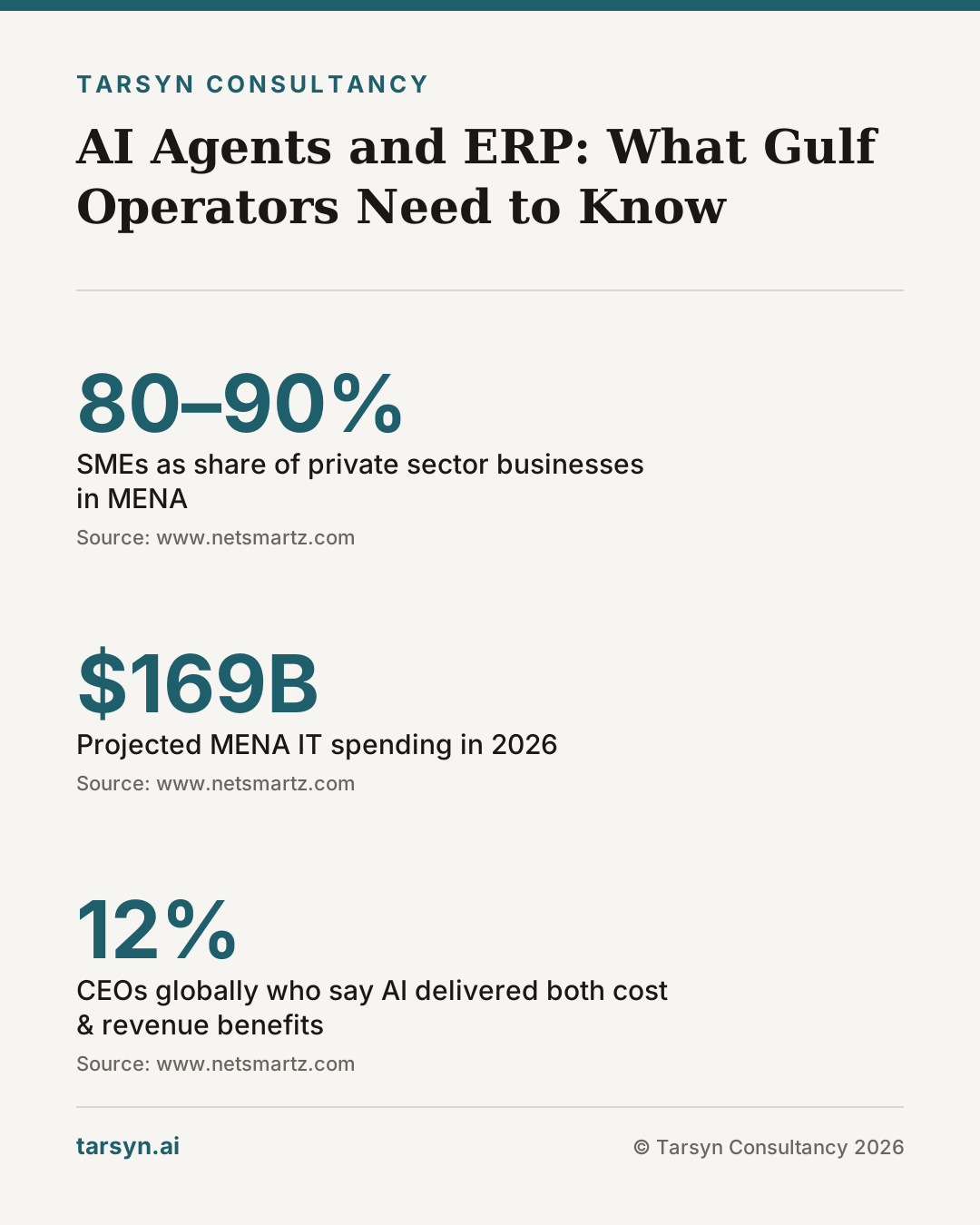
The MENA integration gap is well-documented. SMEs make up 80–90% of private sector businesses in the region, and most still lack integration expertise [4]. MENA IT spending is projected at $169 billion in 2026 [4], but investment in new systems without a plan to connect them creates more silos, not fewer. Every new tool added without an integration strategy makes the business harder to run — and an agent deployment without integration readiness is just the most expensive version of that mistake.
Where agents are already delivering in Gulf operations — and where they fail
Agents are not uniformly failing across the GCC. Where the three conditions above are met, the results are concrete. The pattern we see working:
Invoice processing with a clean AP workflow. Where the ERP has a defined vendor master, invoice matching rules are codified, and exception routing is explicit, an agent can handle straight-through processing for the majority of invoices and route exceptions correctly. The GCC buyer's guide to invoice automation covers what that plumbing actually looks like.
Inventory reorder in distribution with live WMS feeds. Where the warehouse management system feeds the ERP in real time and reorder logic is defined by SKU, an agent can raise draft purchase requisitions and notify buyers without touching a spreadsheet. The prerequisite is the WMS-to-Business Central integration being live and event-driven.
Workflow routing for structured approval chains. Where approval hierarchies are codified in the ERP or a connected BPM layer, an agent can route documents, chase approvers, and escalate correctly. Where approvals live in WhatsApp, the agent breaks at the first exception.
Where agents consistently fail in the Gulf context:
- Multi-entity operations with separate ERP instances and no integration layer between them.
- Any workflow where the decision criteria include information not in the ERP (supplier relationship history, verbal commitments, regional regulatory nuance).
- Processes that depend on Ramadan or public holiday calendar logic that has never been codified in the system.
- Any approval chain where the actual decision-maker is not the person listed in the org chart.
The broader picture of which industries are actually automating versus which are running vendor demos shows a consistent pattern: the operations that deliver results are the ones that did the data work first. The ones generating case studies are often still in pilot.
Only 12% of CEOs globally say AI has delivered both cost and revenue benefits [4]. That number is not an indictment of AI. It is an indictment of deploying AI before the integration layer is ready.
Tarsyn's view: run the integration audit before the agent pilot
We are not against AI agents. We run them ourselves and we build them for clients. But we have a rule that comes from seeing enough failed deployments: the agent is never the problem. The data is always the problem.
Multiply chaos by intelligence and you get articulate chaos. An agent on top of fragmented, stale, undocumented ERP data does not fix the fragmentation — it accelerates the consequences of it, at a cost that is easier to justify to leadership because the word "AI" is in the budget line.
The honest framing: before you budget for an agent, budget for the five-step integration audit that tells you whether you have the three ERP conditions above. That audit will either give you a clear path to a working agent deployment, or it will tell you that you need to fix the spreadsheets before buying AI — which is the more valuable finding.
What the audit covers in practice: mapping every data source the proposed agent would read, checking update frequency and authority for each field, documenting existing approval logic and identifying where it lives outside the system, and identifying the exception cases that are currently handled by a person using judgement.
That last point matters most. Agents handle the rule. Humans handle the exception. If you cannot articulate the rule, you cannot build the agent. If you cannot articulate the exception path, you will deploy an agent that fails silently when reality diverges from the happy path — and in Gulf operations, reality diverges from the happy path regularly.
The infrastructure is getting cheaper. Google's AX platform is a real contribution to making agent deployment more accessible [1]. The model quality is improving faster than anyone expected. None of that changes the sequence: integration audit first, agent pilot second.
We offer a structured integration and automation audit that covers exactly this ground — mapping your ERP data layer against the operational requirements of any agent or automation you are considering. It takes two to three weeks. It tells you what to build and, equally useful, what not to build yet.
The agent vendors will not tell you that second part. We charge the same either way.
Frequently asked questions
What is an AI agent, exactly?+
An AI agent is software that receives a goal, breaks it into steps, calls tools or APIs, and loops until the task is complete — without a human approving each action. It is not autonomous in any broad sense. It is constrained by the tools it can call, the data it can read, and the boundaries set by whoever built the workflow. Think of it as a very fast junior analyst with no judgement outside its defined scope.
Why does ERP data quality matter so much for AI agents?+
An agent acts on what it reads. If your stock-on-hand figure in the ERP is three days stale, or split across four spreadsheets reconciled manually every Monday, the agent will act on wrong data — confidently and at speed. Clean, event-driven ERP data is not a nice-to-have; it is the minimum viable condition for any agent deployment. Garbage in, articulate garbage out.
What does Google's open agentic orchestrator actually change?+
Google's AX platform (agentexecutor.io) provides sandboxed task execution, network policy controls, and workspace setup as open-source primitives. It makes the infrastructure layer cheaper to access and easier to manage at scale. What it does not provide is clean data, defined business rules, or integration between your ERP and your agent's tool layer — that work still sits entirely with the operator.
How should a Gulf business start with AI agents?+
Start with an integration audit before any agent pilot. Map where your ERP data lives, which fields are updated in real time versus batched, and which approval steps exist only in WhatsApp threads or email. Every gap you find is a place where an agent will either fail silently or act on stale information. Fix the data plumbing first; the agent layer is then straightforward to add.
Sources
- 1. Google's Open Agentic Orchestrator — hn:frontpage
- 2. Google's Open Agentic Orchestrator (discussion) — Hacker News
- 3. AI, ERP, and Integration: The Missing Link to Value — blogs.opentext.com
- 4. Why Middle East Businesses Need an Integration Strategy | Netsmartz — www.netsmartz.com
Mohammed Z
Founder, Tarsyn
Mohammed builds the systems behind modern businesses — automation, AI decision layers, and the unglamorous plumbing that makes them work. He founded Tarsyn in Abu Dhabi.
Find out where your operation actually stands.
The AI Opportunity Audit maps your workflows, your data, and your decision bottlenecks — and tells you honestly whether AI is worth it yet.
Start the audit