21 August 2026 · 6 min read
Enterprise AI Isn't Sticky: What Gulf Buyers Must Know
New spend data shows businesses flip between AI vendors with each model release. Gulf operators need to architect around the integration layer, not the model, to protect operations.

Key takeaways
- Among 70,000+ US businesses tracked by Ramp, Anthropic held ~44% share vs OpenAI's ~40% as of July 2026 — a lead that flipped from OpenAI in a single quarter.
- Enterprise AI has near-zero switching costs today: model allegiance shifts with each product release, exposing any workflow hardcoded to a specific vendor.
- The integration layer — API contracts, data pipelines, and workflow logic — determines AI ROI far more than which model sits behind it.
- Gulf ERP buyers should demand vendor-agnostic integration architecture before committing to any AI rollout, or plan to rebuild every six months.
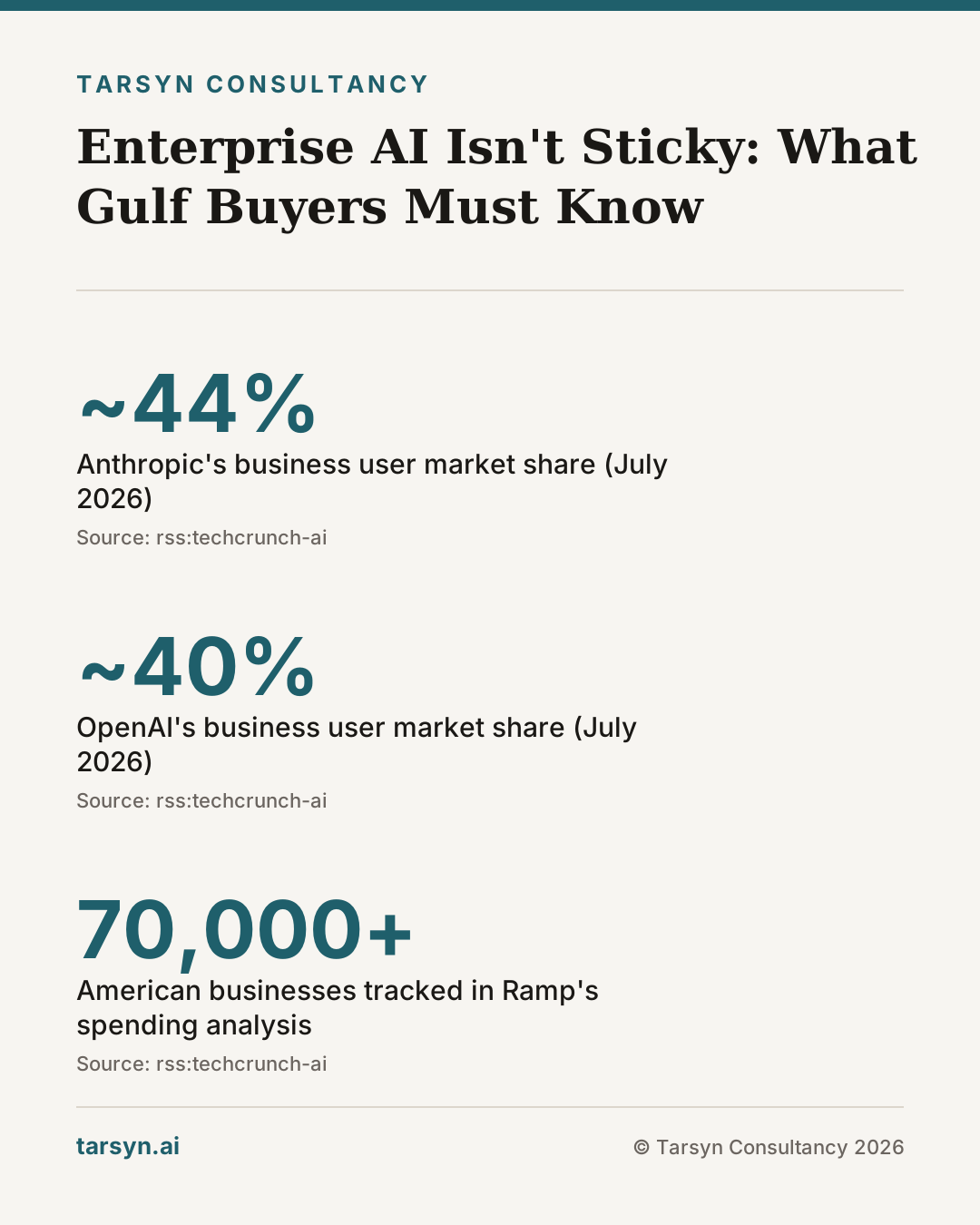
In May 2026, Anthropic quietly overtook OpenAI among paying business users. By July, the gap had widened: Anthropic held nearly 44% share against OpenAI's nearly 40%, according to Ramp's analysis of spending data across more than 70,000 American businesses. [1] Then, mid-quarter, OpenAI began closing the gap again. One quarter. Multiple lead changes. Thirty AI years of news cycles compressed into a single earnings period.
For Gulf operators embedding AI into ERP and workflow layers, that volatility is not a trivia point — it is a structural warning.
Businesses Are Switching AI Vendors Like Streaming Services — Here's the Data
The Ramp data [1] is worth pausing on. These are not consumers experimenting with free tiers. These are businesses spending real budget through corporate cards and bill-pay products. The fact that vendor preference among this group shifted measurably in a single quarter tells you something clear: enterprise AI has almost no switching costs today.
That is unusual. In most enterprise software categories — ERP, CRM, HRIS — switching costs are the entire business model. Implementation inertia, data migration risk, and retraining friction lock customers in for years. AI models have none of that. When Anthropic ships Claude 4 and GPT-5 lands a week later, a business can literally update one API key and the model changes. The prompt library stays. The spend management dashboard stays. The vendor does not.
Ramp's economist noted that OpenAI was growing faster among the segment in Q3 to date, but acknowledged there was still a month left in the quarter — enough time for the lead to flip again. [1] That is the rhythm now: sprint, counter-sprint, repeat.
Why Low Switching Costs Sound Good but Create Real Operational Risk
On the surface, zero switching costs sound like buyer leverage. Competition keeps quality up and prices honest. That is true at the model layer. The problem sits one level deeper.
If your AI deployment is architected for easy model swapping, low switching costs are an asset. If your AI deployment is hardcoded to a specific model — prompt formats, output parsers, ERP field mappings, approval triggers — then every model upgrade is a potential breaking change wrapped in a feature announcement.
Consider the operational texture of a mid-sized Gulf trading company: procurement approvals routed through a WhatsApp-to-ERP bridge (a gap we've written about here), freight cut-offs timed to Ramadan schedules, supplier master data spread across seventeen spreadsheets and two legacy systems. Now embed an AI layer that summarises outstanding POs and flags anomalies. If that AI layer is directly coupled to a specific model's output schema, a model version change can silently corrupt the field mappings. The dashboard still reports success. The operations quietly fail. We've covered exactly this failure mode in our piece on automation silent failures.
Low switching costs at the model layer create high rebuilding costs at the operations layer — unless the architecture accounts for it.
The Layer That Actually Determines Your AI ROI (It's Not the Model)
Enterprise AI deployments sit across several architectural tiers. The model — GPT, Claude, Gemini, Llama — is one tier. Below it and above it are the layers that actually determine whether AI produces business value: data pipelines that feed clean, contextual inputs; API contracts that translate model outputs into structured records; workflow logic that routes those records into ERP transactions, approval chains, and reporting.
This integration layer is the connective tissue. [3] It is also the layer that is hardest to replace — and therefore the right place to concentrate architectural investment. A well-designed integration layer is model-agnostic by construction: it defines the contract (inputs, outputs, data types) and lets the model behind it be swapped without touching downstream systems.
The Stripe/OpenRouter move — which we analysed separately — is a commercial signal pointing in the same direction: the industry is commoditising the model layer deliberately, because the durable value lies in routing, orchestration, and integration, not in which transformer weights sit underneath.
This is also why a dashboard is not a decision. Dashboards report on the model layer. Decision layers act on the integration layer. Confusing the two is how companies buy impressive demos and see no operational lift.
What Gulf ERP Buyers Should Demand from Any AI Integration
Before signing any AI contract — whether it is a Copilot seat, a Claude API integration, or a packaged "AI module" from an ERP vendor — Gulf buyers should run four tests:
- Model substitution test. Ask the vendor: if we replace the underlying model tomorrow, what breaks? Document the answer in writing. If "everything" is the honest reply, the architecture is wrong.
- Data schema ownership test. Confirm that your input data schemas, output field mappings, and prompt templates are owned by you — not stored in the vendor's proprietary format. Proprietary formats are switching costs in disguise.
- Integration middleware independence test. Verify that the middleware connecting the AI layer to your ERP (Odoo, SAP, Dynamics — see our Odoo vs SAP comparison for context) is not the AI vendor's own connector. Vendor-bundled connectors create dependency. Standard API layers do not.
- Monitoring and failure audit test. Confirm there is a mechanism to detect when the AI layer silently produces wrong outputs — not just when it goes down. Silent failures are the most common and least caught. Our ERP AI readiness audit covers how to check for this before you go live.
These are not exotic requests. Any vendor building for enterprise longevity should answer them without hesitation. Hesitation is information.
For context on what healthy AI integration architecture looks like inside connected enterprise systems, the principle is consistent: integration sits at the centre, and the AI model is one pluggable component within it — not the foundation. [3]
Tarsyn's View: Build the Foundation, Not the Bet
The Ramp data [1] will keep updating. Next quarter, OpenAI may be ahead. The quarter after, a new entrant may hold the lead. That churn is structural, not temporary — because the model layer is genuinely commoditising, and competition is working exactly as intended.
The wrong response is to track that data and try to pick the winning model. Multiply chaos by intelligence and you get articulate chaos. Betting on a specific model is the wrong unit of analysis. The durable asset is the data and workflow foundation underneath it.
What that looks like in practice: clean, documented data pipelines before any AI layer goes live. Vendor-agnostic API contracts. Workflow logic that is version-controlled and testable independently of the model. Monitoring that catches output drift, not just downtime. This is precisely the checklist we run through in our five-step audit before any client commits spend.
We run that audit with clients before recommending any AI purchase — and sometimes the honest answer is: not yet. Fix the spreadsheets first. The case for doing that has not changed just because the model options multiplied. If you want to know where your operation stands before the next model release reshuffles the market again, the Tarsyn Audit is the right starting point.
The model that wins Q3 2026 will not be the model that wins Q2 2027. The integration layer you build this year can last a decade — if you build it right.
Frequently asked questions
What does enterprise AI switching cost actually look like?+
Today, very little — which is the problem. Ramp's data tracking 70,000+ businesses shows AI vendor share can swing by several percentage points in a single quarter as new model releases land. The switching cost is not financial; it is operational. Any workflow, prompt chain, or ERP integration hardcoded to a specific model breaks the moment you move.
Why does the integration layer matter more than the AI model?+
The model is a commodity that gets replaced. Your data pipelines, API contracts, and workflow logic are what make AI outputs usable inside your operations. Build those as a durable, vendor-agnostic layer and you can swap the model behind it without touching your ERP, your approval chains, or your reporting. Skip that foundation and every model upgrade is a rebuild project.
What should Gulf ERP buyers demand from AI vendors?+
Insist on open API interfaces, documented data schemas, and integration middleware that is not proprietary to the AI vendor. Ask specifically: if we replace the underlying model tomorrow, what breaks? If the honest answer is 'everything', the architecture is wrong. Model-agnostic middleware means your Odoo, SAP, or Dynamics instance is insulated from vendor volatility.
How does enterprise AI volatility affect GCC operations specifically?+
Gulf businesses often run approval chains, freight cut-offs, and supplier communications through a patchwork of ERP, WhatsApp, and manual handoffs. Embedding a specific AI vendor into that patchwork without a clean integration layer means one model deprecation or pricing change can silently break core workflows — with no monitoring to catch it.
Sources
- 1. OpenAI is gaining on Anthropic with business users, new data indicates — rss:techcrunch-ai
- 2. Build AI-Ready Integration for Connected Enterprises — sageitinc.com
Mohammed Z
Founder, Tarsyn
Mohammed builds the systems behind modern businesses — automation, AI decision layers, and the unglamorous plumbing that makes them work. He founded Tarsyn in Abu Dhabi.
Find out where your operation actually stands.
The AI Opportunity Audit maps your workflows, your data, and your decision bottlenecks — and tells you honestly whether AI is worth it yet.
Start the audit