17 August 2026 · 6 min read
Stripe Buys OpenRouter: What It Means for Your AI Stack
Stripe paid $7B+ for OpenRouter — not a payments play, but an infrastructure grab. Here's what GCC operators running AI-embedded workflows need to do now.

Key takeaways
- Stripe paid $7B+ for OpenRouter — a 5x step-up from its $1.3B valuation just three months earlier, signalling how fast AI routing is being priced as infrastructure.
- OpenRouter routes across 400+ AI models for 8 million developers; Stripe now owns the metering and billing layer sitting between those developers and every major LLM provider.
- GCC operators whose ERP vendors are embedding AI without exposing routing controls are handing those vendors permanent margin authority over their automation costs.
- Evaluate your routing abstraction layer before your ERP vendor bundles it into a locked SKU — the window to own that decision is narrow and closing.
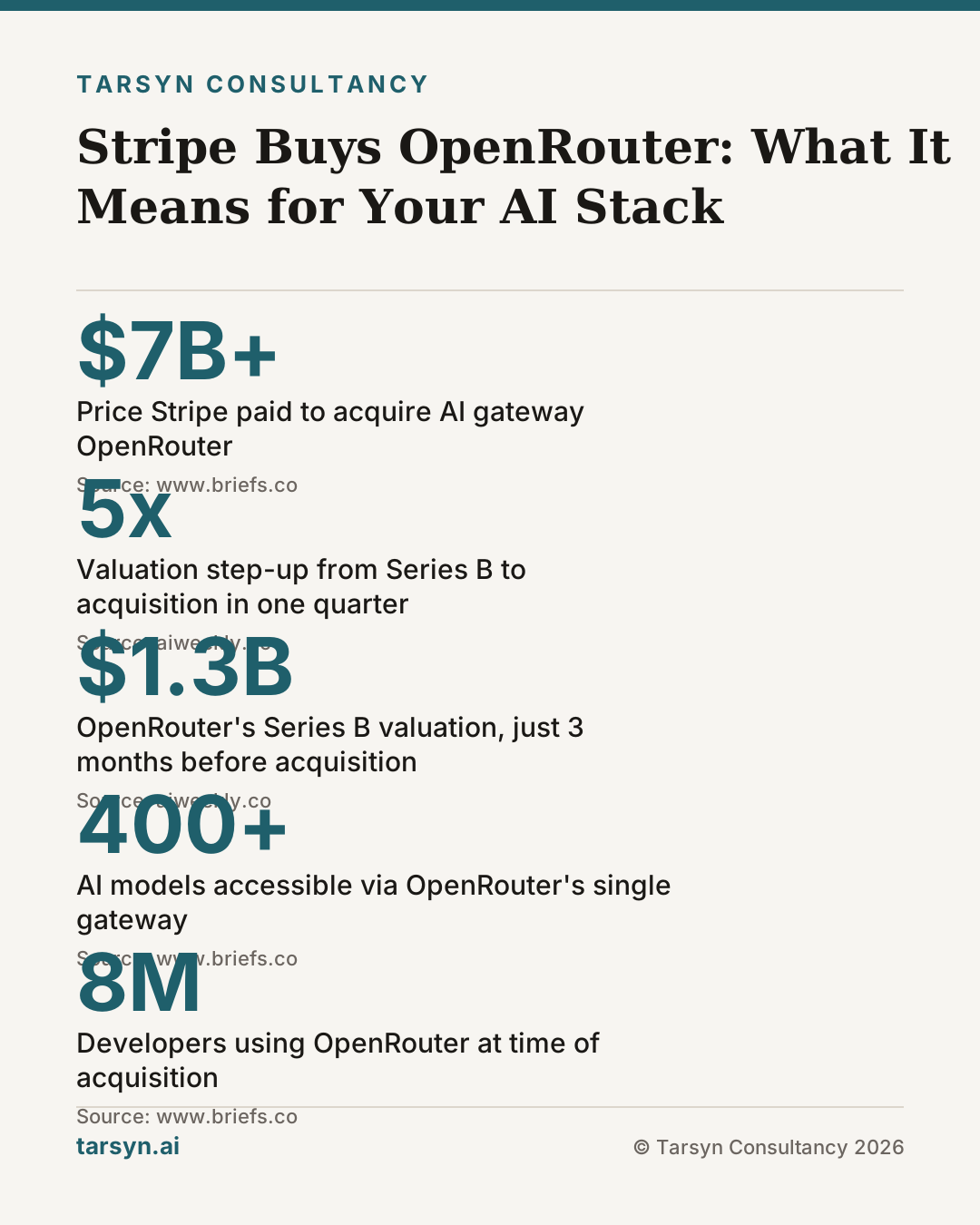
Three months after OpenRouter closed a $1.3 billion Series B, Stripe paid more than $7 billion for it — a 5x step-up in a single quarter [2]. The story that landed in Bloomberg and TechCrunch was filed under "payments giant diversifies." That framing misses the point entirely.
This is not a payments story. It is a routing story. And if you are a GCC operator with AI woven into your ERP, your approval chains, or your document workflows, the routing layer is now directly relevant to what you pay and who controls it.
What Stripe Actually Bought — and Why OpenRouter Matters Beyond Payments
OpenRouter's pitch, in the words of its own CEO Alex Atallah, was to be "the equivalent of Stripe for AI" [2]. That line aged well in under three months.
The product is an AI model gateway: a single access point across more than 400 models for a claimed 8 million developers, letting customers swap providers without rebuilding integrations every time a better or cheaper model appears [3]. In May 2026, it raised $113 million at a $1.3 billion valuation, backed by Sequoia, Andreessen Horowitz, Menlo Ventures, and Alphabet's CapitalG [2]. In August, Stripe closed for $7 billion-plus [1].
What Stripe bought is not the models. It bought the metering and billing surface sitting between developers and every major LLM provider. As one Hacker News commenter put it cleanly: "Tokens are simply a lightweight valuable asset. Stripe can serve as the middleman as well as anyone. They know how to route to many providers with huge differences in service characteristics. LLM providers are far easier [than payment rails]." [1]
Stripe's business is abstraction. It abstracted bank rails for payments. Now it is abstracting model rails for AI. The margin lives in the abstraction layer — not in the commodity underneath it.
AI Model Routing Is Quietly Deciding Your Automation Costs
Most operators running workflow automation today have no idea which LLM is answering their queries, at what per-token cost, or whether that model is the cheapest viable option for the task at hand. That is not ignorance — it is the default. ERP vendors, SaaS platforms, and no-code automation tools almost universally hide the routing layer from the buyer.
That was a reasonable design choice when AI was a novelty. It is a structural liability now.
Here is the cost dynamic that matters: a simple document classification task might cost twelve times less on a lightweight open model than on a frontier closed model — and produce equivalent output quality for that specific task. Routing across open and closed LLMs intelligently is how sophisticated operators are already compressing per-task AI cost. But you can only do that if you control the routing layer. If your vendor controls it, they have little incentive to route you to the cheaper option — especially if they have a margin arrangement with a specific provider.
The Stripe-OpenRouter deal is the market making that dynamic permanent and explicit. A single company will soon own the most widely used routing abstraction for developers globally. That company's commercial incentives will shape which models your workflows land on, at what price tier, under what terms.
How This Changes the Calculus for ERP-Embedded AI in the Gulf
GCC operators face a specific version of this problem. The region's enterprise software landscape is consolidating fast: SAP RISE, Microsoft Dynamics 365 Copilot, and Odoo are all embedding AI features with varying levels of transparency about what runs underneath see our comparison of Odoo versus SAP AI features for GCC operations. Almost none of them expose routing controls to the buyer.
At the same time, Gulf operators have a structural workflow characteristic that amplifies AI cost risk: approval chains. A procurement order in a mid-sized trading company in Jebel Ali might touch seven approval steps, each of which could invoke an AI-assisted summary, a compliance check, or a risk flag. Multiply that by daily transaction volume across Ramadan cutoffs, VAT reconciliation cycles, and multi-entity structures, and you have hundreds of AI calls per day whose cost is invisible to you.
Dynamics 365 AI agents and SAP's embedded AI features are both moving in the direction of agentic workflows — software that plans and takes multi-step actions. Agentic AI calls models in loops. A single agentic task might invoke an LLM four to twelve times. If the routing layer is locked to a single premium provider, that cost compounds with every automation run.
This is not hypothetical. It is the WhatsApp-to-ERP gap problem expressed in cost terms: the leakage is invisible until someone adds it up.
Three Questions GCC Operators Should Ask Their Software Vendors Right Now
Before your next renewal conversation or AI feature negotiation, get specific answers to these three questions:
-
Which LLM providers does your AI feature call, and can we see that in the contract? If the answer is "it depends on what gives you the best result" without further specificity, you have no routing control. The vendor has it.
-
Is AI usage metered separately, or bundled into our licence fee? Bundled sounds simpler until usage scales. Separate metering gives you visibility and, eventually, negotiating leverage. A bundled AI fee is a vendor-controlled cost that can rise at renewal without you seeing the underlying driver.
-
Can we bring our own model or API key? A vendor that allows BYOM (bring-your-own-model) or BYOK (bring-your-own-key) is offering routing optionality. Most enterprise vendors currently do not — but the ones who will survive the next three years of competitive pressure are increasingly going to need to.
If your vendor cannot answer these questions or treats them as unusual, that is a data point. Log it before the next contract cycle.
For a structured way to assess this before any AI commitment, the ERP AI readiness audit framework covers exactly this gap — routing visibility sits in step two of that five-part check.
Tarsyn's View: Own Your Routing Layer Before Your Vendor Does
We have said before that most companies do not need more AI — they need fewer broken processes. That is still true. But the Stripe-OpenRouter deal introduces a second-order problem that operators need to understand even if they are not heavy AI users yet: the infrastructure layer is being bought and locked, and the window to establish routing independence is narrowing.
Our read: OpenRouter's acquisition at a 5x valuation step-up in three months is not a fluke — it is the market pricing infrastructure scarcity [2]. Multiple major tech firms evaluated acquisition bids before Stripe closed [2]. The hyperscalers wanted this asset too. They lost. That tells you something about what they think it is worth to own the routing layer going forward.
For GCC operators, the practical implication is not "build your own OpenRouter." It is simpler: do not let your ERP vendor make this decision for you by default. The time to establish which AI calls in your workflow are routable, which are locked, and what that costs you at scale is before you sign the next feature expansion — not eighteen months after, when switching costs are real.
A workflow automation consultant who cannot answer routing questions is selling you a half-picture. Push the question. If it surfaces complexity your current vendor cannot resolve, that is worth surfacing now.
The honest version: sometimes the right answer after this audit is "our current vendor setup is fine for our volume, and routing optimisation is premature." We will tell you that if it is true. But we have also seen operators discover that seventeen percent of their monthly AI cost is going to a premium model being used for tasks that a lightweight model handles identically. That finding pays for the audit in the first month.
Run the AI and automation audit before the routing layer is someone else's locked SKU. The Stripe-OpenRouter deal is a signal, not a crisis — but signals are only useful if you act on them before they become constraints.
Frequently asked questions
What is OpenRouter and why did Stripe pay $7B+ for it?+
OpenRouter is an AI model gateway that gives developers a single access point to more than 400 AI models, letting them switch providers without rebuilding integrations. Stripe paid over $7 billion — more than five times OpenRouter's $1.3 billion valuation from three months prior — because owning that routing layer means owning the metering and billing surface for AI spend across millions of developers.
How does the Stripe-OpenRouter deal affect workflow automation costs?+
When one company controls AI model routing, it also controls how usage is metered and priced. Businesses that have no independent routing layer will increasingly have costs set by whichever platform bundles routing into their toolchain. Automation workflows that call LLMs repeatedly — for document processing, approvals, or agent tasks — are the highest-exposure workloads.
Should GCC businesses be worried about ERP vendor lock-in on AI?+
Yes, specifically on the routing layer. ERP vendors in the Gulf are embedding AI features rapidly, but few expose which model is called, at what cost, or whether you can switch. Once AI is bundled into a locked SKU, renegotiating those terms is as difficult as renegotiating your core ERP licence — which most operators do not do more than once a decade.
What is an AI routing abstraction layer and do I need one?+
A routing abstraction layer sits between your application and LLM providers, letting you direct requests to different models based on cost, latency, or capability — without rewriting your integration each time. If you process more than a few hundred AI-assisted tasks per day, or if your ERP vendor has not disclosed which models power its AI features, you likely need to audit this before vendor choices are made for you.
Sources
- 1. Stripe Clinches over $7B Deal to Buy AI Firm OpenRouter (discussion) — Hacker News
- 2. Stripe finalizes reported $7B+ buy of AI gateway OpenRouter | AI Weekly — aiweekly.co
- 3. Stripe Acquires AI Gateway OpenRouter for $7B+ — www.briefs.co
Mohammed Z
Founder, Tarsyn
Mohammed builds the systems behind modern businesses — automation, AI decision layers, and the unglamorous plumbing that makes them work. He founded Tarsyn in Abu Dhabi.
Find out where your operation actually stands.
The AI Opportunity Audit maps your workflows, your data, and your decision bottlenecks — and tells you honestly whether AI is worth it yet.
Start the audit