12 September 2026 · 8 min read
What Switzerland's Microsoft Exit Teaches GCC ERP Buyers
Switzerland is migrating 3,000 government machines off Microsoft 365. Here's what GCC enterprises must learn about ERP lock-in, exit costs, and data portability before their next renewal.

Key takeaways
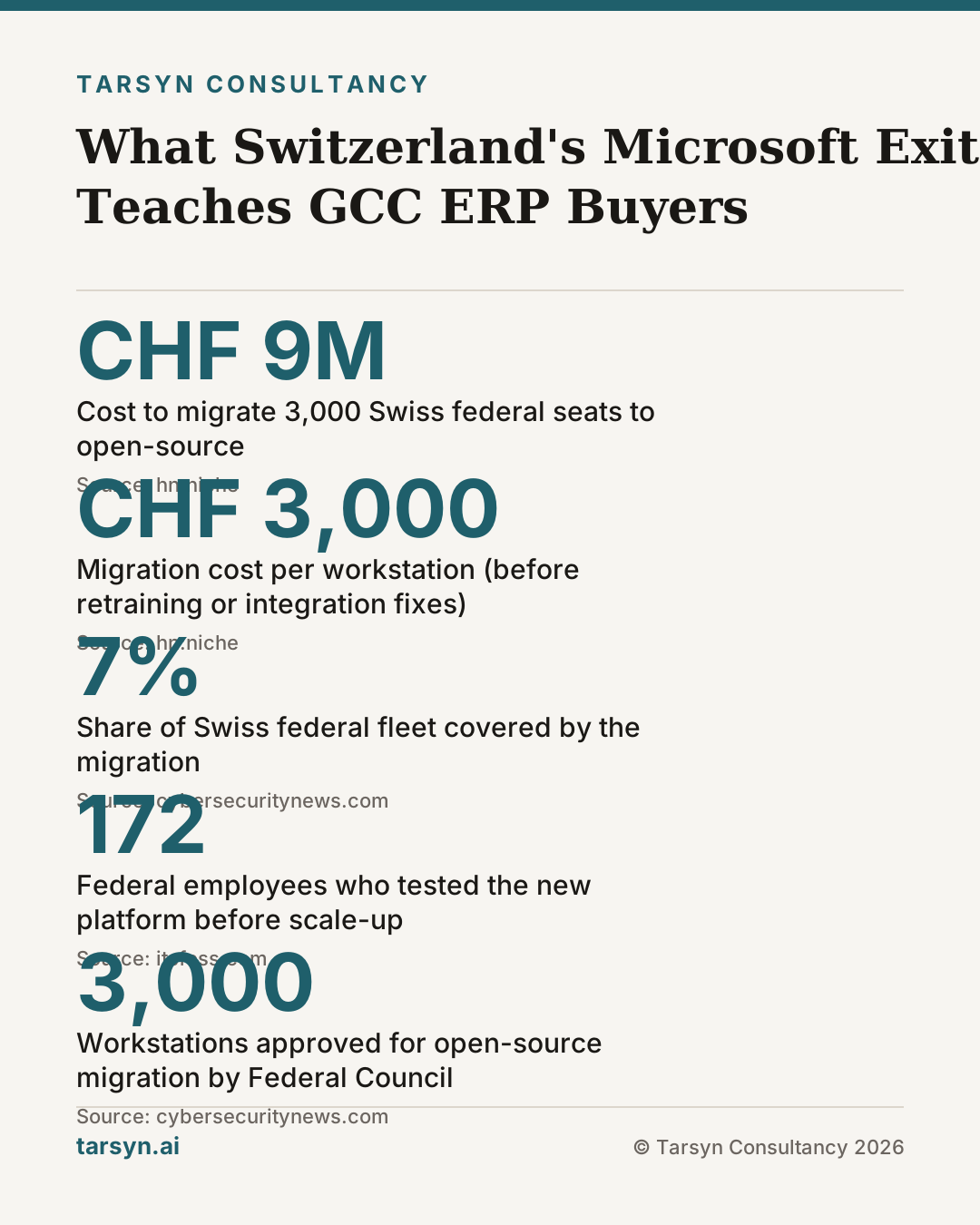
- Switzerland's Federal Chancellery is spending CHF 9 million to migrate just 3,000 workstations — roughly 7% of federal machines — by end of 2027, with the remaining 51,000 still on Microsoft.
- The Swiss pilot runs the open-source platform *in parallel* with Microsoft 365, a telling signal that cold-turkey migrations from entrenched productivity suites are not yet viable even for well-funded governments.
- ERP lock-in in the GCC is deeper than OS lock-in: custom approval workflows, Arabic VAT logic, and WhatsApp-triggered purchase orders leave data and process stranded in ways no off-the-shelf export resolves.
- The right time to calculate switching costs is before contract signature, not at renewal — a structured exit audit covering integration depth, data portability, and retraining burden changes negotiating leverage entirely.
A government of 3,000 civil servants sat down in September 2026 and discovered, in precise francs, what it actually costs to leave a productivity suite you have used for decades. Switzerland's Federal Chancellery is spending CHF 9 million to move those employees to open-source alternatives — and that covers only 7% of the federal fleet. [1] [4] The other 93% stays on Microsoft for now. For any GCC enterprise mid-way through an ERP implementation, that number deserves a closer look than it is getting in the trade press.
What Switzerland Actually Did — and What It Cost
The Swiss story begins with a proof-of-concept called "PoC BOSS", run with 172 federal employees testing openDesk, a German open-source collaboration platform. [1] Core tasks — email, document editing, calendars — got positive marks. Large-scale video conferencing did not. [3] Based on that partial success, the Federal Council approved scaling to 3,000 workstations, with a target completion date of end-2027. [4]
Two details matter most for GCC buyers reading this:
- The migration runs in parallel, not in replacement. Microsoft 365 stays live for the pilot group. [4] Switzerland is not pulling the plug; it is building an emergency exit while keeping the front door open. That costs double the infrastructure during transition.
- CHF 9 million for 3,000 seats. That works out to roughly CHF 3,000 per workstation — before accounting for retraining, productivity dip, or any integrations that break when the underlying platform shifts. [1]
The Swiss government frames this as a digital sovereignty project, not a cost-cutting exercise. [4] The concern is what happens to federal data if a major cloud provider has an outage, faces geopolitical sanctions, or simply changes licensing terms unilaterally. That framing should sound familiar to any Gulf enterprise that has negotiated a multi-year ERP contract under DIFC data-residency rules or Saudi Cloud First policy.
Vendor Lock-In Is an ERP Problem, Not Just an OS Problem
Here is where most commentary on the Switzerland story goes wrong: it treats this as an open-source versus Microsoft debate. That is the least interesting version of the lesson.
The deeper problem is integration depth over time. Every year a company runs on the same ERP — whether SAP, Dynamics 365, or Odoo — the system accretes custom logic. Finance teams build reports that join proprietary tables. Procurement teams build approval workflows that call vendor-specific APIs. Warehouse managers receive WhatsApp messages that trigger stock adjustments directly in the system through a connector someone built three years ago and nobody fully documented. (We have seen this exact configuration in Jebel Ali trading arms on more than one engagement.)
Switching costs in this environment are not primarily about data export. They are about process archaeology — finding every integration, every custom field, every scheduled job, and every report before you can honestly price what leaving would cost. Most organisations do not have that map. Switzerland had 172 employees test a new system for months before committing CHF 9 million to 3,000 seats. Most Gulf enterprises commit to five-year ERP contracts with far less diligence than that.
The ERP vendor lock-in problem has a sibling in the AI stack — a dynamic we explored in Enterprise AI Isn't Sticky — What That Means for Gulf Buyers. The principle is the same: the stickiness is rarely the software itself, it is the integrations and data formats built on top.
The Four Switching Costs Gulf Buyers Routinely Underestimate
These are listed in order of how often they are missed, not order of magnitude:
-
Custom integration debt. Every API connector, middleware bridge, and custom webhook built on the outgoing vendor's schema must be rebuilt or retired. In GCC manufacturing and logistics, this often includes connections to freight forwarders, customs brokers, and government portals (FASAH, Customs Authority, ZATCA e-invoicing). See also WMS Integration with Business Central: What Actually Works for a concrete example of how deep these connections go.
-
Data portability gaps. Most ERP vendors offer export tools, but the exports cover structured master data — items, customers, accounts. They do not cleanly migrate transaction history, approval audit trails, or attachment libraries. A company running SAP ECC since 2014 may have eleven years of purchase order attachments stored in the vendor's document management schema that do not survive a standard export. This is one reason the SAP 2027 Deadline conversation is so fraught: "extend" and "replace" carry very different data-portability implications.
-
Retraining burden. Saudi Arabia's VAT and Zakat regulations, UAE Corporate Tax, and Bahrain's specific customs tariff structures are learned behaviours inside ERP teams, not just system configurations. When you change the system, you reset the institutional knowledge that sits between the screen and the regulation. Budget for this explicitly or it shows up as errors during the first audit cycle on the new platform.
-
Compliance re-engineering. Localisation is not a configuration toggle. ZATCA Phase 2 e-invoicing, VAT grouping rules, and Arabic-language statutory reports are typically built as custom extensions on top of the base ERP. Those extensions do not port automatically, and rebuilding them is not a small project. If your current system was certified by ZATCA and the new one is not yet certified in-country, you have a regulatory gap, not just a technical one.
If your organisation cannot produce a written answer to all four of these questions for its current ERP today, that is the finding — before any migration conversation begins. The same logic applies before adding AI layers on top; a fragile ERP foundation does not become stable because you add an AI copilot. [2]
Open-Source ERP vs. Proprietary Suites: The Real Trade-Off in the GCC
Switzerland chose openDesk partly because of digital sovereignty — the ability to control its own data and remain operational if a foreign vendor withdraws service or changes terms. [4] Gulf enterprises face a version of the same concern, amplified by data-residency regulations and the reality that most large ERP vendors are headquartered in the US or Germany.
The honest comparison for GCC operators evaluating Odoo against Dynamics 365 or SAP S/4HANA looks like this:
| Dimension | Open-source (e.g., Odoo) | Proprietary (e.g., Dynamics, SAP) | |---|---|---| | Licence cost | Low upfront; scales with users | High upfront or SaaS fee; volume discounts | | Data access | Full — you own the database | Partial — exports available but schema is vendor-controlled | | Customisation ceiling | High — fork the code if needed | Bounded by vendor's extension framework | | Local partner ecosystem | Growing in KSA, UAE; thinner in smaller markets | Mature; certified SI partners widely available | | Regulatory localisation | Community-maintained; verify ZATCA status | Vendor-maintained; usually certified | | Exit cost | Low licence lock-in; high if heavily customised | High licence lock-in; similar customisation problem |
The last row is the one most buyers miss. An Odoo implementation that has been customised for three years by three different development shops can be just as difficult to migrate away from as a proprietary ERP — because the lock-in is in the custom code, not the licence. This is identical to what Switzerland discovered: the platform is openDesk, but the switching cost is in the integrations and workflows, not the software itself. [1]
For a deeper look at how the AI feature race between these platforms plays out for GCC operations specifically, see Odoo vs SAP: Which ERP's AI Features Actually Work for GCC Operations?
Tarsyn's View: Run the Exit Audit Before You Sign, Not After
The Switzerland story is not an argument for open-source ERP. It is an argument for knowing, precisely, what you are getting into before you sign anything — and what it would cost to leave, before that question becomes urgent.
We see the same pattern repeatedly across GCC enterprise clients: a five-year ERP contract is signed based on a vendor demo and a reference from a similar company. The integration scope expands during implementation. By year two, the system is deeply embedded. By year four, when the licence renewal arrives with a 20% price increase, the switching cost conversation finally happens — and the number is always a surprise.
The fix is straightforward, even if it requires discipline to execute: run the exit audit before you sign the entry contract.
That audit has three components:
- Integration map. Every system the ERP connects to, the API schema it uses, and whether that schema is open or proprietary. Seventeen integrations is typical for a mid-market GCC manufacturer. Document all seventeen before signing.
- Data portability test. Request a sample export from the vendor in your negotiation phase. Run it. See what is missing. The gap between what the contract says about data portability and what the export actually delivers is your real risk.
- Replication cost estimate. Pick your top five custom workflows and price what it would cost to rebuild them on the two most likely alternative platforms. That number, divided by your annual licence fee, gives you a rough lock-in premium you are implicitly paying every year.
This is the same logic that applies before any AI layer goes on top of an ERP. A dashboard that reports on a broken process does not fix the process. A decision layer needs a solid data foundation beneath it — a point we made in A Dashboard Is Not a Decision. Switzerland is learning this at CHF 9 million for 3,000 seats. [1] [4] Learning it before your next renewal costs considerably less.
If you want a structured framework for this, our Automation and AI Audit covers ERP integration depth, data portability, and workflow lock-in as standard deliverables. The output is a written map, not a vendor recommendation — because sometimes the right answer is to stay where you are, but with better contract terms and a documented exit plan.
That is a considerably cheaper lesson than CHF 9 million.
Frequently asked questions
What did Switzerland actually do with its Microsoft migration?+
Switzerland's Federal Council approved a pilot program moving approximately 3,000 government workstations — about 7% of the 54,000-machine federal fleet — to an open-source platform called openDesk by end of 2027. The Federal Chancellery allocated CHF 9 million for this first phase. Critically, the open-source environment runs alongside Microsoft 365 rather than replacing it outright, because full replacement at scale is not yet validated.
Why does a Swiss OS migration matter for ERP implementation in the GCC?+
The mechanics are identical. When any organisation embeds a single vendor deeply — whether Microsoft 365 for productivity or SAP/Dynamics/Odoo for operations — it accumulates switching costs that only become visible at renewal. Switzerland's CHF 9 million spend on 3,000 machines is a live benchmark for what deep integration actually costs to unwind, and GCC ERP buyers face the same dynamic at enterprise scale.
What are the biggest hidden switching costs in an ERP implementation?+
Four costs are routinely underestimated: custom integration debt (APIs, middleware, and connectors built on vendor-specific schemas), data portability gaps (records in proprietary formats or locked behind export rate limits), retraining burden (users who know only one system's logic), and compliance re-engineering (VAT, Zakat, and localisation rules baked into the current system that must be rebuilt from scratch in any replacement).
Should Gulf companies choose open-source ERP over proprietary suites?+
Neither choice is universal. Open-source ERP like Odoo offers lower licence fees and full data access, but total cost of ownership includes implementation, customisation, and ongoing maintenance that proprietary vendors bundle differently. The honest question is not which licence model to pick, but whether you have mapped exit costs for any option you are considering — that analysis changes both the decision and the contract terms you should demand.
Sources
- 1. Switzerland's Federal Government Is Replacing Microsoft on 3k Computers — hn:niche
- 2. Switzerland's Federal Government Is Replacing Microsoft on 3k Computers (discussion) — Hacker News
- 3. Switzerland's Federal Government is Replacing Microsoft on 3,000 Computers — itsfoss.com
- 4. Switzerland Moves Away From Microsoft 365 to Open-Source Alternatives — cybersecuritynews.com
Mohammed Z
Founder, Tarsyn
Mohammed builds the systems behind modern businesses — automation, AI decision layers, and the unglamorous plumbing that makes them work. He founded Tarsyn in Abu Dhabi.
Find out where your operation actually stands.
The AI Opportunity Audit maps your workflows, your data, and your decision bottlenecks — and tells you honestly whether AI is worth it yet.
Start the audit