9 October 2026 · 8 min read
SAP Autonomous Enterprise: What GCC Operators Must Decide
SAP Connect's Joule Work rollout sets a 2030 architecture deadline. For GCC operators on legacy stacks, the sequence matters more than the AI headline. Here's what to decide first.

Key takeaways
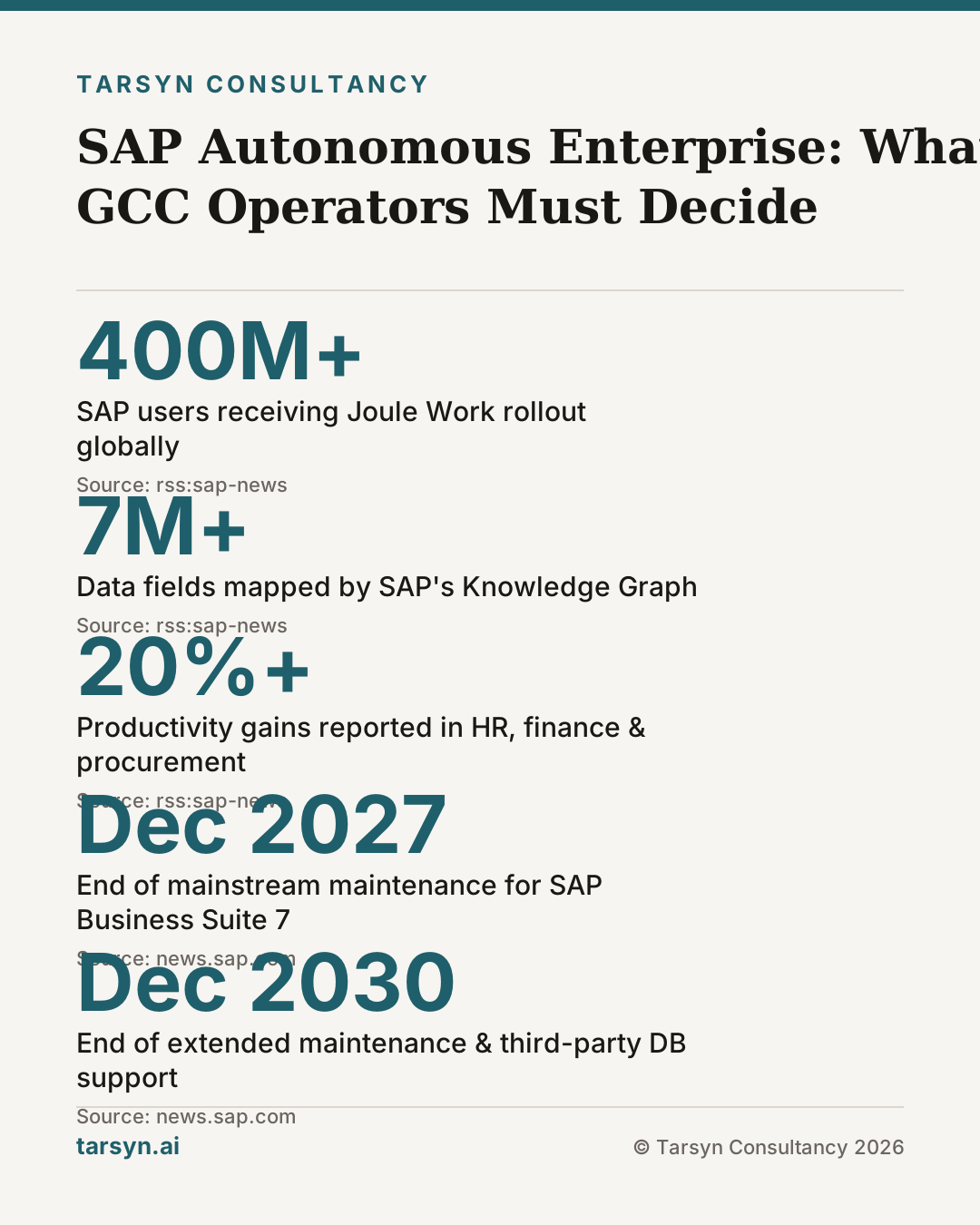
- SAP is rolling out Joule Work to all 400+ million users this month, built on a Knowledge Graph of 7 million data fields and 50,000 APIs — the autonomous layer is no longer a roadmap slide.
- Business Suite 7 mainstream maintenance ends December 31, 2027; third-party database and Java support agreements expire December 31, 2030 — two hard clocks, not one.
- SAP's own internal data shows 20%+ productivity gains in HR, finance, and procurement from Joule — but only where data context is already clean and unified.
- Most GCC SAP shops will hit a data fragmentation problem before they hit an AI capability problem; fixing that sequence first is the only way autonomous features pay off.
A Gulf trading conglomerate running SAP ECC on Oracle Database, with seventeen custom Z-tables feeding a legacy approval chain, watched SAP Connect's keynote last week and saw one thing: a beautiful demo of things their system cannot do yet. That gap — between what SAP showed in Las Vegas and what most GCC SAP shops actually have running — is the real decision point that emerged from Connect 2026.
What SAP Actually Announced at Connect — and What It Means in Practice
SAP CEO Christian Klein's message at Connect was precise: the Autonomous Enterprise, first introduced at Sapphire in May 2026 as "the beginning of better," is now shipping [1]. This month, SAP is rolling out Joule Work to all customers — all 400 million-plus SAP users, globally, simultaneously [1].
Joule Work rests on three pillars: conversations (users delegate tasks to agents in plain language), spaces (contextual work surfaces replacing traditional transaction menus), and Joule Studio (a build environment for custom agents) [1]. The intelligence underneath is SAP's Knowledge Graph, mapping more than 7 million data fields, 50 million tables, more than 50,000 public and private APIs, and 400 data products [1]. Klein's framing: "That's why Joule doesn't guess."
SAP's own deployment tells the productivity story. The company's 110,000 employees are already running hundreds of thousands of tasks daily through Joule, with reported productivity gains of over 20% in HR, finance, and procurement, and larger gains in complex analytical and planning work [1].
The second layer, the SAP Autonomous Suite, extends this to end-to-end process orchestration — AI agents coordinating across SAP and non-SAP systems, not just responding to queries inside a single module [4].
For enterprises already on S/4HANA Cloud, this is a software update. For everyone else, it is an architecture question with a hard deadline attached.
Joule Work and the Autonomous Supply Chain: Capabilities vs. Readiness
The vision SAP is selling is coherent: an AI-native operating model where governed agents orchestrate business processes end-to-end, with humans in the loop by design [4]. The Business AI Platform provides the runtime; Joule Work provides the interface; the Knowledge Graph provides the context that stops agents from hallucinating across your procurement data.
That context is the catch. SAP's Knowledge Graph works because SAP controls the semantic layer — the mapping of 7 million data fields is SAP's intellectual property, built over decades [1]. Where your SAP implementation is clean and close to standard, Joule can traverse your processes intelligently. Where it is not — where there are deep customisations, third-party middleware, non-SAP data sources stitched in with flat-file transfers, or master data that diverges between plant codes — Joule's context collapses into the same data quality problem your ERP has always had.
For GCC supply chain operations specifically: a Jebel Ali distribution arm running SAP with a bespoke warehouse management bolt-on and daily stock reconciliation via spreadsheet will not get an autonomous supply chain from Joule. It will get an articulate interface on top of an unresolved data problem. Multiply chaos by intelligence and you get articulate chaos.
The readiness question is not "can we turn on Joule Work?" — you can, it is rolling out to all customers. The question is "does our underlying data model support what Joule needs to reason correctly?" For most GCC SAP sites, the honest answer is not yet.
The 2030 Clock: What Business Suite 7 and NetWeaver Customers Must Decide
The timeline pressure is real and has two distinct deadlines that are easy to conflate [2].
Deadline one — December 31, 2027: Mainstream maintenance for SAP Business Suite 7 ends. After this date, SAP will not deliver legal and regulatory updates, patches, or corrections under standard maintenance terms [2].
Deadline two — December 31, 2030: Optional extended maintenance ends. At the same moment, SAP's current reselling and support agreements with major third-party database providers — Oracle, IBM DB2, and others — and Java arrangements for these legacy environments also expire [2]. This is the compounding event. Two support layers dropping simultaneously, not sequentially.
SAP's Philipp Herzig, writing on October 7 2026, was explicit: "Customers using these technologies should prepare now and plan accordingly" [2]. The German-speaking SAP User Group (DSAG) board member Michael Bloch echoed the urgency: "Early information is essential for companies operating SAP landscapes" and "any decision should be based on a comprehensive assessment of all available alternatives" [2].
Four-plus years sounds comfortable. For a GCC enterprise with a complex SAP landscape, it is not. A S/4HANA migration for a mid-size manufacturing or trading company typically runs eighteen to thirty-six months of implementation work, preceded by six to twelve months of assessment, data cleansing, and landscape simplification. Start the assessment in 2027 and you are cutting it very close to 2030 — with zero buffer for Ramadan schedule compression, approval chain delays, or the system integrator capacity crunch that will arrive as the 2030 deadline concentrates demand.
Our earlier analysis of the SAP 2027 Deadline covers the extend-or-replace calculus in detail. The 2030 layer adds a new dimension: it is not just your SAP maintenance that expires, it is the vendor ecosystem holding your third-party database configuration together.
Why Most GCC SAP Sites Will Hit a Data Problem Before an AI Problem
SAP's autonomous features require four things at the data layer: trusted data foundations, unified semantics, governed APIs, and business-context-aware AI [4]. Strip any one of them and the autonomous layer degrades.
GCC SAP implementations — particularly those that went live in the 2008-2015 wave — commonly have:
- Heavily customised codebases that diverge from SAP standard, making clean HANA migration technically complex and expensive.
- Master data fragmented across systems — vendor masters that differ between MM and FI, customer records that don't match the CRM, plant codes that only make sense to the person who set them up in 2011.
- Non-SAP integrations running on flat files or custom middleware, outside SAP's API governance layer entirely.
- Reporting built on copied data — data extracted nightly into local Excel or Power BI environments because the SAP environment was too slow or too locked-down to query directly. As we noted in A Dashboard Is Not a Decision, dashboards that report on replicated data cannot support agents that need to act on live operational data.
- WhatsApp-as-ERP patterns for last-mile approvals — purchase requisitions approved via WhatsApp group, then keyed into SAP retroactively. Any agent trying to reason over your procurement process will find gaps where the real decisions happened outside the system.
The data problem is not unique to the GCC. But the GCC variant has specific characteristics: high rates of manual workaround adoption driven by slow approval chains, significant localisation customisation for Arabic reporting and VAT compliance added in layers, and a consulting market that historically rewarded fast go-live over clean configuration.
Before any conversation about Joule, autonomous agents, or Business AI Platform, the relevant question is the one we walk through in the five-step audit before any AI spend: where is the data actually governed, and where is it just assumed to be correct?
Tarsyn's View: The Right Sequence for Moving Toward Autonomous SAP Operations
We are not going to tell you to rush toward SAP's autonomous vision. We are going to tell you what order to do things in, because the order is what determines whether you get a return.
Step 1: Landscape audit before roadmap commitment. Before signing anything — RISE with SAP, a new system integrator contract, a BTP licence — map what you actually have. Count the custom Z-objects. Document every non-SAP integration. Score your master data quality in the four core domains: vendor, customer, material, finance. If you do not know what you have, you cannot plan a credible migration. Start with our /Audit engagement — it is designed to produce exactly this output in four to six weeks, and the findings are yours regardless of what you decide next.
Step 2: Decide extend-or-replace before the 2027 mainstream maintenance window closes. If you are on Business Suite 7, you have a genuine choice until the end of 2027 maintenance: extend with SAP support packages, or begin S/4HANA migration. After 2027, extended maintenance has a cost premium and narrows your options. After 2030, you are managing a system with no vendor support for the database layer. The decision is not "migrate now vs. never" — it is "migrate on your timeline vs. on the deadline's timeline."
Step 3: HANA migration and master data governance in parallel. The HANA migration is the technical prerequisite. Master data governance is the business prerequisite. Running them sequentially wastes eighteen months. Running them in parallel — with a dedicated data stewardship workstream alongside the technical migration — is harder to manage but produces a system that Joule can actually reason over on day one of go-live.
Step 4: API layer before AI layer. SAP's Knowledge Graph works through governed APIs. If your landscape has custom integrations bypassing standard APIs, the autonomous layer cannot see those processes. Rationalising your integration architecture onto BTP Integration Suite or an equivalent governed middleware is the prerequisite for any agent that needs end-to-end visibility. We covered the ROI case for this in 368% ROI on SAP Integration.
Step 5: Autonomous features as the outcome, not the objective. Joule Work, AI agents, the Business AI Platform — these are what you get when the four steps above are complete. They are not the project. They are the benefit of doing the project correctly.
The operators who will extract real value from SAP's Autonomous Enterprise over the next four years are not the ones who move fastest toward the AI features. They are the ones who build the foundation that makes those features work as advertised. The 2030 deadline is a forcing function for that foundation — use it.
If you want to know where your SAP landscape actually stands before committing to a direction, start with the audit. We charge the same whether the answer is "migrate now" or "not yet."
By Mohammed Z, Tarsyn — Abu Dhabi & Khobar
Frequently asked questions
What did SAP announce at Connect 2026 that affects existing customers?+
SAP announced the full rollout of Joule Work — described as a new AI engagement UI for all 400+ million SAP users — alongside the Autonomous Suite and Business AI Platform. Critically, it also clarified that third-party database and Java support agreements for legacy environments expire December 31, 2030, making the migration conversation urgent for any site still on Business Suite 7 or older NetWeaver stacks.
What is the actual 2027 vs. 2030 deadline difference for SAP customers?+
Mainstream maintenance for SAP Business Suite 7 ends December 31, 2027. Optional extended maintenance runs through December 31, 2030, but at that point SAP's reselling and support agreements with third-party database providers and Java also expire. Customers on those legacy configurations face a compounding deadline: two support layers dropping simultaneously at end of 2030.
Can GCC enterprises realistically benefit from SAP's autonomous AI features on their current systems?+
Only if their data foundation is clean. SAP's autonomous features — Joule Work, agent orchestration, Business AI Platform — require unified semantics, governed APIs, and consistent master data. Most GCC SAP deployments carry years of customisations, third-party add-ons, and fragmented data models. Autonomous AI layered on top of fragmented data produces faster wrong answers, not faster right ones.
What is the right sequence for a GCC SAP operator preparing for the 2030 deadline?+
Audit the current data model and integration landscape before committing to any AI or migration roadmap. Identify which processes are broken at the data layer versus the application layer. Prioritise HANA migration and master data governance, then evaluate RISE with SAP or BTP integration. Autonomous features should come last — they are the reward for doing the foundational work, not the starting point.
Sources
Mohammed Z
Founder, Tarsyn
Mohammed builds the systems behind modern businesses — automation, AI decision layers, and the unglamorous plumbing that makes them work. He founded Tarsyn in Abu Dhabi.
Find out where your operation actually stands.
The AI Opportunity Audit maps your workflows, your data, and your decision bottlenecks — and tells you honestly whether AI is worth it yet.
Start the audit