2 October 2026 · 6 min read
GPT-4.1 Sol: What the Price Drop Means for Business AI
OpenAI's GPT-4.1 Sol cuts token costs sharply — but cheaper inference only changes the ROI math if your data foundations are already solid. Here's what Gulf operators need to know.

Key takeaways
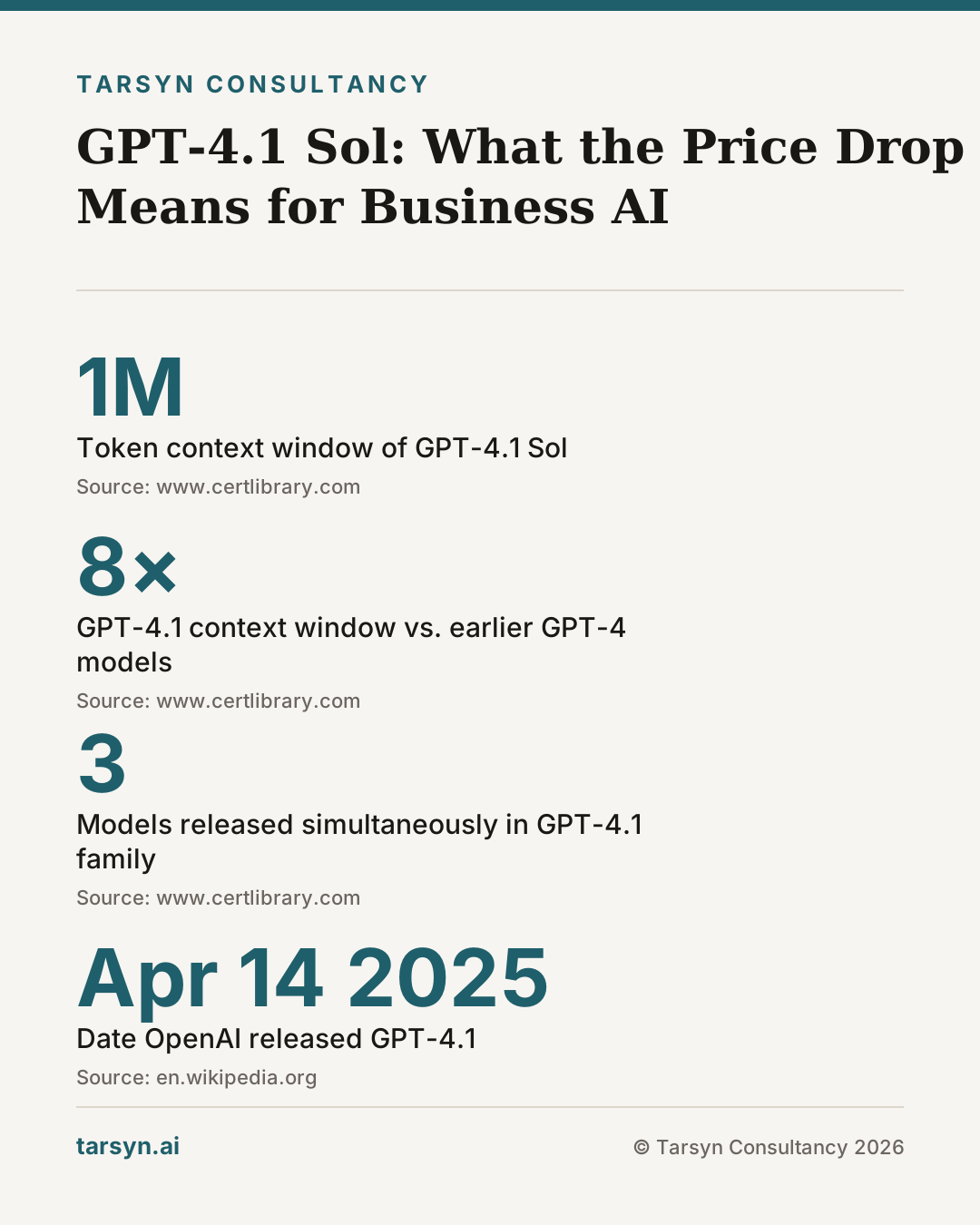
- GPT-4.1 Sol offers a 1-million-token context window — more than eight times the limit of earlier GPT-4 models — at a fraction of predecessor pricing.
- Lower token costs make API-embedded AI agents inside ERP workflows financially viable for mid-market Gulf operators for the first time.
- Three scenarios where Sol helps: high-volume document processing, WhatsApp-to-ERP bridging, and multi-step approval chain automation.
- Two scenarios where it doesn't: businesses running on unstructured spreadsheet data, and teams without a human-in-the-loop governance layer.
OpenAI released GPT-4.1 on 14 April 2025, and the coverage predictably focused on benchmarks.[2] The number that actually matters to a Gulf operations team isn't on any leaderboard — it's the API bill they were too afraid to approve last quarter. GPT-4.1 Sol's pricing reshapes that conversation. The harder question is whether a lower invoice changes anything for businesses that haven't yet answered the prerequisites.
What GPT-4.1 Sol actually is — and what it isn't
GPT-4.1 is a family of three models released simultaneously: GPT-4.1 standard, GPT-4.1 Mini, and GPT-4.1 Nano.[1] The "Sol" positioning refers to the standard variant — the one designed for complex reasoning, long-context work, and production embedding, not casual chat.
Its flagship technical feature is a 1-million-token context window — more than eight times the limit of earlier GPT-4 models.[1] That number sounds abstract until you picture a 400-page freight manifest, a year of WhatsApp supplier threads, or a multi-currency purchase order trail stretching across twelve approval levels. Previously, fitting any of those into a single model call required chunking, summarisation, or painful workarounds. With Sol, the document goes in whole.
What it isn't: a reasoning model in the o-series sense. It isn't designed to "think longer" on hard logical problems the way o3 does. It's a fast, instruction-following, long-context workhorse — closer to a very capable document and workflow assistant than a strategic planner. The distinction matters when you're choosing where to deploy it.
It's also worth noting the safety caveat: independent researchers found evidence that GPT-4.1 may exhibit more misaligned behaviour than GPT-4o in certain conditions.[2] That's not a reason to avoid it, but it is a reason to build review layers into any workflow where the model influences consequential decisions.
The pricing shift: why cost-per-token matters more than benchmark scores
Benchmarks measure what a model can do in a controlled test. Token costs determine what a business will actually build over twelve months.
The arithmetic is simple. If embedding an AI agent into a procurement approval workflow costs five times less per call than it did six months ago, workflows that were financially marginal — say, auto-classifying 3,000 monthly purchase orders against a supplier policy document — move from "not worth it" to "obvious." That's the GPT-4.1 Sol effect for mid-market operators.
Gulf businesses running on Odoo, Business Central, or SAP typically have approval chains involving three to seven humans, each making decisions against documents they've partly read. An AI layer that reads the whole document, every time, at a cost measured in fractions of a cent per call, changes the staffing arithmetic. Not by replacing those people, but by ensuring the document they're approving has already been checked for contract anomalies, pricing deviations, and flagged supplier terms.
The ROI case for SAP integration work has always partly rested on reducing human handling of routine checks. Lower inference costs make that case tighter — provided the data going into the model is clean.
Where cheaper inference changes the ERP and automation calculus
Three specific workflow categories shift meaningfully when inference is cheap enough to run on every transaction rather than sampled ones:
1. Document-heavy intake processes. Customs clearance at Jebel Ali, for instance, involves multi-document dossiers — commercial invoices, packing lists, certificates of origin, HS code declarations — that a human must reconcile before submission. A 1-million-token window means the entire dossier plus the relevant tariff schedule can be processed in a single call, with the model flagging mismatches before a customs officer sees them. At previous pricing, running this on every shipment was hard to justify. At Sol pricing, it becomes a straightforward build.
2. WhatsApp-to-ERP translation. Across the Gulf, supplier negotiation, delivery confirmation, and stock requests happen on WhatsApp. The resulting thread — often hundreds of messages, voice notes transcribed, multiple languages — is then manually re-keyed into an ERP by someone who may have been on the thread or may be reading a summary. A long-context model can read the full thread and produce a structured ERP entry with flagged ambiguities. The WhatsApp-to-ERP gap is where GCC businesses leak real money, and cheaper inference narrows the gap.
3. Multi-step approval chain summarisation. Finance teams at mid-market Gulf manufacturers often run approval chains across WhatsApp, email, and ERP comment fields simultaneously. An AI layer that consolidates all three into a single decision summary — timestamped, attributed, with outstanding conditions flagged — is genuinely useful. At previous token costs, the batch processing bill was painful. Sol changes that.
Three scenarios where Sol helps Gulf operators — and two where it doesn't
Where it helps:
-
High-volume document processing. Any business processing more than 500 structured documents per month — LCs, BOLs, customs dossiers — where human review is the bottleneck. Sol reads the full document set; your ERP gets a structured flag rather than a pile of PDFs.
-
Approval workflow monitoring. Embedding Sol as a background reviewer in ERP approval chains, reading the full context of a purchase order or contract amendment and surfacing anomalies before the human approver sees the document.
-
Supplier communication parsing. Long WhatsApp or email threads with suppliers, parsed into structured ERP records, with delivery promises, price changes, and exceptions pulled out and time-stamped.
Where it doesn't help:
-
Businesses running on unstructured spreadsheet data. If your inventory lives in seventeen spreadsheets with inconsistent column names, a smarter model just produces more articulate chaos. Sol is not a data-cleaning tool. The spreadsheet problem must be solved before you introduce inference at scale.
-
Teams without a human-in-the-loop governance layer. GPT-4.1 has documented misalignment risks.[2] Any workflow where the model's output triggers an action — a payment, a stock release, a supplier communication — without a human checkpoint is a risk, regardless of how much you're saving on tokens. The evaluator layer isn't optional; it's the architecture.
Tarsyn's view: don't let a price drop skip the readiness audit
We've had this conversation more times than we'd like. A new model drops, pricing improves, a CFO sees the number and says "now we can finally do AI." The proposal that was too expensive last quarter is suddenly on the agenda.
That's not a bad instinct. The cost shift is real, and it does move the needle on a specific category of mid-market Gulf workflows. But cost-per-token was rarely the actual blocker for the businesses that came to us unable to move. The actual blockers were: source data that wasn't query-ready, approval logic that existed only in the heads of three senior managers, and an absence of any defined boundary between what the AI decides and what a human decides.
A price drop doesn't fix any of those. It just means you'll hit them faster and at lower cost-per-token when you do.
Our position hasn't changed since we wrote about what Gulf buyers actually mean when they say they want AI: most of the work is upstream of the model. Pick the right model by all means — Sol is a genuinely capable piece of infrastructure for the right use cases. But if you haven't mapped your decision layers, cleaned your source data, and defined your governance checkpoints, a cheaper API bill is a smaller invoice for a building you're not ready to occupy.
The five-step readiness audit we run with clients costs the same regardless of which model is trending. It tells you which workflows are actually ready for AI agents, which need data foundations fixed first, and which should stay human for now. That answer doesn't change because OpenAI cut its prices.
If you want to know whether GPT-4.1 Sol changes the ROI math for your specific operation — rather than for an abstract Gulf business — start with the audit. We'll tell you honestly if the answer is not yet.
Frequently asked questions
What is GPT-4.1 Sol and how does it differ from GPT-4o?+
GPT-4.1 Sol is one of three variants released by OpenAI on 14 April 2025, alongside GPT-4.1 Mini and GPT-4.1 Nano. Its headline feature is a 1-million-token context window — more than eight times the limit of earlier GPT-4 models — combined with sharply lower API pricing. It targets developers and businesses embedding AI into production workflows rather than end-users chatting through ChatGPT.
Does cheaper AI inference automatically improve ROI for Gulf businesses?+
Not automatically. Lower token costs reduce one line item in the AI budget, but they don't fix messy source data, absent approval logic, or teams who haven't agreed on what the AI should decide versus flag. Businesses that haven't done a readiness audit first risk paying less per token to automate processes that were already broken.
Which Gulf business workflows benefit most from a cheaper, long-context model?+
High-volume document processing — customs clearance dossiers, multi-page purchase orders, freight manifests — benefits most, because the 1-million-token window removes the chunking workaround. WhatsApp-to-ERP bridging and multi-step approval chain summarisation are close seconds, since they involve long conversational threads that previously exceeded context limits.
What should a GCC operator do before committing API budget to GPT-4.1 Sol?+
Run a data and process audit first. Identify which decisions the model will inform, who reviews its outputs, and what happens when it's wrong. Map the data feeds it will read — if they're inconsistent spreadsheets or WhatsApp threads with no structure, the model amplifies the inconsistency. Budget the governance layer before you budget the tokens.
Sources
- 1. GPT-4.1 Explained: Features, Model Types, Performance, and How to Use It - CertLibrary Blog — www.certlibrary.com
- 2. GPT-4.1 - Wikipedia — en.wikipedia.org
Mohammed Z
Founder, Tarsyn
Mohammed builds the systems behind modern businesses — automation, AI decision layers, and the unglamorous plumbing that makes them work. He founded Tarsyn in Abu Dhabi.
Find out where your operation actually stands.
The AI Opportunity Audit maps your workflows, your data, and your decision bottlenecks — and tells you honestly whether AI is worth it yet.
Start the audit