21 September 2026 · 6 min read
Enterprise AI Now Needs an Evaluator, Not Just a Vendor
Anthropic just embedded Accenture inside its labs as an AI evaluator. For Gulf operators buying AI tools, "trust the vendor" is no longer a governance posture that holds.
Key takeaways
- Anthropic and Accenture each committed at least $1 billion over five years to embed external evaluators inside Anthropic's own building — a structural admission that frontier AI needs a watchdog on site.
- Embedded evaluators get access comparable to a full employee: they observe model training, monitor deployment decisions, and interact directly with staff — not just finished outputs.
- Three failure modes slip past vendor assurances: silent drift in model outputs, hallucinated data in structured workflows, and approval-chain gaps that automation tools exploit.
- For GCC operators, the procurement deliverable is an internal audit and evaluation framework before any AI contract is signed — not after go-live.
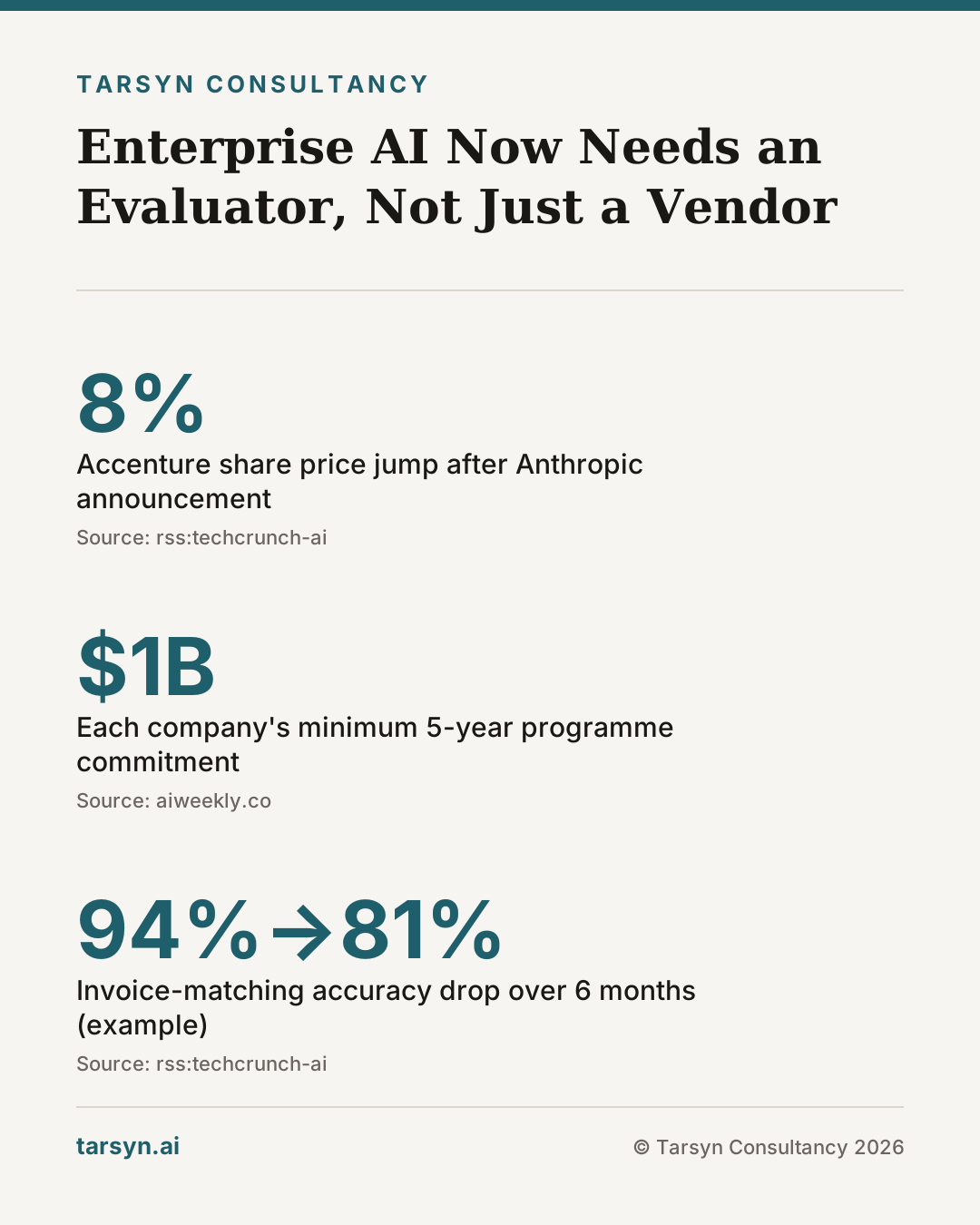
A consulting giant just got an office desk inside an AI safety lab — and the markets noticed. Accenture's shares jumped 8% after hours when Anthropic announced its first embedded evaluator arrangement. [1] Investors weren't celebrating a research breakthrough. They were pricing in a new consulting revenue category: AI watchdog services. For Gulf operators running AI-augmented procurement, ERP, or workflow tools, that market signal deserves more attention than the press release.
What Anthropic and Accenture Actually Announced
On September 18, 2026, Anthropic confirmed that staff from Faculty — the specialist AI division Accenture acquired earlier this year — would work inside Anthropic's own building. [1] The job: red-teaming models, conducting alignment assessments, and testing model safeguards. The access level granted is explicitly "comparable to an employee's," meaning these evaluators can observe model training in progress, monitor deployment decisions, and talk directly to Anthropic staff — not just poke at finished outputs from the outside. [2]
Both companies committed at least $1 billion each over five years to the programme. [2] The arrangement is described as non-exclusive — Anthropic is in parallel talks with METR, Redwood Research, and other safety-focused nonprofits about piloting elements of embedded evaluation using their own funding. [1]
What surprised AI watchers was the choice of Accenture over safety-native organisations like METR. Anthropic's stated rationale: Accenture's practical experience deploying AI for large corporations and government agencies matters as much as deep-learning research credentials. [1] That is a revealing admission about where AI failures actually occur — not in the lab, but in the enterprise deployment.
Why Enterprise AI Fails Quietly Without an Evaluation Layer
The structural problem is not dramatic. Models do not suddenly refuse to work. They drift. An invoice-matching workflow that was 94% accurate in month one is 81% accurate in month six — and nobody notices because the dashboard still shows "automation running." A procurement agent trained on last year's supplier data starts recommending vendors that no longer hold valid trade licences in the UAE. An approval-chain automation skips a signatory step because a staff reorganisation changed a role name that the workflow logic referenced by exact string.
None of these failures announce themselves. That is the "quiet and expensive" failure mode that the Anthropic-Accenture deal implicitly acknowledges. Anthropic frames the arrangement plainly: "independent embedded evaluators do not reduce our accountability, but help to make it more verifiable." [2] Verifiability is the operative word. A vendor's internal QA process verifies what the vendor chose to test. An embedded evaluator — with employee-level access — can find what nobody thought to look for.
For GCC operations specifically, the failure modes compound. Many Gulf businesses still run approval hierarchies on WhatsApp and shadow-data in spreadsheets alongside their ERP. [See: The WhatsApp-to-ERP Gap Is Where GCC Businesses Leak Money.] When AI tools are layered onto this architecture, the automation inherits the ambiguity. A model that behaves correctly in a clean demo environment can behave unexpectedly when half the input data arrives as a forwarded WhatsApp screenshot and half comes from an SAP export.
The Three Things a Real AI Evaluator Catches Before Go-Live
Based on the Anthropic-Accenture structure — and on the practical failures we see in GCC deployments — a rigorous evaluation layer looks for three things the vendor's own testing typically misses:
-
Output drift under real data conditions. Vendors test on curated datasets. Real operations have dirty data: duplicate vendor codes, Arabic-English field mismatches, fiscal year formats that differ by entity. An evaluator runs the model against your actual data, not the vendor's demo set, and measures accuracy degradation over a simulated six-month window.
-
Hallucinated structure in high-stakes workflows. Language-model-based tools can generate plausible-looking but factually wrong outputs — a purchase order with a transposed amount, a contract summary that omits a liability clause. Standard QA checks whether the output exists; an evaluator checks whether it is correct. This matters enormously in invoice automation and contract review, two areas where Gulf businesses are adopting AI fastest. [See: Invoice Automation That Actually Holds: A GCC Buyer's Guide.]
-
Governance and approval-chain gaps. Automation tools are designed to reduce friction. That is also what makes them dangerous in environments with multi-tier approval requirements — common in Saudi government-linked entities and UAE free-zone operators. An evaluator maps every decision the AI makes autonomously and asks: does a human see this before it becomes irreversible? [See also: When Automation Reports Success and Your Business Fails.]
None of these checks require a $1 billion partnership. They require a structured methodology applied before the contract is signed — not during hypercare.
What This Looks Like for ERP and Workflow AI in the GCC
Gulf ERP buyers are not evaluating frontier safety labs. They are evaluating whether a Dynamics 365 Copilot agent, an Odoo AI feature, or an n8n workflow automation tool will hold up in a real operating environment — with Ramadan freight cutoffs, multi-currency VAT filings, and approval chains that run through a principal's office before any PO above AED 50,000 is released.
The Anthropic-Accenture deal is instructive precisely because it applies the same logic at a different scale. The question is not "is this AI safe in the abstract?" The question is "what does this AI do when it encounters the edge cases in our specific environment?" For ERP buyers, those edge cases are not hypothetical. They are the seventeen spreadsheets your warehouse team still maintains in parallel with the ERP because nobody trusts the system's stock count after the last integration broke silently. [See: Most Companies Don't Need More AI.]
AI vendors operating in the GCC — whether selling ERP copilots, document automation, or agentic workflow tools — are not structured to surface these failures before go-live. Their incentive is to close the deal and hit the implementation milestone. An evaluation layer breaks that incentive alignment. It creates a separate, structured process for asking: what would have to be true for this to fail, and how would we know?
Tarsyn's View: Your Evaluator Should Be Internal Before It Is External
The Anthropic-Accenture arrangement is genuinely useful for the AI industry. It is also a cautionary tale for enterprise buyers who read it as "Anthropic is handling safety, so we don't have to."
The deal does not transfer safety responsibility to Accenture. Anthropic acknowledges this directly: the evaluator "helps to make accountability more verifiable" — it does not replace the lab's own accountability. [2] By the same logic, your AI vendor's safety documentation does not replace your organisation's accountability for what the tool does inside your operations.
There is also an independence problem worth naming. Anthropic funds its own evaluator. The evaluators have employee-level access, but Anthropic may redact "security, legal, or commercial material." [2] Investors see this as a new revenue category; critics see it as a conflict of interest dressed in audit language. Gulf buyers should apply exactly that scepticism to any vendor that offers to evaluate its own deployment on your behalf.
Our honest position: the evaluation framework is the procurement deliverable. Before you sign any AI contract — for workflow automation, ERP copilot features, document processing, or agentic tools — you need a structured internal audit that defines what good looks like, what failure looks like, and who owns the difference. That audit should happen before the vendor demo, not after the go-live. It should be run by someone whose job does not depend on the project succeeding.
We run this audit for clients across the GCC. Sometimes it confirms the AI purchase is the right next step. Sometimes it reveals that fixing three broken integrations and consolidating four reporting spreadsheets would deliver more value than any AI tool currently on the market. We charge the same either way. Start with our structured pre-AI audit →
If you want the longer version of the audit methodology — the five-step framework we use before recommending any AI spend — it is here: The Audit That Decides If AI Is Worth It. And if you are wondering whether your dashboards are already giving you the decision support you think they are before you layer AI on top, this is worth reading first: A Dashboard Is Not a Decision.
Multiply chaos by intelligence and you get articulate chaos. The evaluator's job — internal or external — is to find the chaos before the contract is signed, not after the automation has been running quietly wrong for six months.
Frequently asked questions
What did Anthropic and Accenture actually announce?+
Anthropic announced it will embed evaluators from Accenture's Faculty division inside its own operations. These evaluators will red-team models, conduct alignment assessments, and test safeguards — with access comparable to a full employee. Both companies committed at least $1 billion each over five years to the programme. Anthropic described this as the first in a planned series of embedded evaluator arrangements.
Why does enterprise AI need an independent evaluator?+
Vendor teams are incentivised to ship, not to surface failures. An independent evaluator — embedded before go-live, not after — catches output drift, hallucinated data in structured workflows, and compliance gaps that standard QA misses. The Anthropic-Accenture deal formalises this logic at the frontier-lab level. The same logic applies to any organisation deploying AI in finance, procurement, or operations.
What should a Gulf business do before signing an AI contract?+
Build an internal evaluation framework first: map which decisions the AI will touch, define what a wrong output looks like, and assign a human owner for each automated step. This is not extra process — it is the procurement deliverable. Signing a contract and running a pilot without this framework means your vendor's go-live checklist becomes your de facto governance standard.
Is the Accenture evaluator role a conflict of interest?+
Structurally, yes — and Anthropic acknowledges it. The lab funds its own watchdog, which creates an independence problem. Anthropic is in parallel talks with METR and other nonprofits about government- or pooled-funded evaluation models. Until those alternatives exist at scale, the lesson for buyers is clear: do not rely on a vendor's self-commissioned evaluation as your only assurance layer.
Sources
- 1. Anthropic’s first embedded evaluator is … Accenture? — rss:techcrunch-ai
- 2. Anthropic, Accenture Pledge $1B Each to Embed AI Evaluators | AI Weekly — aiweekly.co
Mohammed Z
Founder, Tarsyn
Mohammed builds the systems behind modern businesses — automation, AI decision layers, and the unglamorous plumbing that makes them work. He founded Tarsyn in Abu Dhabi.
Find out where your operation actually stands.
The AI Opportunity Audit maps your workflows, your data, and your decision bottlenecks — and tells you honestly whether AI is worth it yet.
Start the audit