16 October 2026 · 7 min read
SAP FPS02: When ERP Stops Experimenting
SAP FPS02 embeds AI agents directly into governed ERP workflows. For GCC operators, the real question is whether your data and processes are clean enough to use them.
Key takeaways
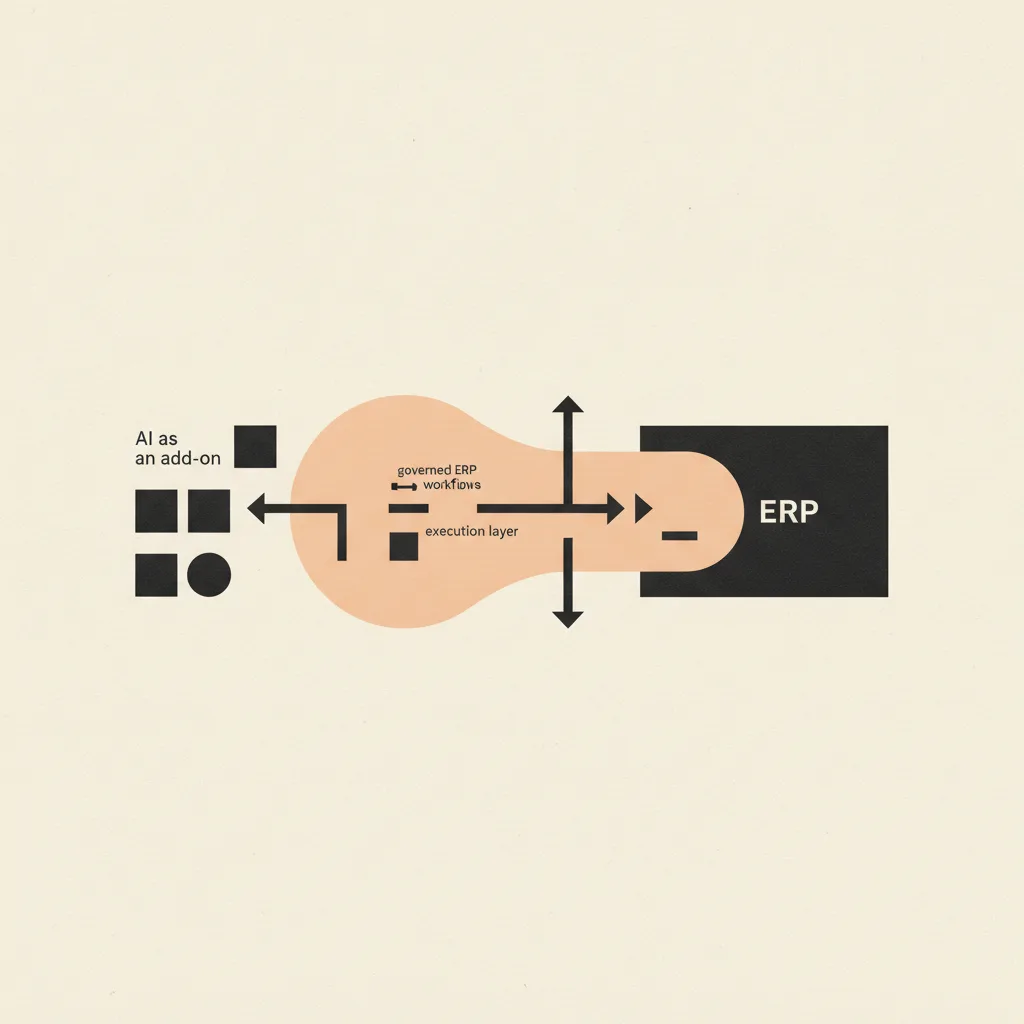
- SAP FPS02 ships AI agents embedded in finance, sales order-to-cash, and asset-intensive industry workflows — not as optional add-ons but as execution-layer components.
- The release frames ERP as the governance layer AI needs: trusted data, defined business rules, and human-review checkpoints built in.
- For GCC operators, three capabilities matter most right now: AI-assisted period-close, fulfillment-exception agents in order-to-cash, and regulatory compliance automation.
- No AI agent in FPS02 can fix dirty master data, unconfigured roles, or approval chains that live in WhatsApp — clean the foundation before upgrading the feature set.
An ERP system sits at the center of most Gulf enterprises — approving purchase orders, closing financial periods, releasing inventory to logistics. For years, AI sat beside that system, offering recommendations that someone still had to act on. SAP's FPS02 release changes the geometry. The agents don't advise anymore. They execute.
That shift is worth examining carefully, because it changes what a well-run SAP implementation actually needs to look like — and the gap between where most GCC deployments stand today and where they need to be is significant.
What SAP FPS02 Actually Ships — and What It Doesn't Promise
SAP Cloud ERP Private 2025 Feature Pack Stack 02 (FPS02), released in October 2026, introduces AI agents and AI-assisted capabilities embedded directly into core business process domains [1]. These are not chatbot overlays or dashboard summaries. They operate inside the workflow.
In finance, agents support planning and forecasting, period-close activities, working capital management, tax processes, and compliance operations [2]. The premise is that instead of an employee manually identifying a reconciliation discrepancy and emailing the relevant team, the system surfaces the risk, recommends a resolution, and manages the exception chain.
In sales order-to-cash, agents enable teams to identify fulfillment issues and receive resolutions without leaving the process context [1]. Asset-intensive industries, retail, and energy sectors each receive additional industry-specific capabilities in this release.
What FPS02 doesn't promise: it doesn't promise that your data is clean enough for agents to act on correctly. It doesn't promise that your authorization model will hold when an agent can initiate a transaction. And it doesn't promise that the cultural assumption — that a human always reviews before execution — will survive contact with a system designed to reduce that review step.
Those promises, or the absence of them, are entirely on the customer side.
The 'Autonomous Enterprise' Frame: Marketing or Architecture Shift?
SAP has been building toward what it calls the "Autonomous Enterprise" for several years. FPS02 is described explicitly as strengthening the foundation for that vision [2].
It's worth separating the marketing language from the architectural claim, because the architectural claim is real and important. SAP's position — stated plainly in the FPS02 announcement — is that AI alone is not enough [1]. To operate at enterprise scale, AI needs access to trusted data, process context, business rules, and governance. ERP is what provides those things. This is why, as SAP notes, "the conversation about AI increasingly becomes a conversation about ERP."
That is not a marketing line. It is a systems architecture fact. AI agents require more than information — they need to understand what actions are permitted, which controls must be respected, and when decisions require human review [2]. An ERP system that has been properly configured, data-harmonized, and role-governed can provide that scaffolding. One that hasn't been touched since its original go-live, with seventeen custom tables and approval workflows that exist only in someone's inbox, cannot.
The shift from "AI as add-on" to "AI as execution layer" is genuine. But it raises the entry bar, not lowers it.
This connects directly to the broader debate around SAP's Autonomous Enterprise strategy and what GCC buyers should weigh before committing.
Why Governed Execution Is the Hard Part for GCC Deployments
GCC enterprise deployments carry a specific set of complications that make "governed execution" harder than it sounds in a product announcement.
Master data integrity. Many Gulf businesses — particularly trading arms, logistics operators, and project-based contractors — carry vendor and material master records that accumulated through multiple ERP rollouts, acquisitions, and manual migrations. Duplicate vendors, inconsistent cost centers, and unit-of-measure mismatches are common. An AI agent that acts on these records doesn't clean them up; it operationalizes the errors at speed.
Authorization and role design. SAP role configurations at many GCC sites reflect the political compromise of the original implementation, not the intended security model. Users have broad access because the project team was under go-live pressure. An AI agent operating within those roles inherits every permission overage. The risks of AI agents operating on poorly configured ERP authorization structures are not theoretical — they are live in multiple deployments in the region.
The WhatsApp approval layer. This is the most consistent finding across GCC implementations: a parallel decision-making infrastructure exists outside the ERP. Approvals travel through WhatsApp group chats. Freight hold decisions happen in a regional manager's phone. Payment releases are confirmed verbally in Jebel Ali warehouse offices. No AI agent embedded in SAP can act on a decision that was made in a messaging app. The process gap is the real implementation problem, and it doesn't show up in any FPS02 demo.
Regulatory compliance cycles. The new compliance capabilities in FPS02 are genuinely useful — particularly for VAT, Zakat, and cross-border documentation requirements across GCC jurisdictions. But they require that the underlying transaction data feeding the compliance engine is accurate and consistently posted. If period-close has historically required manual journal entries to correct classification errors, an AI-assisted close will surface the same errors faster.
As we've written before, a dashboard reports what happened — a decision layer acts on it. FPS02 is building decision layers. That changes what "ready" has to mean.
Three Capabilities That Matter Most to Gulf Operators Right Now
Given where most GCC SAP deployments actually sit, three FPS02 capabilities carry the most immediate relevance:
-
AI-assisted period-close in finance. Gulf finance teams are under pressure from multiple reporting regimes simultaneously — local statutory requirements, group consolidation, and increasingly sophisticated VAT and Zakat reporting. The FPS02 agents that surface period-close risks and recommend actions [1] directly address a pain point that currently consumes significant manual capacity. The prerequisite is clean chart-of-accounts configuration and consistent posting discipline throughout the period, not just at close.
-
Fulfillment-exception agents in order-to-cash. For trading and distribution businesses — a large portion of GCC mid-market operators — the gap between a booked order and a delivered shipment is where margin leaks. Agents that identify fulfillment issues and surface resolutions within the order-to-cash process [2] address a real operational problem. The value depends entirely on whether order management, inventory, and logistics are in SAP or split across legacy systems and spreadsheets.
-
Regulatory compliance automation. New compliance capabilities in FPS02 target asset-intensive industries and energy sectors specifically [1] — both significant in the GCC. For operators managing complex asset bases across multiple legal entities in different jurisdictions, automated compliance support is not a convenience feature; it's a risk-management requirement. Again, the value is proportional to data quality and process consistency.
For context on how ERP selection mistakes compound over time in exactly this kind of environment, see what mid-market manufacturers consistently get wrong in ERP selection.
Tarsyn's View: Don't Buy the Upgrade Before You've Earned It
Here is the honest assessment: FPS02 is a substantive release. The architectural direction — AI execution embedded in governed ERP workflows rather than bolted on top — is correct. SAP's framing that AI needs ERP's governance layer, not the other way around [2], reflects real experience with what happens when you deploy AI against unstructured processes. It produces articulate chaos.
But the release doesn't change the underlying readiness problem. Most SAP implementations we encounter in the GCC — and across the broader Gulf mid-market — have three to five years of accumulated debt: master data that was never cleaned post-go-live, role configurations that were cloned from templates rather than designed, and process adherence that is strong in some areas and completely informal in others.
Enabling FPS02's AI agents on top of that foundation doesn't accelerate the business. It accelerates the existing errors and the existing workarounds.
The question a Gulf operator should be asking right now is not "what's new in FPS02?" It's "if I ran an honest audit of my SAP implementation today — data quality, authorization design, process compliance, the gap between what the system records and what actually happens — what would I find?"
If the answer is uncomfortable, that audit is the investment. Not the feature pack.
We've seen this pattern enough times that we built our engagement model around it: the five-step audit before any AI spend applies here as much as anywhere. And the companies that tend to get the most from ERP AI features are, without exception, the ones who had already fixed what we describe in why most companies don't need more AI — they need better basics.
If you're weighing whether your SAP environment is actually ready for agentic execution, start with a structured readiness audit. Not because the features aren't real — they are — but because the features work exactly as well as the foundation they run on.
FPS02 raises the ceiling on what SAP can do. It does not raise the floor. That work remains yours.
Frequently asked questions
What does SAP FPS02 actually deliver for ERP users?+
FPS02 embeds AI agents and AI-assisted capabilities across finance, sales order-to-cash, and asset-intensive industry processes. These agents surface risks, recommend actions, and manage exceptions — replacing manual issue-spotting with governed, automated execution inside existing SAP Cloud ERP Private workflows. It is not a separate AI product layered on top; it runs inside core business processes.
Is SAP FPS02 relevant to on-premise SAP customers in the GCC?+
Directly, no — FPS02 is part of SAP Cloud ERP Private. But it signals SAP's strategic direction: AI execution requires cloud-hosted, harmonized data and governance infrastructure. For GCC operators still on ECC or hybrid deployments, FPS02 sharpens the case to decide a migration path before the 2027 mainstream maintenance deadline rather than after it.
What are the biggest risks of enabling AI agents in SAP without preparation?+
The three most common failure points are dirty master data that agents act on incorrectly, role and authorization configurations that haven't been audited since go-live, and approval workflows that exist in WhatsApp or email rather than in the system. An AI agent given access to broken processes doesn't fix them — it executes them faster and at greater scale.
How should a Gulf operator evaluate whether they're ready for SAP's AI features?+
Start with a process and data readiness audit before any AI feature activation. Map which decisions are currently made inside SAP versus outside it. If significant approval chains, exception handling, or master data corrections happen in spreadsheets or messaging apps, that gap must close first. The technology is ready; most implementations are not.
Sources
Mohammed Z
Founder, Tarsyn
Mohammed builds the systems behind modern businesses — automation, AI decision layers, and the unglamorous plumbing that makes them work. He founded Tarsyn in Abu Dhabi.
Find out where your operation actually stands.
The AI Opportunity Audit maps your workflows, your data, and your decision bottlenecks — and tells you honestly whether AI is worth it yet.
Start the audit