7 October 2026 · 7 min read
Odoo 20: What Gulf Operators Need to Know
Odoo 20 isn't just a feature drop. For GCC businesses mid-evaluation between Odoo ERP and heavier alternatives, it shifts the calculus — if scoped correctly from day one.
Key takeaways
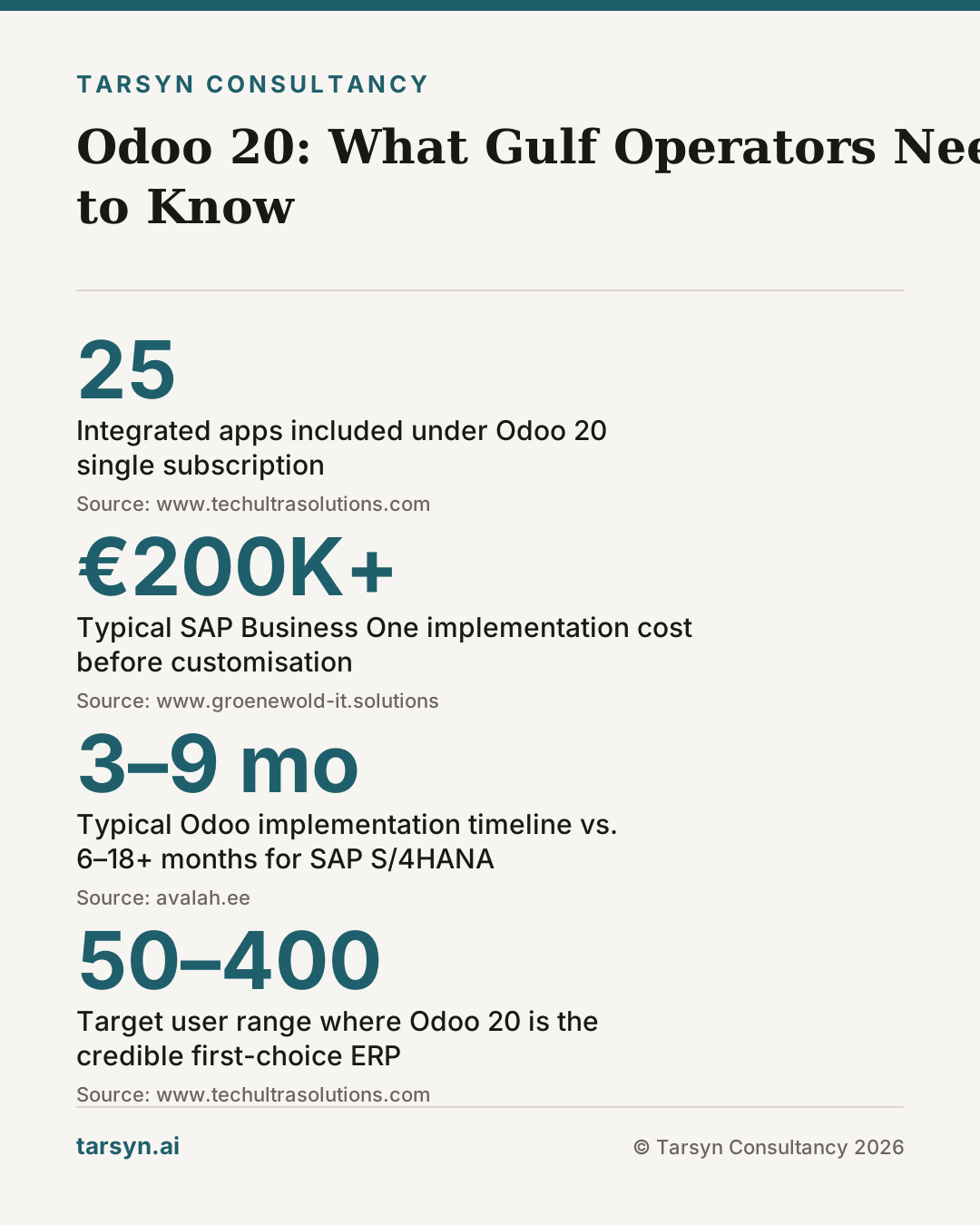
- Odoo 20 ships 25 integrated apps in a single subscription, closing a key cost gap against SAP Business One and Dynamics 365 Business Central for sub-500-seat operations.
- The operational simplification layer — fewer clicks, tighter audit trails — matters more for GCC buyers than the headline Indian tax compliance updates.
- Odoo's typical SME implementation runs 3–9 months versus 6–18+ months for SAP S/4HANA, but that advantage disappears when scope is undefined at kickoff.
- Misscoping is the primary failure mode: treating Odoo 20 as an out-of-box SAP replacement without mapping processes first converts a cost advantage into a rework bill.
Somewhere in Odoo's release notes for version 20, between a paragraph on Indian GST e-invoicing compliance and a note about updated tax ledger structures, sits the feature set that actually matters to a business in Dubai, Riyadh, or Khobar evaluating ERP systems right now. The release didn't lead with it. Most coverage hasn't found it either. That gap is worth closing.
What Actually Changed in Odoo 20 Beyond the Tax Headlines
The loudest announcement in Odoo 20 centres on Indian tax compliance: GST, e-invoicing, updated IRN workflows. Useful for India. Largely irrelevant as a headline for Gulf operators. But read past it and the picture changes.
Odoo 20 ships 25 integrated apps under a single subscription [1]. That's not new territory conceptually — Odoo has bundled apps for years — but version 20 tightens the module architecture in ways that matter operationally. Fewer handoffs between modules, reduced click paths on high-frequency workflows (purchase approvals, inventory adjustments, invoice matching), and an audit trail structure that doesn't require third-party add-ons to produce a clean record.
For GCC operators who have spent the past two years watching their finance teams maintain seventeen spreadsheets alongside a half-configured ERP, those changes are the story. The tax headline is a compliance deliverable for one geography. The operational simplification layer is a platform bet.
Odoo's agentic AI integration also advances in version 20 — Studio now ships in the base subscription, meaning custom workflow logic can be built without developer overhead [1]. That matters for businesses where approval chains are complex and change frequently. It also matters for phased rollouts, where teams need to adjust configurations without triggering a professional services engagement every time.
Why Operational Simplification Matters More Than New Features
There's a pattern in GCC ERP deployments that any implementation team recognises immediately. A company buys a system for its feature list. It goes live on sixty percent of those features. The other forty percent get deferred, worked around, or quietly abandoned. The result is an ERP that costs enterprise money but delivers spreadsheet-era results.
The reason is usually not the software. It's the gap between what the system can do and what the team was actually trained to use. Operational simplification — fewer steps to complete a common task, clearer feedback when something fails, audit trails that don't require a consultant to interpret — directly narrows that gap.
Odoo 20's changes here aren't dramatic. But they're directional. A purchase approval that took four screens now takes two. An inventory discrepancy that previously required a support ticket to trace now surfaces in the stock valuation report directly. These aren't features you put in a brochure. They're the difference between an ERP that people use and one that people route around.
For Gulf businesses where WhatsApp is still a primary coordination layer between warehouse and procurement, and where approval chains involve principals who are not in the office on the same schedule, reducing friction inside the system is not a nice-to-have. It's a prerequisite for adoption.
Odoo 20 vs. the Alternatives: Where It Now Wins and Where It Still Doesn't
Let's be specific, because adjectives don't help anyone make a decision.
Where Odoo 20 now wins for GCC sub-500-seat operations:
- Total cost of ownership. Entry cost is lower than SAP Business One and Dynamics 365, and the single-subscription model means fewer licensing surprises as headcount grows [2]. SAP Business One implementations typically run €50,000–€200,000+ before customisation [2].
- Implementation speed. A well-scoped Odoo project runs 3–9 months. SAP S/4HANA runs 6–18+ months for the same business profile [3]. That timeline difference has real cash implications for a business running on interim systems.
- Flexibility for process-first businesses. Odoo is open source with full code access [3]. For a business whose processes don't conform to SAP's standard flows — common in GCC trading, logistics, and contracting — that flexibility is not a luxury, it's a requirement.
- Phased rollout viability. Version 20's module architecture makes it more practical to start with finance and inventory, then add manufacturing or project management without a re-implementation. The previous version's module interdependencies made phasing painful.
Where Odoo 20 still doesn't win:
- Deep manufacturing. For MES-level functionality — shop floor execution, quality management at scale, detailed capacity planning — SAP S/4HANA's native depth is still ahead [3]. Odoo has MRP and shop floor modules, but complex discrete manufacturers will hit limits.
- Microsoft-stack integration. If your business runs on Azure, Teams, and Power BI with heavy cross-system data flows, Dynamics 365 Business Central is a more natural fit. Integration between Odoo and the Microsoft ecosystem requires custom connectors that add cost and maintenance overhead.
- Heavily regulated multi-jurisdiction compliance. VAT, Zakat, and ZATCA e-invoicing are now addressable in Odoo, but businesses with complex multi-country reporting obligations — spanning UAE, KSA, Bahrain, and international subsidiaries — will find SAP's compliance framework more battle-tested.
The honest summary: Odoo 20 narrows the gap with SAP and Dynamics for sub-500-seat operations. It doesn't eliminate it. And the calculus shifts further in Odoo's favour specifically for businesses that are mid-evaluation right now, because the version 20 architecture makes a phased, lower-risk implementation more achievable than it was eighteen months ago. See also our earlier analysis of what the AI features in Odoo 20 mean for ERP buyers for the AI-specific dimension of this release.
The Implementation Trap: How Odoo 20 Gets Misscoped
This is where Gulf ERP projects go wrong, and it happens with Odoo more than with SAP or Dynamics — partly because Odoo's lower cost and faster sales cycle creates the impression that the implementation itself will be proportionally straightforward.
It won't be. Not if scope is undefined.
The typical misscoping pattern looks like this: a company signs an Odoo implementation contract based on a demo. The demo shows a clean, configured system doing exactly what the business needs. The contract covers module setup and data migration. It doesn't cover process mapping, data remediation, or approval logic documentation — because those were assumed to be the client's responsibility, and no one said that explicitly.
Go-live arrives. The system is configured. The processes aren't. Warehouse staff revert to WhatsApp. Finance runs parallel ledgers in Excel for three months. A second engagement is scoped to fix what the first one missed.
This pattern is documented across GCC ERP deployments of every flavour. We've written about it directly in the context of ERP implementation lessons nobody tells you before you start, and in what mid-market manufacturers get wrong in ERP selection. Version 20 doesn't change the failure mode. It makes a well-scoped implementation faster and cleaner — which is a different thing.
The specific risks for Odoo 20 projects in the GCC:
- Approval chain documentation. Gulf businesses often have informal approval hierarchies that don't map cleanly to Odoo's default workflow engine. These need to be documented and configured before go-live, not discovered during UAT.
- Data quality. Odoo's inventory and accounting modules are only as accurate as the opening balances and master data loaded into them. A ZATCA-compliant e-invoicing setup built on incorrect customer records is compliant in format and wrong in fact.
- Localisation assumptions. ZATCA Phase 2 compliance, Arabic language support, and multi-currency setups for AED/SAR/USD operations all need explicit scoping. They're achievable in Odoo 20 but not automatic.
If you're at the evaluation stage, a structured readiness review before selecting any system — Odoo or otherwise — is the right sequence. Our Audit is designed specifically for that: map your processes and data quality before you commit to a platform, not after.
Tarsyn's View: Who Should Be Paying Attention Right Now
Odoo 20 is not a system upgrade to file away for the next review cycle. For a specific profile of GCC business, it's a decision accelerator.
That profile: a trading, logistics, contracting, or light-manufacturing business with 50–400 users, currently running on a combination of QuickBooks or Tally plus spreadsheets, evaluating whether to move to Odoo or step up to SAP Business One or Dynamics 365 Business Central. Revenue in the AED 20–200M range. One or two legal entities, with ZATCA compliance obligations already live or imminent.
For that business, Odoo 20's single-subscription model, 3–9 month implementation window [3], and improved module architecture make it the credible first-choice ERP today. Not the default because it's cheap. The considered choice because the implementation risk, when scoped correctly, is now lower than it has been at any previous version.
The caveat is non-negotiable: implementation partner selection and scoping rigour determine the outcome more than the software version. We've written specifically about what Gulf buyers get wrong when choosing Odoo implementation partners — it's worth reading before signing any contract.
For businesses already running SAP or Dynamics, Odoo 20 is not a migration argument today. The switching cost and retraining overhead don't justify it unless the existing system is fundamentally broken. If you're in that position, the SAP 2027 deadline analysis is a more relevant starting point.
One more honest note: Odoo 20 with poorly governed AI features enabled is not better than Odoo 17 with clean data. The agentic AI additions — automated document processing, predictive reordering, AI-assisted workflows — only return value when the records they read are accurate. Multiply chaos by intelligence and you get articulate chaos. The order is: fix the data, scope the process, then layer the AI. Every time.
If you're mid-evaluation and want a structured view of whether Odoo 20, SAP, or Dynamics fits your current operations, the Tarsyn Audit is the right first step. We charge the same whether the answer is Odoo or "don't buy anything yet."
Frequently asked questions
How does Odoo 20 compare to SAP S/4HANA for a Gulf business under 500 employees?+
Odoo 20 offers a lower entry cost and faster implementation — typically 3–9 months versus 6–18+ months for SAP S/4HANA — with 25 apps under one subscription. SAP still leads on deep compliance and global enterprise complexity. For sub-500-seat Gulf operations that want one integrated system without six-figure licensing, Odoo 20 is now a credible first-choice, not a fallback.
What actually changed operationally in Odoo 20 beyond tax compliance?+
The headline was Indian GST and e-invoicing compliance, but the substantive change for GCC operators is the operational simplification layer: reduced click paths for common workflows, improved audit trail architecture, and a modular structure that makes phased rollouts more predictable. These changes matter most to businesses that previously found Odoo's module sprawl hard to govern.
What is the biggest implementation mistake Gulf companies make with Odoo ERP?+
Misscoping. Teams treat Odoo as an out-of-box system and defer process mapping until after go-live. The result: custom workarounds, shadow spreadsheets, and a second implementation budget. The correct approach is a structured scoping phase before any configuration begins — mapping existing workflows, data quality, and approval chains to the module architecture Odoo 20 actually ships.
When should a Gulf business choose Dynamics 365 or SAP over Odoo 20?+
When Microsoft-stack integration is heavy, compliance obligations span multiple jurisdictions, or manufacturing depth requires MES-level functionality beyond Odoo's native modules. For mid-market manufacturers running €2–50M in revenue who want flexibility and a single-vendor app suite, Odoo 20 wins on price-to-functionality. The decision hinges on your existing systems, not the feature brochure.
Sources
- 1. Odoo vs SAP S/4HANA | 2026 ERP Comparison | TechUltra — www.techultrasolutions.com
- 2. ERP Systems Comparison 2026: Odoo vs SAP vs Dynamics | Groenewold IT Solutions — www.groenewold-it.solutions
- 3. Odoo vs SAP vs Dynamics for Manufacturing — Honest Comparison | Avalah — avalah.ee
Mohammed Z
Founder, Tarsyn
Mohammed builds the systems behind modern businesses — automation, AI decision layers, and the unglamorous plumbing that makes them work. He founded Tarsyn in Abu Dhabi.
Find out where your operation actually stands.
The AI Opportunity Audit maps your workflows, your data, and your decision bottlenecks — and tells you honestly whether AI is worth it yet.
Start the audit