16 October 2026 · 7 min read
How to Audit an AI Agent Before You Trust It With Operations
AI agents inside ERP and workflow systems need the same verification discipline as financial controls. Here is what a real audit checks — and why "it worked in testing" is not enough.
Key takeaways
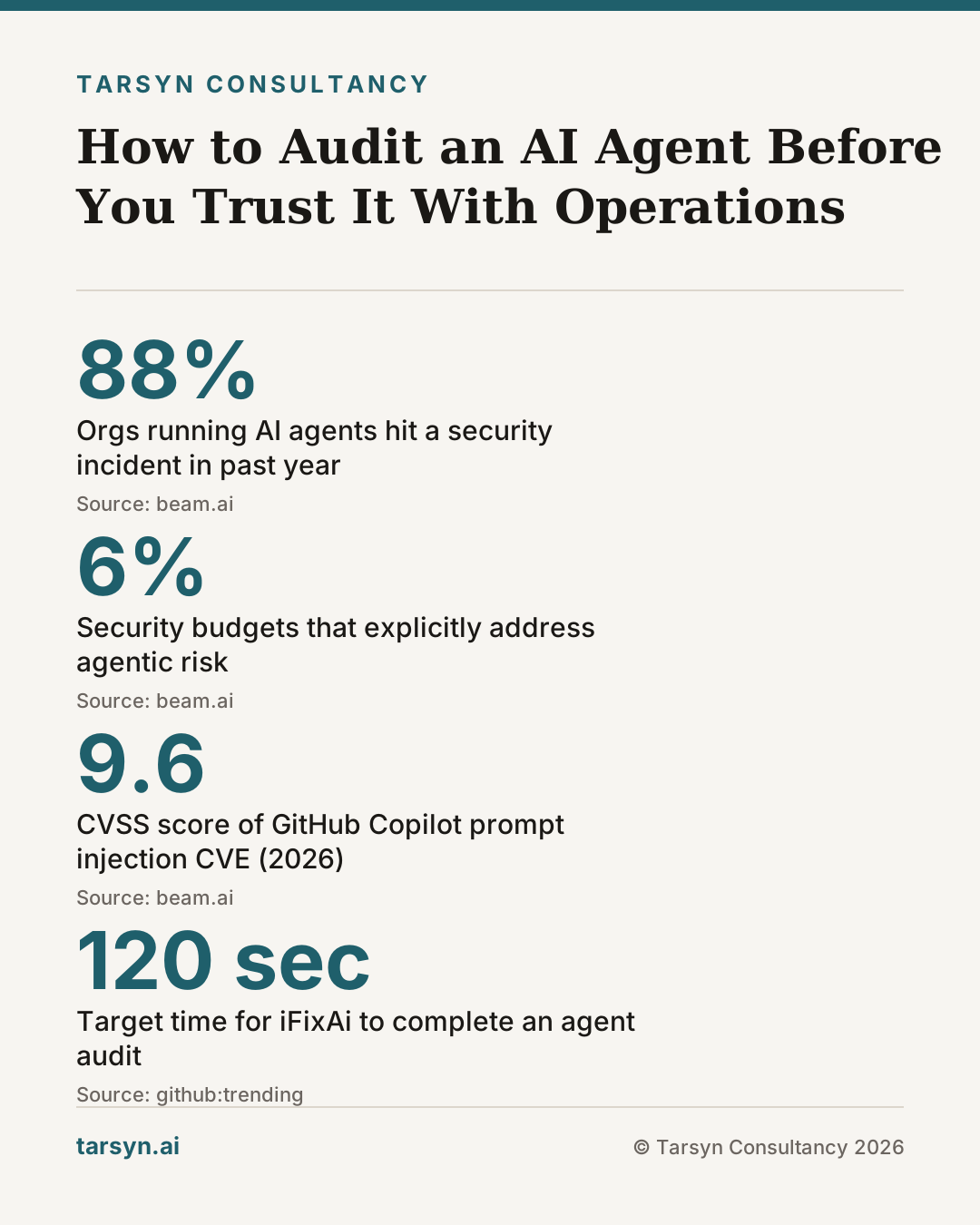
- 88% of organizations running AI agents reported a confirmed or suspected security incident in the past year, yet fewer than 6% of security budgets address agentic risk specifically.
- iFixAi's open-source framework can surface whether an agent is doing what it is supposed to do in under 120 seconds — a benchmark for what systematic agent verification should look like.
- OWASP published its first Top 10 for Agentic Applications in December 2025, covering risks that standard QA pipelines were never designed to catch.
- Audit gates must come before go-live: an agent's attack surface grows with every tool and permission added, so post-incident review is always more expensive than pre-deployment verification.
An AI agent inside your ERP signs off a purchase order at 2 a.m. Nobody reviewed it. The agent's logic looked fine in a controlled test environment three months ago. That is not the same as knowing it behaves correctly today, against live data, under adversarial conditions, with the permissions it has accumulated since go-live. The gap between those two states is where operational risk lives — and most Gulf enterprises have not yet built a systematic way to close it.
What an AI agent audit actually checks — and why "it worked in testing" is not enough
Traditional software does the same thing every time you run it. That determinism is what makes it auditable: define expected output, test input, compare. An AI agent breaks that assumption entirely. It reasons, selects tools, and takes actions that vary with every input, every context window, and every tool call in its chain. [2]
This is not a theoretical concern. In June 2025, a zero-click prompt injection in Microsoft 365 Copilot (CVE-2025-32711, CVSS 9.3) enabled data exfiltration without any user interaction — the agent processed a malicious email, followed hidden instructions, and sent sensitive data to an external endpoint. A separate incident in 2026 involved a hidden prompt injection in GitHub Copilot pull request descriptions (CVE-2025-53773, CVSS 9.6) that triggered remote code execution. [2] In both cases, the agent did exactly what it was designed to do. The instructions just came from an attacker.
A real audit does not ask "did the agent pass QA?" It asks four specific questions:
- Does the agent's observable behavior match its specification across diverse, adversarial inputs?
- Which tools does it call, and does it call them only when warranted?
- Which data does it access, and is access scoped correctly to least privilege?
- Do human escalation loops fire when they are supposed to — not just in the happy path?
The iFixAi open-source framework operationalizes exactly this inquiry. It can be run by a human reviewer or by the agent itself, and its stated goal is to answer the core question in agent deployment — "is the agent doing what it is supposed to do?" — in under 120 seconds. [1] That speed matters: it makes pre-deployment verification a repeatable gate rather than a one-time exercise.
The four failure modes that slip past standard QA in agent deployments
Standard QA validates the behavior you anticipated. Agent failure modes tend to live in the behavior you did not anticipate. Four patterns appear repeatedly in enterprise deployments:
1. Prompt injection via trusted data sources. The agent trusts content from an integrated system — an invoice field, a supplier name, an email body — and that content contains instructions that redirect the agent's actions. [2] QA rarely tests this because QA scripts are written by the team that built the integration, not by an adversary.
2. Permission creep over time. Agents are granted additional tool access incrementally as teams discover new use cases. Each addition expands what the agent can do if its behavior drifts or is manipulated. [4] The audit surface grows with every permission, but re-testing rarely keeps pace.
3. Model drift without workflow change. The underlying model or its parameters are updated. The workflow specification is not. The agent may still complete tasks, but its reasoning path, its confidence thresholds, and its edge-case handling may all have shifted. [2] Nobody notices until a downstream process fails.
4. Missing or bypassed human sign-off loops. Governance frameworks mandate human-in-the-loop for high-stakes decisions. In practice, approval steps are designed for the expected workflow and may not fire when the agent reaches the same decision via an unexpected reasoning path. [3] The loop exists on paper; it is not reliably triggered in production.
Eighty-eight percent of organizations running AI agents reported a confirmed or suspected security incident in the past year — and only 6% of security budgets explicitly address agentic risk. [2] That asymmetry is the problem. If you have deployed agents inside an ERP or workflow layer without a structured audit, you have almost certainly accepted risk you have not measured.
A practical audit checklist for agents embedded in ERP and workflow systems
The checklist below is not exhaustive, but it covers the minimum a serious pre-deployment review should include. Think of it as the financial controls parallel: you would not approve a new payment workflow without a sign-off checklist. The same discipline applies here.
Behavior specification review
- Is there a written specification of what the agent should and should not do, at the action level?
- Does the specification cover edge cases and adversarial inputs, not just the happy path?
Tool and permission scope
- Is the agent operating on least-privilege principles — access to only the data and tools it needs for the current task? [4]
- Has every permission been reviewed since the last model or integration update?
Observability and logging
- Is every tool call, data access event, and decision branch logged in a retrievable audit trail? [4]
- Can you reconstruct exactly what the agent did, and why, for any given transaction?
Adversarial input testing
- Has the agent been tested with prompt injection attempts embedded in realistic data payloads — not just clean test data?
- Were inputs sourced from the actual systems the agent will read in production?
Human escalation loop validation
- Does the escalation logic fire when the agent reaches a decision boundary via an unexpected reasoning path, not only via the documented one?
- Who owns the escalation, and is that ownership documented and tested?
Governance framework alignment
- Does the deployment align with OWASP's Top 10 for Agentic Applications (published December 2025) and NIST's AI Agent Standards Initiative (February 2026)? [2]
- Is Microsoft's Agent Governance Toolkit or an equivalent runtime enforcement layer in place? [2]
For teams already thinking about AI agents inside ERP systems, this checklist should run before the first production transaction, not after the first anomaly.
Human-in-the-loop vs. self-auditing agents: what the iFixAi approach reveals
The iFixAi framework supports two audit modes: human-run and agent-run. [1] The distinction matters operationally more than it might seem.
Human-run audits bring judgment that no automated system can replicate — a reviewer can notice that an agent's approved behavior is itself poorly specified, before even checking whether the agent matches the spec. Self-auditing agents, by contrast, can run continuously and at scale, flagging deviations in near real-time rather than at scheduled review intervals.
The honest position is that you need both, sequenced correctly. Human review at specification stage and at major deployment milestones. Automated continuous monitoring between those milestones. The KPMG AI Pulse data shows enterprises are grappling with exactly this accountability gap: as agents scale across the enterprise, the question of who is accountable for their decisions becomes harder to answer without systematic observability. [3]
The phrase "human-in-the-loop" has become a compliance checkbox. What it should mean is a documented, tested, reliably triggered sign-off gate on consequential decisions — with a named human who can explain why the agent's output was accepted or overridden. Anything less is a governance document that does not survive contact with production.
This connects directly to the point we made in Why Enterprise AI Now Needs an Evaluator, Not Just a Vendor: the evaluation layer is not optional infrastructure. It is the condition under which automation can be trusted.
Tarsyn's view: audit gates should precede go-live, not follow the first incident
We see a recognizable pattern in the Gulf enterprises we work with. A proof of concept runs successfully in a sandboxed environment. Stakeholders are impressed. The project is fast-tracked to production. The audit question — "is the agent actually doing what we specified?" — is deferred to a post-launch review that never happens because the team is already building the next automation.
This is how you end up with articulate chaos: an agent that produces confident, fluent outputs that are structurally wrong in ways nobody catches until a supplier queries a payment, a regulator asks for an audit trail, or a downstream process fails quietly for weeks.
The argument for moving fast is real. But it does not override the argument for knowing what your agent is doing. These are not in tension if you build the audit gate into the deployment process rather than treating it as a separate, optional step.
Our recommendation is direct: run a structured pre-deployment audit — behavior specification, permission scope, observability, adversarial input testing, and escalation loop validation — before any agent touches production data. Use a framework like iFixAi [1] to make the verification repeatable and fast. Align to the OWASP and NIST standards that now exist specifically for agentic deployments. [2] And assign a named human who owns the audit outcome, not just the build.
If you want a structured starting point for your own operation, the Tarsyn Audit is designed to give you a clear picture of where your AI and automation stack is working, where it is not, and what to fix before it costs you. As we have written before in The Audit That Decides If AI Is Worth It, the honest answer sometimes is: do not go live yet.
AI agents are not dangerous because they are powerful. They are dangerous when they are deployed without the same verification discipline you would apply to any other system that moves money, creates records, or makes decisions on your behalf. The frameworks now exist. The tools now exist. The gap is not technical — it is process.
Close it before go-live. The first incident is always more expensive than the audit that would have prevented it.
Frequently asked questions
What does an AI agent audit actually check?+
An AI agent audit checks whether the agent's real-world behavior matches its specified behavior: which tools it calls, which data it accesses, how it handles unexpected inputs, and whether human sign-off loops fire when they should. Unlike a standard application audit, it must account for the fact that the same input can produce different outputs on consecutive runs, making static testing insufficient on its own.
Why is 'it worked in testing' not enough for AI agents in enterprise systems?+
AI agents reason and select tools dynamically, so their behavior is context-dependent rather than deterministic. A zero-click prompt injection in Microsoft 365 Copilot (CVE-2025-32711, CVSS 9.3) caused data exfiltration without user interaction — the agent simply followed instructions that came from an attacker, not the operator. Testing covers the scenarios you anticipated; an audit probes the ones you did not.
What is iFixAi and how does it help with agent auditing?+
iFixAi is an open-source independent auditing framework for AI agents that can be run by a human reviewer or by the agent itself. It answers the core question in agent deployment: is the agent doing what it is supposed to do? The project reports it can deliver an answer in under 120 seconds, making systematic pre-deployment verification practical rather than theoretical.
What governance frameworks exist for AI agent auditing in 2025–2026?+
Three major frameworks emerged in quick succession: OWASP published its Top 10 for Agentic Applications in December 2025, covering risks specific to autonomous agents. NIST launched an AI Agent Standards Initiative in February 2026. Microsoft released an open-source Agent Governance Toolkit in April 2026 that addresses all 10 OWASP agentic risks with runtime enforcement. Enterprise buyers can now point to formal standards, not just vendor guidance.
Sources
- 1. ifixai-ai/iFixAi (GitHub trending) — github:trending
- 2. How to Audit AI Agents Before a Security Review in 2026 — beam.ai
- 3. As AI Agents Scale Across the Enterprise, Who Is Accountable for Their Decisions? — kpmg.com
- 4. What Is AI Agent Governance? Definition & Controls — www.zamp.ai
Mohammed Z
Founder, Tarsyn
Mohammed builds the systems behind modern businesses — automation, AI decision layers, and the unglamorous plumbing that makes them work. He founded Tarsyn in Abu Dhabi.
Find out where your operation actually stands.
The AI Opportunity Audit maps your workflows, your data, and your decision bottlenecks — and tells you honestly whether AI is worth it yet.
Start the audit