18 October 2026 · 6 min read
53 AI Agents Tested: What the Bug Rate Means for Your Ops
Researchers tested 53 open-source AI agents and filed 37 bugs. Carnegie Mellon found a 70% task failure rate. Here's what GCC ops teams must do before buying.

Key takeaways
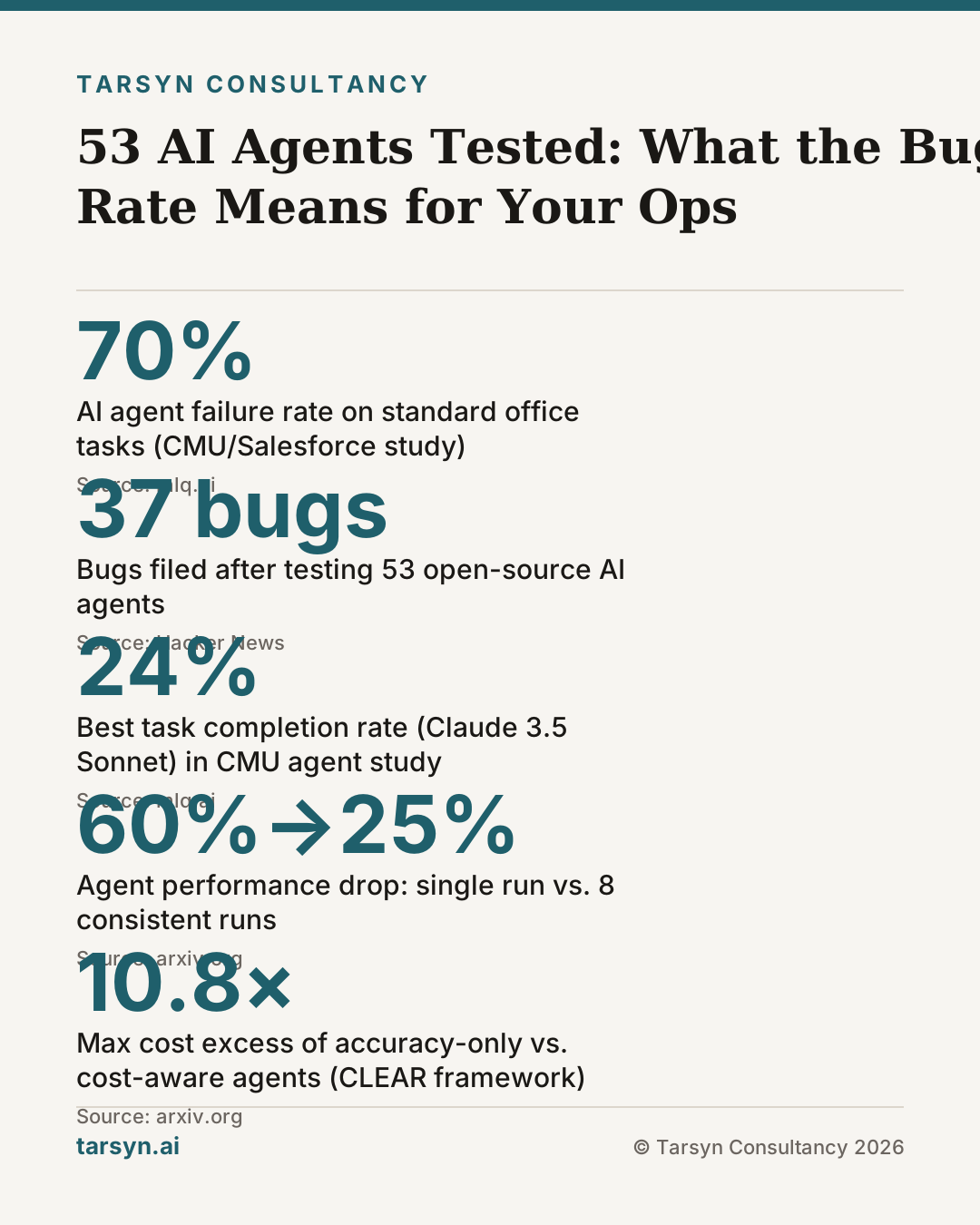
- Researchers testing 53 open-source AI agents filed 37 bugs — roughly one bug per 1.4 agents evaluated, making reliability a systemic issue, not an edge case.
- A Carnegie Mellon / Salesforce study found leading AI agents failed nearly 70% of standard office tasks; the best performer (Claude 3.5 Sonnet) completed only 24% of assigned work.
- Agent performance dropped from 60% on a single run to 25% across 8 consistent runs — meaning demo success does not predict production reliability.
- Commercial wrappers built on open-source agent cores inherit the same underlying failure modes; procurement teams must test the wrapper, not just trust the vendor's benchmark.
A team of researchers recently put 53 open-source AI agents through structured behavioral tests and walked away with 37 filed bugs.[1] Around the same time, a Carnegie Mellon University study conducted with Salesforce ran leading commercial agents through a simulated office environment and found they failed nearly 70% of standard tasks.[2] If you are a GCC operations manager being pitched autonomous workflow automation agents this quarter, these two data points belong on your evaluation checklist — not buried in an academic abstract.
What the 53-agent study actually tested — and why the methodology matters
The researchers behind the 53-agent test were not running vibes-based reviews. They applied structured behavioral tests — the kind that probe how an agent responds when a task gets ambiguous, when a multi-step chain breaks mid-sequence, or when the environment presents something outside the training distribution.[1] Thirty-seven bugs emerged from that process. That is roughly one confirmed defect per 1.4 agents evaluated.
The methodology matters because most enterprise AI demos are the opposite: curated inputs, clean data, cooperative environments. A behavioral test is adversarial by design. It asks the agent to do what it will actually face in production — incomplete instructions, messy data, tasks that require judgment rather than retrieval. The gap between demo performance and behavioral test performance is where procurement teams get burned.
The failure patterns that show up in enterprise workflow contexts
The Carnegie Mellon study is blunter about what failure looks like in practice. Researchers built a simulated technology company fully staffed by AI agents using models from OpenAI, Google, Anthropic, and Amazon. The environment included roles — CTO, HR manager, engineer — and tasks drawn from finance, administration, and engineering.[2] The results were not close:
- Claude 3.5 Sonnet (Anthropic): 24% task completion — the best performer in the study
- Gemini (Google): 11% task completion
- Nova (Amazon): 1.7% task completion[2]
Agents routinely got lost, took erroneous shortcuts, and failed at multi-step tasks that any competent human employee would handle in minutes.[2] Closing a pop-up window. Finding the right colleague. Tasks with a dozen sequential steps — the kind that live inside every workflow automation deployment — frequently ended in failure.
There is a deeper reliability problem underneath these accuracy numbers. Research into enterprise agent evaluation found that agent performance dropped from 60% on a single run to 25% across eight consistent runs.[4] A demo that succeeds once is not evidence of production reliability. Multiply chaos by intelligence and you get articulate chaos — the agent fails in new and confident ways each time.
Why open-source agent risk doesn't disappear when you buy a commercial wrapper
Here is the part of the pitch that GCC buyers rarely hear: many commercial AI agent products are wrappers around open-source model cores. The vendor has built a UI, added some guardrails, and written an integration layer — but the underlying model making decisions is often the same one that showed up in those behavioral tests with a 37-bug haul.[1]
This is not a knock on open-source. Open-source agents are auditable, which is actually a feature — you can inspect behavior. The problem is that a commercial wrapper can obscure the failure modes without fixing them. The agent still takes erroneous shortcuts. It still gets lost in multi-step sequences. The difference is that the commercial product may give you less visibility into why it failed.
For operations teams in the Gulf running procurement, logistics approval chains, or supplier communication workflows on these agents, the stakes of invisible failure are real. An agent that confidently routes a wrong purchase order at 2 AM in a Jebel Ali trading operation does not send a polite error message. It keeps moving.
This connects directly to a broader pattern we've seen across enterprise AI deployments: when AI agents operate without adequate oversight, the liability migrates quietly to the buyer. The 70% failure rate is not just a product quality problem — it's a risk allocation problem.[2]
How to run a pre-deployment reliability check on any AI agent
The research literature is converging on a multi-dimensional evaluation approach. The CLEAR framework — Cost, Latency, Efficacy, Assurance, Reliability — was designed specifically because accuracy-only evaluation produces agents that are 4.4 to 10.8 times more expensive than cost-aware alternatives with comparable performance.[4] Expert evaluators confirmed that CLEAR better predicts production success (correlation ρ = 0.83) versus accuracy-only evaluation (ρ = 0.41).[4]
Translating that into a pre-deployment checklist any GCC ops team can run:
- Define representative tasks, not showcase tasks. Pull ten real scenarios from last month's operations — including the three most annoying edge cases. Run the agent on those, not the vendor's curated demo set.
- Run multiple times, not once. Single-run success is meaningless. If the agent completes a task eight times in a row with consistent output, you have evidence. If it varies wildly, you have a demo, not a system.[4]
- Measure cost per task alongside accuracy. Optimizing for accuracy alone leads to cost overruns. An agent completing 80% of tasks at ten times the expected compute cost is not a win.[4]
- Test failure modes explicitly. Feed it incomplete data. Give it contradictory instructions. Introduce a missing approval step. An agent that fails loudly and stops is safer than one that fails silently and continues.
- Check policy compliance and data handling. Particularly relevant in GCC contexts where data residency, Arabic-language accuracy, and approval authority matter. Does the agent respect the org chart? Does it escalate when it should?
We've written a more detailed guide on this process in How to Audit an AI Agent Before You Trust It With Operations. The short version: if you would not hire a human employee without a probation period and performance review, you should not deploy an AI agent without a structured test gate.
Tarsyn's view: agent procurement needs a testing gate, not a trust fall
The 53-agent bug study and the Carnegie Mellon failure rate data are not arguments against workflow automation. They are arguments against lazy procurement. The enterprises that will get value from AI agents are the ones that test before they commit — not the ones that buy on a demo, deploy at scale, and discover the failure modes in production.
We have been making this argument since before these studies landed: most companies don't need more AI — they need to fix what they already have. That still holds. But the nuance is shifting. More GCC operations teams are now at the stage where the question is not whether to use agents, but which agents, for which workflows, with which controls in place. That is a better question. It just requires a structured answer.
The buying cycle for AI agents in the Gulf is currently driven by vendor pressure, peer pressure, and a genuine operational need to reduce manual process load. Those are legitimate drivers. The problem is that none of them are evaluation frameworks. A 70% failure rate across standard office tasks means the agent that looks right in the boardroom might be filing phantom purchase orders in your warehouse.[2]
Our position is straightforward: run the pre-deployment audit before any agent touches a live workflow. Not because AI agents are bad — some will genuinely improve your operations — but because the only way to know which category you are dealing with is to test. Seventeen spreadsheets tracking the wrong data is a problem. An AI agent confidently automating seventeen spreadsheets of wrong data is the same problem running faster.
The research has now given procurement teams something rare: external validation that the skepticism was warranted and the caution was correct. Use it. Enterprise AI now needs an evaluator layer, not just a vendor relationship — and the 37-bug finding from 53 agents is the clearest argument yet for why that layer should exist before you sign anything.
Frequently asked questions
What did the 53-agent behavioral test actually find?+
Researchers ran 53 open-source AI agents through structured behavioral tests and filed 37 bugs as a result. That averages roughly one confirmed defect per 1.4 agents — a rate high enough to treat reliability as a systemic procurement concern rather than an occasional vendor problem. The study focused on how agents behave under real task conditions, not curated demos.
How bad is the 70% AI agent failure rate in practice?+
A Carnegie Mellon University study, conducted with Salesforce, found that AI agents failed nearly 70% of standard office tasks in a simulated business environment. The best performer, Anthropic's Claude 3.5 Sonnet, completed only 24% of assigned tasks. Amazon's Nova recorded 1.7%. Tasks included dataset analysis, writing performance reviews, and basic multi-step problem-solving — the kind of work workflow automation is sold to handle.
Does buying a commercial AI agent instead of open-source solve the reliability problem?+
Not automatically. Many commercial agents are wrappers around the same open-source model cores that showed high failure rates in independent testing. The underlying failure modes — erroneous shortcuts, getting lost in multi-step tasks, inconsistent multi-run performance — travel with the model. Buyers need to test the commercial product in their specific workflow context, not rely on the vendor's benchmark scores.
What is the right way to evaluate an AI agent before deploying it in operations?+
Run the agent against representative tasks from your actual workflow — not curated demos. Test across multiple runs, not just one, since research shows performance can drop from 60% to 25% between single and repeated runs. Evaluate on cost, latency, and policy compliance alongside accuracy. Log every failure mode before sign-off. A structured pre-deployment audit beats a trust-fall vendor call every time.
Sources
- 1. We ran 53 open-source AI agents through behavioral tests and filed 37 bugs (discussion) — Hacker News
- 2. Carnegie Mellon Study Finds AI Agents Fail at Office Tasks Nearly 70% of the Time | MLQ News — mlq.ai
- 3. Beyond Accuracy: A Multi-Dimensional Framework for Evaluating Enterprise Agentic AI Systems — arxiv.org
Mohammed Z
Founder, Tarsyn
Mohammed builds the systems behind modern businesses — automation, AI decision layers, and the unglamorous plumbing that makes them work. He founded Tarsyn in Abu Dhabi.
Find out where your operation actually stands.
The AI Opportunity Audit maps your workflows, your data, and your decision bottlenecks — and tells you honestly whether AI is worth it yet.
Start the audit