17 October 2026 · 8 min read
SAP to Oracle (or Back): What Switchers Don't Tell You
Vendor brochures skip the scar tissue. This guide surfaces the real triggers, hidden costs, and Gulf-specific localisation traps that decide whether switching ERP platforms is worth it.
Key takeaways
- The top trigger for ERP switches is not weak features — it's a support or licensing crisis that makes the status quo more painful than the migration.
- Gulf businesses face a localisation tax that Western case studies ignore: ZATCA Phase 2 e-invoicing, UAE PDPL data residency, and multi-entity VAT filing each add months and cost to any cutover.
- Hidden data-migration and interface-rebuild costs routinely double the vendor's headline implementation quote — budget for both, not one.
- Staying on a well-configured incumbent system is frequently the higher-ROI decision; switching only wins when the business model has structurally changed, not when the UI feels dated.
A CFO in Riyadh asks her CIO for an honest assessment of switching from SAP to Oracle Cloud. Six months later, she has four competing slide decks, two vendor demos, and zero answers to the questions that actually matter: how bad is the data migration, who owns the ZATCA certification after go-live, and what happens to the seventeen custom reports Finance built over eight years. The slide decks don't say.
This piece is about what they leave out.
Why Companies Start Looking: The Real Triggers Behind an ERP Switch
The standard narrative — "our business outgrew the system" — is almost never the real story. The real triggers are messier and more specific.
Support and licensing pressure. SAP's 2027 ECC end-of-mainstream-maintenance deadline has pushed a significant share of the Gulf market into active evaluation mode, not because S/4HANA is objectively superior for their use case, but because the status quo carries a price tag that is climbing [2]. Oracle customers face their own licensing audits. When the cost of staying becomes visible in the P&L, switching starts to look rational even when it isn't.
A failed or frozen implementation. The most common conversation we have at Tarsyn starts with some version of: "We went live eighteen months ago and we're still not using half of it." A badly configured SAP or Oracle instance accumulates workarounds — shadow spreadsheets, WhatsApp approval chains, manual reconciliation steps — until the system is technically live but operationally bypassed. At that point, companies start looking at competitors' platforms, when what they actually need is a proper audit of what went wrong.
Acquisitions and restructuring. A Saudi conglomerate absorbing a UAE subsidiary on a different ERP must consolidate. A private equity firm taking over a business running Oracle E-Business Suite may mandate a platform move to align with their portfolio standard. These structural triggers are legitimate, but they rarely arrive with realistic project timelines.
The competitor upgrade story. Someone on the board heard that a rival is moving to Oracle Fusion and reads it as a signal. This is the least defensible trigger and the one most likely to produce a failed project.
What Switchers Consistently Underestimate: A Ranked List of Surprises
Here is what the Reddit threads, post-mortems, and practitioner conversations actually surface — ranked by how often they appear and how badly they're underestimated:
-
Data migration complexity. Every company believes their data is cleaner than it is. Master data — customers, vendors, materials, chart of accounts — accumulates decades of inconsistency. Cleaning and mapping it is the single most labour-intensive phase of any ERP switch, and it is almost always scoped too lightly at the proposal stage.
-
Interface rebuild cost. SAP connects to your WMS, your banking portal, your government e-invoicing node, your CRM. Oracle connects to different things, differently. Each integration must be remapped, retested, and re-certified. In the Gulf specifically, connections to ZATCA's Fatoora platform, MOF payment systems, and customs clearance APIs add certified-integration requirements that don't exist in Western deployments [2].
-
Change management. The people who built workarounds around the old system will build new workarounds around the new one unless the process re-engineering happens first. Technology does not fix behaviour. Multiplying chaos by intelligence gives you articulate chaos.
-
Parallel-run headcount. Running two systems simultaneously during cutover doubles the operational burden on Finance and IT for three to six months. This cost is never in the vendor quote.
-
Partner quality variance. The same platform delivers wildly different outcomes depending on the implementation partner. A certified SAP partner with no live GCC payroll references is not the same as one with ten. The platform choice and the partner choice are inseparable decisions, but vendors present them as separate.
-
Post-go-live hypercare. The first quarter after go-live is when the system is most fragile and the team is most exhausted. Budget for dedicated hypercare support. Most projects don't.
SAP vs Oracle Head-to-Head: The Decisions That Actually Differ
Feature matrices are written by vendors. What actually differs — and what determines whether a switch pays off — comes down to four decision points:
Industry depth vs. financial architecture. SAP S/4HANA has deeper native industry templates for manufacturing, logistics, and utilities. Oracle Fusion Cloud's financial engine — subledger accounting, multi-GAAP, intercompany netting — is structurally stronger for complex holding groups and financial services. Neither is universally superior; the question is which gap costs more to bridge for your specific business model [2].
Cloud architecture and data residency. Both SAP and Oracle now operate production cloud regions in the UAE. Microsoft, Google, AWS, and Oracle all have UAE infrastructure, and the UAE colocation market has been expanding rapidly [3]. The constraint is no longer capacity — it's contractual precision around data residency under UAE Federal Decree-Law No. 45 of 2021 (PDPL). Any ERP vendor commitment on data sovereignty must be documented at the contract level, not the sales deck level [3].
Extensibility and the AI roadmap. SAP is embedding Joule agents across its supply chain and finance modules — we covered what that means operationally in our piece on SAP Joule Agents moving into supply chain. Oracle is extending its AI layer through Oracle Fusion Analytics and the OCI AI infrastructure. Both roadmaps are real; both are earlier-stage than the marketing implies. Don't buy either platform's current AI capability — evaluate the maturity of the underlying data model it produces, because that's what the AI will actually run on.
Licensing model and total cost of ownership. Oracle's subscription model is generally more predictable for cloud-native deployments. SAP's pricing — particularly around S/4HANA Cloud Public Edition vs. Private Edition vs. RISE — introduces complexity that regularly surprises buyers at renewal time [2]. Get a three-year TCO model from an independent advisor before signing either.
The Gulf Variable: Localisation, VAT, and Integration Complexity
This is the section that Western case studies skip entirely.
Both SAP and Oracle carry certified localisation packs for ZATCA Phase 2 e-invoicing in Saudi Arabia and for UAE corporate tax [2]. On paper, both platforms are compliant. In practice, the certification lives in the standard configuration — and every customisation your business has added creates a gap between the certified baseline and your actual system. Closing that gap is the localisation tax that switchers discover mid-project.
Specific Gulf complexity that any ERP switch must price:
- ZATCA Phase 2 Fatoora integration. Real-time e-invoicing with cryptographic signing and clearance before invoice delivery. This is not a reporting bolt-on; it's a transactional dependency that must be rebuilt from scratch in the new system and tested against ZATCA's simulation environment before go-live.
- UAE PDPL data residency. If your current SAP or Oracle estate processes UAE resident data, the new system must contractually guarantee in-country storage. Both vendors have UAE cloud regions, but the contract must be explicit, and the data-flow map must be documented [3].
- Multi-entity VAT filing. Gulf holding groups filing across UAE, KSA, Bahrain, and Oman have inter-company and cross-border VAT complexity that standard ERP templates handle poorly. The configuration work is bespoke, and it doesn't transfer from one platform to another.
- WPS and payroll localisation. Saudi Arabia's Wage Protection System and various localised leave, end-of-service, and Saudization reporting requirements are certified in both platforms — but only in the versions your implementation partner has actually deployed. Ask for live references, not platform documentation.
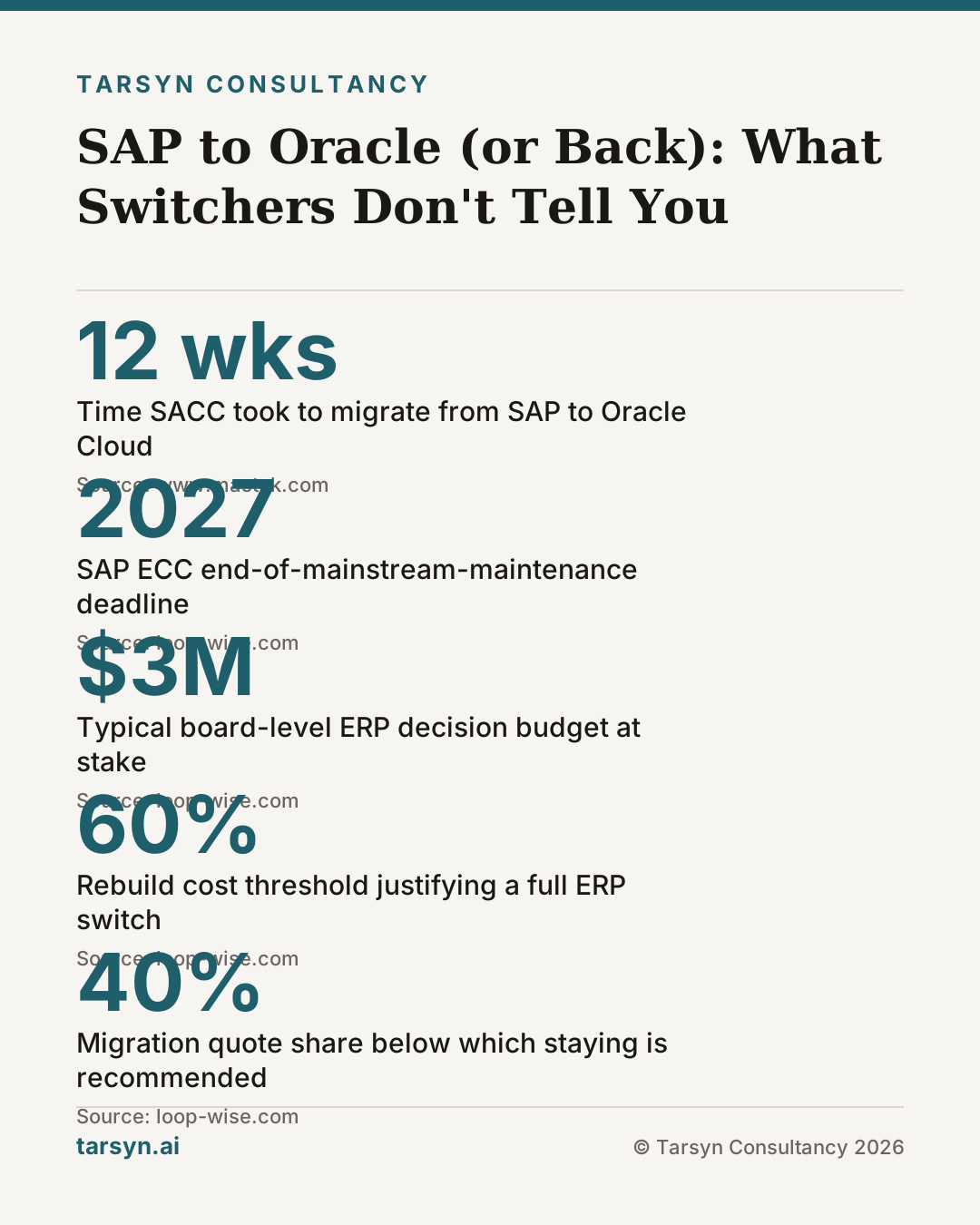
The 12-week migration headline [1] is real — for a single-entity airline catering business with minimal customisation lifting from SAP to Oracle Cloud. For a Saudi conglomerate with multi-entity VAT, ZATCA Phase 2, and fifteen years of custom ABAP, twelve weeks is the discovery phase, not the project.
For related context on ERP switching pitfalls, our piece on ERP implementation lessons nobody tells you before you start covers the functional consulting blind spots that apply to both platforms. And if you're evaluating mid-market alternatives, the guide on what mid-market manufacturers get wrong in ERP selection is worth reading first.
Our View: When a Switch Is Worth It — and When It Isn't
We charge the same for the audit whether the answer is "switch" or "stay." Here is the honest version.
Switch when:
- Your business model has structurally changed — new geographies, new entity structure, new regulatory obligations — and the incumbent system cannot support the new model without rebuilds that cost more than 60% of a migration.
- Your current ERP vendor has announced end of support and the maintenance path requires a platform change anyway (the SAP ECC 2027 situation is a legitimate trigger).
- You are on an Oracle E-Business Suite version that predates cloud integration and your IT team is retiring the institutional knowledge that keeps it running.
- You have been offered an implementation partner with documented, live GCC references on the target platform, covering your industry vertical and your compliance requirements.
Stay when:
- The core pain is process debt: broken workflows, shadow spreadsheets, manual reconciliations. Switching platforms moves the mess. Fix the processes first — see our piece on why most companies don't need more AI for the same argument applied to automation.
- The incumbent system can be reconfigured and its integrations rebuilt for less than 40% of the migration quote. This is more common than most vendors will admit.
- Your team cannot articulate what specific business outcomes the new system enables that the current one cannot — with numbers, not adjectives.
- You are mid-way through a digitalisation or AI initiative that depends on clean data from the ERP. Switching ERP mid-stream is the operational equivalent of changing engines at cruising altitude.
A dashboard that shows your SAP data doesn't decide anything — we made that argument in a dashboard is not a decision. The same logic applies to ERP switches: the platform is not the decision-maker. The business process underneath it is.
If you are in active evaluation — or if your board has been handed a vendor slide deck and is about to make a $3 million decision based on it — the right first step is a structured ERP and automation audit that prices both paths honestly. The vendor will not do that for you. We will.
Frequently asked questions
How long does an ERP switch from SAP to Oracle actually take?+
For a mid-size enterprise, plan for 12 to 18 months on average — and that's with a disciplined scope freeze. The widely cited 12-week migration figure applies to single-entity cloud lifts with minimal customisation. Gulf businesses adding ZATCA e-invoicing, multi-entity VAT, or PDPL data-residency requirements should add at least two to four months to any vendor timeline.
What are the biggest hidden costs in an SAP or Oracle implementation?+
Data cleansing and migration consistently exceed estimates — sometimes consuming 20–30% of total project budget. Interface rebuilds (connecting ERP to WMS, CRM, banking portals, or government e-invoicing nodes) are equally underpriced at the proposal stage. Add change-management costs, parallel-run headcount, and post-go-live hypercare, and the real bill is typically 1.5 to 2x the headline quote.
Is SAP or Oracle better for Gulf businesses with VAT and e-invoicing requirements?+
Both SAP S/4HANA and Oracle Fusion Cloud carry certified localisation packs for ZATCA Phase 2 (Saudi Arabia) and UAE corporate tax. The critical variable is your implementation partner's depth with those packs, not the platform itself. A poorly configured SAP instance fails compliance faster than a well-configured Oracle one, and vice versa. Vet the partner's live GCC references, not the vendor's roadmap slides.
When is staying on an existing ERP the right call?+
When the core pain is process debt — broken approval chains, seventeen spreadsheets outside the system, unclean master data — switching platforms moves the mess, it doesn't fix it. If the incumbent system can be reconfigured and the interfaces rebuilt for less than 40% of a migration quote, staying is almost always the better financial decision. Switch when your business model has changed, not your patience.
Sources
- 1. SACC Moved from SAP to Oracle Cloud in 12 Weeks - Case Study — www.mastek.com
- 2. Oracle Vs SAP Vs Microsoft Dynamics: GCC & Egypt ERP Guide 2026 — loop-wise.com
- 3. SAP and Oracle in UAE Cloud Regions: PDPL Data Residency - The Kentro — thekentro.com
Mohammed Z
Founder, Tarsyn
Mohammed builds the systems behind modern businesses — automation, AI decision layers, and the unglamorous plumbing that makes them work. He founded Tarsyn in Abu Dhabi.
Find out where your operation actually stands.
The AI Opportunity Audit maps your workflows, your data, and your decision bottlenecks — and tells you honestly whether AI is worth it yet.
Start the audit